Wednesday, December 18, 2019

Baltic Christmas Day 18 - A Rīga Winter

Very excited to have Māra McLaughlin-Taylor on 24 Days of a Baltic Christmas today, with her thoughts on winter in Rīga!!!


Often when someone asks me about what Riga is like in the winter, they assume that it’s too cold and too dark and by association, miserable. Truthfully, I find it delightful!

Although I spent much of my childhood in Latvia, it fell during those light-filled summer days of school vacation. Having just moved to Riga from Asheville, North Carolina on a permanent basis, this is my very first winter and Christmas season here. [Disclaimer: I grew up in the tundra of the Midwestern United States, so my context is set against that. This also means that I already own some of the innate skills of those who have grown up in colder climates (like walking on ice in proper footwear).]


It seems as though the “trick” to a joyful winter season is to fully participate in both the inside and the outside life and the traditions that come along with them. So today, I’m sharing the ways I’ve found to enjoy this time:

Inside life

Rigans are already big on houseplants, so greening up your apartment or home isn’t much of a stretch (The Capital R blog writes about this phenomenon beautifully). I love the tradition that each Latvian is entitled to chop down their own tree in a state forest (there’s an app for that), but given that I’m without a car, and the nearest forests in which it is legal to cut down trees is a good 40km away, I’ve settled for decorating my houseplants. A more motivated version of me would go out to any local Christmas market and buy greenery. I might get around to it yet, before December 24th! But, I more than make up for it in the next area…


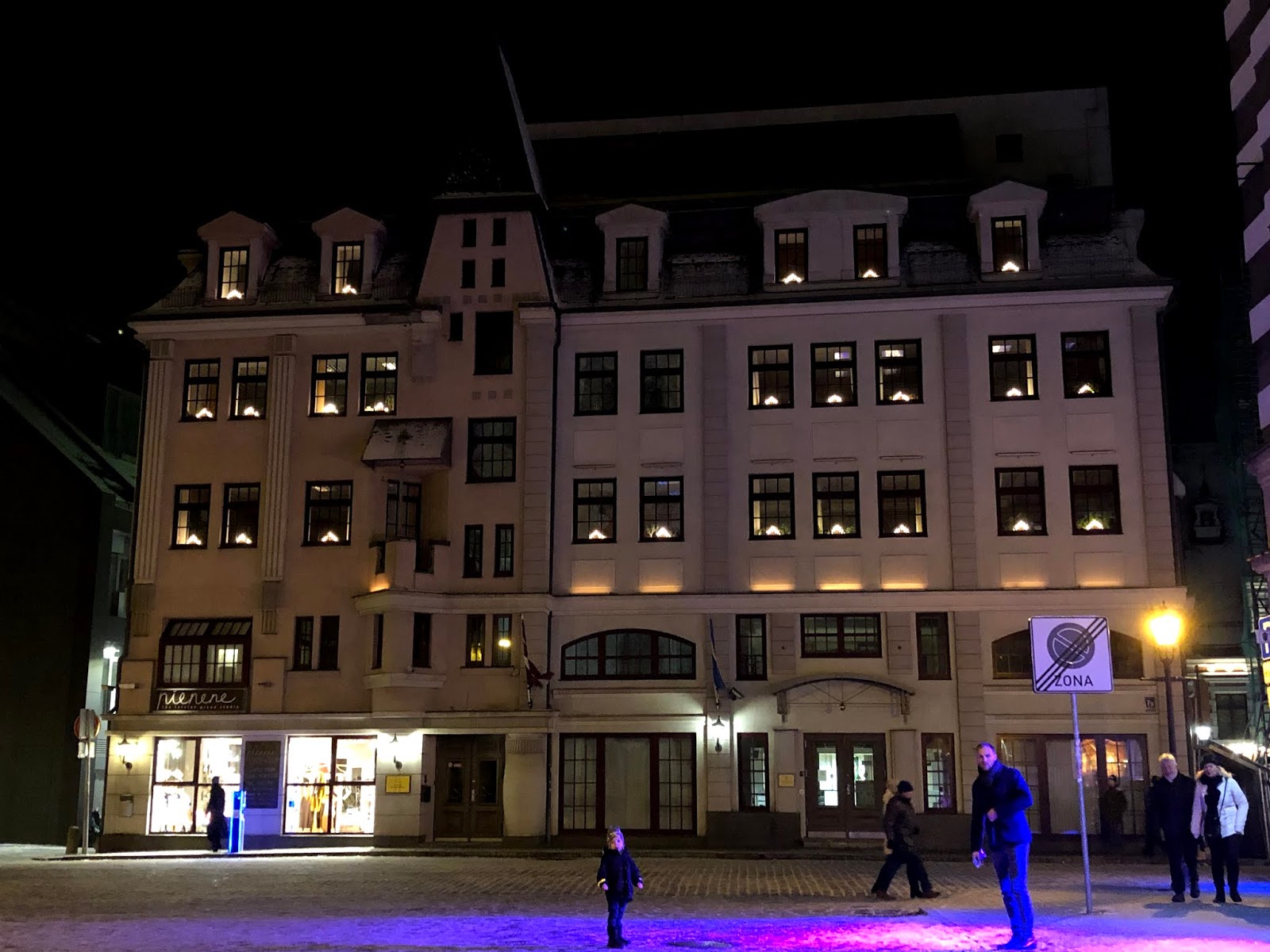
Lights are essential! There aren’t many hours of daylight in the winter and compared to where I used to live much closer to the equator, the daylight you do get is like lukewarm tea--cloudy and watered down. Candles, already revered in Latvian culture, are a must (check!), and many Latvians additionally opt to get electric candelabras for their windows (check!). The tradition of lighting advent calendars is popular here, and you can double both your greenery and light by having or making one (check!). I’ve also noticed that small LED light strings are becoming a popular and energy efficient way to decorate (check!). And, at the risk of going overboard, we have a plant light (which mimics sunlight) under which we sun ourselves (and wait for longer days).


Winter seems to be the season for fragrant spices, and here is no different! We especially like the fresh blends from Spicehouse to add to our gingerbread, oatmeal, and fruit. I start every morning with a cup of strong coffee to let my body know it’s time to wake up even though it’s dark outside, and these days it is made much better with a liberal dash of masala chai spice from my local zero-waste store Turza. An evening option is mulled wine, commonly found this time of year, but also easy to make at home with your own spice mix. 


Food is another essential cozy element for time indoors. As it was when we lived back in the States, this is the time for warm stews and casseroles. Latvians are masters of soup and eat it on a daily basis! When I grow tired of native root vegetables, however, I feel lucky to be in proximity of other goodies from the rest of Europe. It is citrus season, and Spanish mandarin oranges are in plentiful supply to keep my Vitamin C boosted. Surprisingly, in Riga I’ve also discovered a love for persimmons. I’ve never seen them as large, firm, and sweet as they are here.


Finally, the dark weather is perfect for reading. I’ve never found myself more Latvian than when I’m curled up inside in the dark thoroughly engrossed in a good book (why do you think the mascot for Latvian literature is an introverted writer?). I’ve already joined two different book clubs (one started by Expats in Latvia and the other generously sponsored by the American Embassy). When I run out of something to read, bookshops in Riga are like nail salons in my old Brooklyn neighborhood--there’s one on every block. The wonderful Roberts Books is a tucked-away piece of magic, full of English-language books old and new. Zvaigzne ABC is a major book retailer, and their outlet in the Old Town holds some reasonable treasures and kind cashiers.


Outside life 

I don’t know who originally said, “There is no bad weather, only bad clothing,” but it’s absolutely true. One thing that I learned about Riga matches another quote: “If you don’t like the weather, wait five minutes.” In going outside, you must be prepared for rapid changes in wind, precipitation, and temperature. A good pair of waterproof boots might be the most essential way to stay grounded and warm on slippery cobblestones, other uneven surfaces, and random giant puddles (my pair of Columbia Ice Maidens haven’t let me down yet). Generally, some combination of layers (shirt, sweater, vest, outer down shell) allow me to adjust to most anything Mother Nature throws my way. Of course, you’ll also have a scarf or shawl, because no Latvian would be caught dead with a “naked” neck, lest the fearsome “wind” touch it (a good number of Latvian ailments involve wind and breezes touching exposed skin). A brilliant tip I’ve picked up from the locals to navigate the frequent misty, but not quite rainy, weather is to ditch struggling with an umbrella and simply wear a thick hat. Once this is all on your person, you’re ready to transition to the outdoors!


Beginning on the last weekend of November/first weekend of December, there are Christmas markets around every corner and for every taste--from traditional crafts, to homemade foods, to social entrepreneurship, to zero waste, and beyond. It is enjoyable as a destination to walk to, and of course helpful if you still have presents on your list! One of my favorite locations is the Rabbit Kingdom, set up in Esplanade park, where a mini set of castles and houses with stained windows sit atop a straw base for a whole host of rabbits to hop around in. And of course, the main Christmas Market in the center of Old Town, offers a daily romantic view of small houses and lights against the backdrop of Riga’s famed church spires.


Along the way, you’ll be treated to lights on most major streets and even a trail of public art Christmas trees. This is the THIRD public art and light display across the city since I arrived in August. This city loves their art and lights and admittedly, it is a compelling way to battle the darkness!


Event-wise, there is something happening constantly. Facebook events and Riga.lv have kept us apprised of a constant slew of Christmas parties, decoration making, tastings, films, and other things to do. Perhaps all of these events are geared toward the less introverted Latvian (they do exist!), but as a new resident I’ve found that you won’t know as much unless you get out there. A few weekends ago, the Rotary held their annual Santa Fun Run benefiting children in hospital. The hundreds of running Santas, some with creatively embellished costumes (and many dog-like reindeer), were as fun to watch as the confused faces of Old Rīga’s tourists.


This is also the time to think of others. Because we won’t be with our own families this year, our goal has to been to gift to someone else each week of advent. Each year Laima chocolates sets up a picturesque small house next to their famous clock that features the Christmas wishes of children across Latvia. One simply goes in, picks a card, and delivers the gift back within five days or so (we hope little Peter enjoys his set of Hot Wheels!). Other worthwhile causes include Engelu Pasts, which fulfills the Christmas wishes of over 8000 seniors across Latvia, the young folks of Latvijas Kustiba par Neatkaribu Dzivi making 1,000,000,000 candles to open their own group home, and local animal shelters. The gift of giving can also be applied to walks around town. The Kurts coffee huts, recognizable by their name written in big-bulbed lights, is run by a family whose proceeds go to their disabled son’s needs. Recently opened RB Bakery, is one of the few public places that employs people with disabilities. This week’s highlight will be the semi-annual craft fair in the Riga Central Railway station that features exclusively disabled and elder artisans.


All in all, I think it would be safe to say that I’ve only scratched the very surface of how to stay sane and actually enjoy the Latvian winter. But if the little bit I’ve experienced thus far is any clue as to the larger whole, life keeps on charging ahead here and I, for one, am glad to be carried along. Here’s to more exploring and discovering!


Paldies Māra! So happy to have you share your thoughts on the Rīga winter!! My brother moved to Latvija some years ago, and while many of his photographs are taken in the darkness of the Baltic “day,” many of them feature all the things you mention, and it does make everything seem merry and bright!

Mara McLaughlin-Taylor is the daughter and granddaughter of Latvian Displaced Persons. A dual citizen of the US and Latvia, it’s only taken her near 40 years to move to Rīga. She is passionate about sharing Latvian culture, which she primarily does through language, food, and as an administrator of the Baltic Imports Facebook community. You can find more of her beautiful photographs on Instagram - instabaltica.

Tomorrow on 24 Days of a Baltic Christmas, please join us for an a guide on how to cut down your very own Christmas tree in Estonia!


Tuesday, December 17, 2019

Baltic Christmas Day 17 - Searching for a taste of home

It’s across the Atlantic to the UK today on Day 17 of 24 Days of a Baltic Christmas. Please welcome back Margaret Drummond, with her post on Kūčios in London, then and now!


“Searching for a taste of home....” Kūčios in London then and now.


When I was a child growing up in London in the 60’s, my parents were friendly with a fair number of Lithuanian families in the city. Actually, my parents were probably acquainted with every Lithuanian family living in the capital, because in those days there were just 1,000 of us living in London- and only 4,000 altogether in the UK. Most, like my dad, were Displaced Persons who arrived after World War II, with a few “old Lithuanians,”- people whose parents had come between the wars.  We grew used to explaining- “no not the Balkan- the Baltic States,” “no we’re not Polish,” and “no, my dad is not a Russian spy”- this last comment to the girl at school who asked me that very question! We clustered around the Lithuanian Church in Hackney. Dad would pop into the club in Victoria Park to hear the news, any news about what was happening in Lithuania, to borrow books, papers, records from friends who had obtained them somehow and to hear the gossip. Someone who had heard from his sister in Chicago that a cousin in Vilnius had heard that in Gaiziunai......You get the picture. They soldiered on. They had their church, the choir, there was a Saturday school, the Scouts, the dance group, Sodyba in Hampshire, and of course the weekly newspaper printed in West London. However, it was hard, especially for the older people, to retain what they had remembered, or thought they remembered, about the country they had left so long ago.  

However, since Independence and Lithuania’s accession to the European Union in 2004, times have changed! London now has the largest population of ethnic Lithuanians outside the Republic of Lithuania – with approximately 100,000 Lithuanian residents, the majority residing in the eastern boroughs of Newham, Redbridge and Barking and Dagenham where I grew up and where I still live today. With that wave of migration came a new form of Lithuanian culture, one that differed from the one my dad and his friends remembered, but one with some traditions that were familiar all the same.

Take Kūčios. Years ago, when no one had ever heard of Lithuania, my parents would struggle to find things for Christmas Eve. Firstly, there was the problem of whether my sister and I would even eat anything. The texture of salted herring proved very difficult to sell as did the acidity of beets and gherkins- and then there was the much greater problem of actually finding the necessary items in the shops.

Some years there would be a quick trip to Baltic Stores on Hackney Road run by Mr. Juras. Given the fact that his suppliers were mostly behind the Iron Curtain, the availability of products and their practicality for a small family were always unpredictable. 

“Juras has salted herrings,” my dad would announce excitedly, after attending Mass at St Casimir’s, “but they come in a big catering tin and need soaking.” Often it was judged too inconvenient to go off and buy such items. How many herrings would the four of us consume when my sister and I would only eat them reluctantly? And we also lived in an area rich in Jewish delis. You could get almost anything at the deli, and our lovely 2nd-generation Litvak neighbours would recommend where to go and even offer recipes. Then it transpired that the fishmonger next to the deli did special orders on Christmas Eve for Polish customers, and just before Christmas he would go off to Billingsgate with a pocket full of orders from those in the know.


Later in the Eighties we attended an authentic Kūčios at Headley Park and discovered that our version of Kūčios had been but a pale imitation of the real thing; the drive for authenticity became even more competitive. I remember one year at Headley, someone had even gone as far as to snare a fearsome pike from a local lake, hunter-gatherer style. Fishmongers were strictly for softies. We attempted to make poppy seed milk with an old-fashioned pestle and mortar like our grandmothers had done, and poured this over the little biscuits we baked using recipes from the one or two Lithuanian cookery books we possessed- recipes which began “Take twenty-four large eggs.....” We sought out strange grains in health-food shops to eat with honey, and just like our grandmothers who spent hours slaving in their kitchens getting it right in the inter-war years when most farms had neither electricity nor running water, so did we in the West spend the weeks before Christmas Eve running ourselves ragged, tracking down suitable items for the table in a bid to make it all as authentic, as traditional, as possible. Ironic, really…. our cousins on the other side of the Curtain spent their lives carrying their string bags in the hope of suddenly finding something in short supply and bemoaning the fact that there was nothing to buy in the shops, and here we were, scouring East London shops in a bid keep it all alive.

But that is all in the past.

Now in East London you can get everything, and not just in tiny corner shops but in large ethnic supermarkets like Lituanica* in Beckton.  I discovered this culinary palace a few years ago, and this year the management was kind enough to allow me to take some photos to show the variety we now have here in London after all those years of making do. The Lituanica company started in Ireland 20 years ago and has been trading in the UK for the last 15 years. With a number of branches in the London’s East End, the traditional area for Lithuanian settlement, there are also stores further afield in places like Birmingham and Bedford. Lituanica is now the UK’s oldest importer of Eastern European food and its leading wholesaler. The complex in Beckton which I visited also boasts a cosy restaurant, selling authentic ethnic food and delicious coffee & cake, a hairdresser’s, a beauty salon and a wonderfully eclectic bookshop. Sadly, my parents are no longer here to see it but if they were, surely, they would be quite overwhelmed. My Dutch mum used to talk about the early days of her marriage, spent in a bed-sit in Notting Hill Gate, a stone’s throw from Lithuanian House. In those days, she used to say, you couldn’t get salami or even coffee easily in England.

When I visited this year it was too early for my Kūčios shopping, but later this month I will be returning for some herring salad in beetroot and Kedainiai cucumbers which really are the best in the world- well I would say that as that’s where my ancestral roots are- and I shall also buy some of their excellent rye bread to serve with my homemade mushroom soup.  However, I shall still go down the road to the Kosher deli for the salted herrings- the oily ones are not to my taste and those salty Bismarck ones remind me of Christmases past and the special trips we had to make to source them.

Christmas biscuits

And therein lies the nub of the matter. Everyone wants to recreate that Christmas magic that is so special to their own individual family, but how much have tastes and customs changed since my dad left his farmhouse in the forest nearly 75 years ago? Was he striving to recreate that special Kūčios moment for me all those years ago, the same one his mother created for him? Things have moved on everywhere.  How much did tastes and expectations change in Lithuania during the years of Soviet rule? Indeed, how well did our parents remember how and what our grandparents cooked for Kūčios?  And haven’t our palates also changed even in the last twenty or so years in the West?  Lituanica is a taste of home for modern Lithuanians but for those of us who have been longer in the UK, it is best viewed as a holiday to rediscover our roots, rather than a place to find old favourites from the past. Most of those Lithuanian brands are probably thirty or so years old- and modern. Instant Kisielius and ready-made poppy seed milk. Would my močiutė have approved? But then why not, if it makes life a whole lot easier? And I also wonder about the older generation back in the Baltics, today’s grandparents, who grew up under Soviet rule. Do they too hanker after the taste of home?  If you’ve ever seen the film “Goodbye Lenin” and remember the saga of the Spreewaldgurken – where the main character hunts for old East German versions of his mother’s favourite food before they all disappear - you will understand my point.

However, whether you want to celebrate Kūčios as they do today in Lithuania, or if you want to re-create that do-it-yourself version that you experienced as a child, Lituanica is really a top find and like the other new Baltic stores in my area is beautifully clean and reasonably priced with helpful and polite staff. Interestingly it is on a site next door to an Asian supermarket and opposite a Chinese one. Do many customers visit all three just to browse?  Lithuanians are the new kids on the block in our area. Being so close to the Thames there has long been a significant Chinese community in the area and for the last fifty years our suburbs have become a favourite spot for first- and second-generation families with roots in the Indian sub-continent.…….. East London is, and always has been a melting pot, and on a Friday or a Saturday night residents of all ethnicities will “go out for an Indian” or “go out for a Chinese.” So maybe Baltic cuisine will be the next big thing. Cepelinai anyone?


* Special thanks to the staff at Lituanica in Beckton who were so hospitable. You can find out more about them at https://lituanica.co.uk/


Ačiū, Margaret! It is definitely easier to find Latvian foodstuffs and similar products here in the US as well, if not in a shop, then online. However, I still wish for a store like Lituanica, where I could buy authentic rye bread, yeast cakes (instead of active dry) for baking, pelēkie zirņi (grey peas), not to mention things like pīrāgi and piparkūkas! It is exactly as you pointed out – I could make everything from scratch, but the time required (not to mention things don’t usually turn out exactly as I remember they should), makes it impractical in today’s world.

Margaret Drummond grew up in a Dutch/Lithuanian home in London. She is a translator and retired teacher and is interested in how cultures merge and change. You can read last year’s contribution to this blog here: “On the pitfalls of buying a carp for Christmas.” You can also sometimes find her on CafeLit and on the Central and Eastern European Review blog.

Coming up tomorrow, on Day 18 of a Baltic Christmas… Rīga in the winter!

Monday, December 16, 2019

Baltic Christmas Day 16 - Honey-lemon kvass!

Please welcome back to the series a favorite contributor, Inga Lucāns! You might have seen her recipes in publications such as Dzeltenā pavārgrāmata or sampled her piparkūkas and kliņģeris at a local tirdziņš, and she has appeared on 24 Days of a Balic Christmas with posts ranging from piparkūkas and the Latvian pīrāgs, to puzuri and Latvian Christmas stories! Today, on Day 16 of the series, Inga with her recipe for a traditional Baltic fermented beverage, Honey-lemon kvass!


Fermentation is all the rage nowadays. There are foods and beverages that fermentation makes truly interesting, and others that I believe should be left alone (stinky tofu, anyone?). Everyone is familiar with wine and beer – both are fermented beverages with an ancient heritage and a great variety of flavors. Kombucha, which is basically a fermented tea, may be the non-alcoholic fermented beverage most of us have tasted, of at least heard of.

Kvass' roots lead way back to the Slavs of the Middle Ages, where it was brewed and consumed  in humongous quantities in ancient Rus', and became popular throughout the region. Truly everyone, rich or poor, drank it. The peak of its popularity was the 15th and 16th centuries, where every Russian on average drank 200 to 250 liters of kvass per year, from the poor to the Tsars.

(Painting by Vassiliy Kalistov, Street vending of kvass (1862), Chuvash State Art Museum, Russia, photo source here)

Traditional kvass is made by fermentation of bread, most often rye, sometimes, though not necessary with risen bread, boosted with added "iesals" (malt), and flavored by fruit, berries, dried fruit. It's a fine way to make use of stale leftovers and "doniņi" (ends) of "rupjmaize" (rye bread). Modern kvass most often uses rye bread, sugar, raisins, and a yeast culture or "ieraugs" (starter).

(photo source here)

During the years of Latvia's occupation by the Soviet Union, a frequent sight on the streets was was a kvass-wagon, where people could stop, pay a few "centi" (cents), and be handed a communally used glass of kvass. After the fall of the Soviet Union in 1991, new health laws banned street sales of kvass, and many kvass factories closed. Quickly, the Coca-Cola company moved into Latvia and other newly independent nations, and soon bought existing kvass manufacturing facilities to make and market their own brand of kvass.


How does all this apply to Honey-Lemon Kvass? Really, only in the process itself. Our ancestors were innovative and inventive, were already fermenting beer, sauerkraut, a kefir-like drink called "rūgušpiens" (literal translation: fermented milk). Black and red currants, rhubarb, and other fruits were experimented with.  

This particular recipe was the result of a dare. Quite a few years ago, the folklore teacher at our Latvian School was organizing a traditional holiday event, and challenged me to learn to make several traditional foods I had never before had a need to make, and this beverage called "medalus" (literally translated "honeybeer") or "medus kvass" (honey kvass). I began to do research and experiment with different recipes, combinations of recipes, trial and error. I ended up with this, and brew it several times a year, for special Latvian events, like celebrating the Solstice, and for our school's yearly Christmas Market. It has developed a small following.


Traditional kvass has its fans, but it's usually a love it or leave it beverage. I've found that it's kind of the same thing with honey-lemon kvass, although many kvass-haters were pleasantly surprised when they were talked into taking a sip. This kvass is nothing like the traditional bread-based kvass – it is a refreshing and vibrant beverage!

When trying this recipe, leave yourself about a week before drinking; this is not a last-minute-throw-together thing. That said, it really is quite simple. If you find you like it, the recipe multiplies nicely – I usually brew it x8, and it ferments nicely and tastes great. The ingredient amounts for larger quantity are at the end of the recipe.


HONEY-LEMON KVASS


INGREDIENTS:       

½ pound (1 cups or 200 grams) honey (raw honey is best – and should be heated to liquid form, if sugar crystals have developed, but processed honey works just fine)
          grated peel (zest) and juice of ½ lemon
¼ ounce (6 grams) cake yeast  (or approximately teaspoon active dry yeast – I use Red Star cake yeast
          a small amount of sugar
1 quart distilled water – tap water varies from place to place in the amount of minerals, chlorination, taste, and in some instances may give the kvass an unpleasant side-flavor, or it may not ferment properly

YOU WILL NEED:  

          A pot that holds at least a gallon, a wooden spoon, grater or lemon zester, lemon juicer, a cup in which to proof the yeast, a glass container for fermenting the kvass, straining ladle, sieve and cheesecloth, a ladle and a funnel tor transferring kvass, glass bottles or jars that can be well sealed for storage. (Wash bottles with hot water and dish soap, and rinse with VERY hot water; or fill with water, place in a large pot, cover bottles with water, bring slowly to a boil, boil on low for 10 – 12 minutes.)

PREPARATION:


1. Bring water to a boil, add honey, lemon juice and zest. Stir until honey has dissolved completely. 

2. Proof yeast in a cup with the sugar and a splash of warm water (if your tap water has an unpleasant taste, use distilled or filtered drinking water).

3. Cool honey mixture to 18°C (65°F) – the ideal temperature for rising – and gently stir in the proofed yeast.

4. Cover with a clean cotton or linen cloth and let the mixture ferment in a warm place a day or two, three, skimming foam from the surface. Taste it daily, until it you consider the flavor pleasing, not over-fermented.

5. Filter fermented kvass, through cheesecloth in a sieve. Pour into clean glass bottles or jars, seal tightly and store in a cool place – like your refrigerator.

* Kvass will become more effervescent if stored for a few days or a week!
** Since the kvass has no preservatives and is not processed by canning, it will not keep indefinitely. Some solids from the yeast may settle in the bottle – don't shake the bottle – let them stay on the bottom!

Honey-lemon kvass in quantity (somewhere around 3 gallons):


4 pounds honey (5 cups)
Zest and juice of 4 lemons (juice of 4 lemons is about 6 ounces or 12 tablespoons or 3/4 cup)
2 ounces cake yeast (6¾ teaspoons active dry yeast)
2 gallons distilled water


Some little things to know:

Of course, raw honey is always best, but store-bought processed honey works just fine.

Use large lemons, and wash them thoroughly before grating the peel. Grate the peel before squeezing the juice – it's really hard to grate an empty, limp lemon skin!

I always use fresh yeast (cake yeast), and I prefer Red Star brand, but active dry yeast will do in a pinch – let it proof  (make sure it's active and will do the job of rising) really well.

During fermentation, you need not skim the surface more than once daily; you will skim off some lemon zest along with the foam – oh, well. Taste it after skimming – you can follow the changes in flavor, and decide when is enough.

Wash bottles with dish soap and rinse with VERY hot water, or follow instructions for sterilizing bottles as written in recipe.

Once bottled, resist the urge to taste it daily (that lets out the bubbles!). At least two days in the refrigerator are needed to let it start becoming effervescent, a week should have the bottle popping like Champagne!

Remember that home-made kvass is not canned or preserved, and though honey is a very good anti-bacterial agent, it will not keep forever in your refrigerator. Drink up before it "turns".

Honey-Lemon Kvass is non-alcoholic, although it might have a miniscule alcohol content – just like kombucha.  But – rumor has it that the longer left alone in the refrigerator, the higher the alcohol content. I have never known anyone to get drunk from this kvass, but the rumor has helped pre-teen boys think they are getting away with something, and acting a bit silly. I have purchased alcohol-content measuring equipment for use with my next batch, so that I can definitively defend my assertion of non-alcoholicism.

Don't expect everyone to be thrilled and love your new drink, but do encourage them to try it!

  
PRIEKĀ! (It's what you say when you look into the eyes of the person you are about to klink glasses with – literally translated "in happiness"!)

* Historical references sourced from Wikipedia, www.npr.org, various food and drink websites and blogs, old and new Latvian cookbooks.

* This recipe is a mix-and-match of my research, experimentation, and good luck.

Paldies, Inga, for another fascinating post! Your recipes and posts from previous years are among the most-read in the series, and I have no doubt this one will join the others, bookmarked and pinned for frequent reference. I’m so glad you were able to join us again this year!!

If you are in the Chicago area, I urge you to stop by the Krišjāņa Barona Latviešu Skolas tirdziņš; not only will you be able to purchase Inga’s pīrāgi, piparkūkas dough and kliņģeris, but the piparkūkas baked by the school that will be for sale utilize her recipe – which you can find right here on 24 Days of a Baltic Christmas: A Baltic Christmas Day 5 - Piparkūkas!

Tomorrow on the series we cross the ocean to the U.K., to find out more about the Lithuanian shops in London!

Sunday, December 15, 2019

Baltic Christmas Day 15 - Piparkūku Pulvertornis!

On Day 15 of 24 Days of a Baltic Christmas, may I present....

(drumroll please)

... Piparkūku Pulvertornis!


The Christmas section of every store has gingerbread house kits for sale, I propose a Piparkūku Pulvertornis kit in every Rimi and Maxima!


We have been baking up a storm, trying to use up all the piparkūkas dough; I made somewhere around 6 pounds, and then my mother gave me another 5 just in case my homemade dough remained super-sticky. However, the magic of the season accompanied her dough, and now we are working on baking twice the amount I had originally planned. Nothing wrong with 2x the piparkūkas, I suppose.


Wishing 24 Days of a Baltic Christmas readers a happy 3rd Advent, and please join us tomorrow for a fermented Baltic beverage!

Saturday, December 14, 2019

Baltic Christmas Day 14 - Dainava, in concert

Today on Day 14 of 24 Days of a Baltic Christmas, an invitation! 


Kviečiame į Dainavos adventinį kalėdinį koncertą “Gimė mums žodis” kuriame šalia kitų kūrinių atliksime šią nuostabią adventinę grigalinę giesmę “Veni, Veni Emmanuel” (“Ateik, ateik Emanueli”). Įrašas iš Dainavos 2015 metų koncerto.

gruodžio 21 d., šeštadienį, 7 v.v.
Švč. Mergelės Marijos Gimimo bažnyčioje
6812 S. Washtenaw, Chicago, IL
Daugiau informacijos - http://dainava.us/tema/renginiai

Koncerto metu bažnyčios aikštė ir visa apylinkė bus saugoma Illinois Homeland Security tarnybos.

Koncerto lankytojams bus galima veltui statyti mašinas Holy Cross Hospital (Švento Kryžiaus ligoninės) automobilių garaže (įvažiavimas iš 68-tos gatvės).


Dainava invites you to its Advent-Christmas concert “Gimė mums žodis” (To Us the Word Was Born). Among other pieces, they will perform a beautiful rendition of the traditional Gregorian chant Veni, Veni Emmanuel (O Come, O Come Emmanuel).

This video performance is from Dainava’s 2015 concert…


The concert is on Saturday, December 21 at 7pm at the Nativity B.V.M. Church: 6812 S. Washtenaw, Chicago, IL.

During the concert, the church square and the surrounding area will be guarded by Illinois Homeland Security, and parking will be free in the Holy Cross Hospital parking garage (68th Street entrance). For more information, please see their website.

We invite you to pause during your holiday preparations, and enjoy the tranquility of the season, as you listen to excerpts from the Holy Scripture & Lithuanian poetry, and await the Christmas miracle.


Thank you to Aida Gust for the information! I wish the distances weren’t so great and we could attend! Maybe Atlanta needs a concert choir?

Tomorrow on Day 15 of 24 Days of a Baltic Christmas, a piparkūkas experiment


Related Posts Plugin for WordPress, Blogger...