Showing posts with label Italy. Show all posts

Wednesday, July 4, 2012

Chamonix-Mont-Blanc

On our way to Freiburg im Breisgau with the two boys, Roberts, my mother-in-law and myself in the car, we took a slight detour. We wanted to drive through Switzerland on the way there as our route home would take us on a straighter course through France, and so a logical stopping point was Chamonix (about 4 ½ hours from Clermont-Ferrand).

As the last hour or so of driving took place after sunset, we awoke to a surprise. Knife-edge peaks surrounded our little hotel, the valley rising away on both sides changing from green to white in a dizzying ascent. Chamonix-Mont-Blanc is in the Rhône-Alpes region in south-eastern France, separated from Courmayeur, Italy by the jagged peaks of the Aiguilles Rouges. The site of the 1924 Winter Olympics (the first Winter Olympics), it is well known within the world of skiing, snowboarding and mountain climbing. It wasn’t these extreme sports that had us stopping in Chamonix, it was the world-famous cable car that goes up the Aiguille du Midi (3,842m or 12,605 ft). Constructed in 1955, it was then the highest cable car in the world.


Something we hadn’t thought of in our planning was altitude and its effect on the boys. The car ride up to Chamonix was gradual and the altitude quite reasonable (1,037m), but the cable car would ascend a couple thousand meters in about 30 minutes: not good for little ears, and infants are not allowed. And toddlers, well we weren’t going to try it. So we were faced with a dilemma; were we still going to ascend Aiguille du Midi, and in what combination?

Roberts had taken the cable car up to the summit more than five years ago, while living in Geneva, Switzerland with his friend Fredrik. Having paid the fee and arrived at the top – nothing. They were fogged in! He would have liked to try again, but opted to stay with his mother who didn’t wish to make the trip. So off I went, alone, to the highest point I will have ever been in my life.


Although the tower wasn’t open, there were three separate viewing areas that were, and I spent almost an hour admiring the fantastic views over the valley and of the peaks. Only 8km from the summit of Mont Blanc, the cable car was full of adventure seekers with skis and climbing gear. I watched quite a few do last-minute checks on their gear before heading off the platforms, to a base camp down below with miles of seemingly in-traversable terrain separating us.

The picture on the right is a zoomed in shot of where the arrow is pointing on the left

I also was witness to an interesting ritual. A group of men from Mongolia took turns with an ornate teacup, saying a prayer and then tossing a cup of milk to the wind. Perhaps a prayer, maybe an offering, but beautiful in the simplicity atop this soaring mountaintop.


According to the locals, that day was the first in quite a while that the view was as clear without clouds, fog or snow. The experience was worth every penny of the 45,60 € ticket and I suggest it to anyone visiting on a clear day. It is possible in the summer to cross the Mont Blanc massif by cable car into Italy by passing through Pointe Helbronner (3,462m or 11,358 ft) to Entréves in the Aosta Valley. The first car goes up early, and my advice to avoid the queues (and to get the best views since the mornings tend to have better visibility) would be to get there early.

I did wish it was me setting out on this grand adventure...

Meanwhile, the rest of the family was looking into the option of visiting the Mer de Glace (Sea of Ice), the second largest glacier in the Alps. At 14km long, 1800m wide and 400m deep, it is possible to visit an ice cave that has been carved every spring since 1946. However our luck with the weather for my ascent up the Aiguille didn’t extend to the glacier; the mountain train that takes tourists to the cable car was running, but the cable car was not.

After meeting back up with the rest of the family, we drove northeast on small roads, winding up the valley. With breathtaking vistas around every bend it was hard to resist the urge to park and photograph each and every scene. Interlaken was our destination, and we knew that there would be endless photo-opportunities the whole way there, and so it was with tremendous restraint that we kept driving despite the numerous panoramas. Simply unbelievably gorgeous.


Thursday, March 8, 2012

Avignon

After Pont du Gard it seemed that the rest of our trip would be anticlimactic, but it turns out the five of us were in for a Provence adventure worthy of a Peter Mayle book, beginning with the day spent in Avignon. Upon arriving we checked in at the Hotel Bristol, recommended by Sara as an affordable hotel just a short walk from the center of Old Town. A fair price with a convenient location, but not optimal if you are looking at spending a lot of time in the room, so thankfully the weather was nice during our stay. After a dinner just across the street we turned in for the night.

The next morning we awoke to beautiful sunny weather and temperatures ideal for a long stroll through the city. Breakfast was a croissant from the closest boulangerie and our little group set out. We started with a coffee on Place de l’Horloge, bordered by the Hôtel de Ville and the theatre, soaking up some sun and doing a little people watching. On the north end several artists had set up shop and we admired their vivid paintings and watercolors of Provence lavender and sunflower fields on our way to the famous palais des Papes.


In the early 14th century the pontifical court was exiled to France; the court in Rome had become impossible for the popes, and Pope John XXII established the papacy in Avignon where from 1309 to 1377 seven French popes succeeded each other. The city was transformed, not only physically with the construction of the palace of the Popes, but also with a swell of population, from 5,000 to 40,000. Along with the historic center of Avignon, the palais des Papes has been classified as a UNESCO World Heritage Site.

Just to the north stands Cathédrale Notre-Dame-des-Doms, which has been rebuilt many times since its original construction in the mid-12th century. And to the north of that, Rocher des Doms with its gardens and spectacular views of the Rhône, Avignon and the Luberon hills. We spent at least an hour in the gardens with a stop in the children’s playground before descending the long staircase down to the river walk.


For lunch we returned to Place de l’Horloge, as it seemed that not many restaurants were open off the main tourist path due to it being off-season. The food at the sidewalk restaurant was good, but the man had me seriously doubting what little French I know; instead of the magret de canard I thought I ordered I was served a beef dish, when I asked directions to the marché he gave instructions on how to reach Port St-Michel, and when I ordered desert the waiter looked at me like I was speaking ancient Latin. Or maybe I’m going crazy, although it was my mother that ordered coffee before the meal…

Next on the itinerary was Pont St-Bénezet, which actually was a narrow foot bridge before the flood in the 17th century that reduced it to the pier it is today. According to legend it was built after a young shepherd was commanded by voices from heaven to build a bridge at that very spot in 1177. He was thought crazy until he lifted a huge block of stone, and then volunteers and funds appeared and the bridge was built within eight years. The popular children’s song “Sur le pont d’Avignon l’on y danse tous en rond!” sings of dancing under the bridge, but we did our dancing on the bridge while taking in the view of the Rhône, the palace and the city from a different perspective.


In the 14th century the Popes ordered the fortifications around the city built, and much of the old ramparts still exist. We strolled along them down rue du Rempart-du-Rhône to Place Crillon before taking our leave of this beautiful city. Had we a little more time we might have visited the Fort St-André (the 14th century fort that is prominently visible across the river in Villeneuve-lès Avignon) and stayed to watch the sunset, but we had a two-hour drive ahead of us that evening, to the small fishing port of Cassis

Sunday, August 21, 2011

Top 10 things I learned in Italy

1. When stopping for a quick coffee or sandwich, order at the counter and enjoy the coffee standing; you can get immediate service, soak in the atmosphere and get your order for half price by avoiding the seating fee and rent for prime real estate on those tables out front.

2. Public bathrooms are few and far between, take advantage of the one in the restaurant or café you’ve just eaten at, that way you won’t waste time searching for one ten minutes down the road!

3. In a pinch, you can always stop in a nearby café and order a coffee in order to use the restroom... but beware, this will probably only delay the problem!

4. Speaking of toilets, many Italian public WCs have the stand-up variety. Better to be mentally prepared! 

5. A hotel room without a bidet is like a restaurant without pizza on the menu. And the bidet is the most interesting thing in the hotel room to a 15 month old.

6. In the tourist towns tables can fill quickly around lunchtime, and restaurants can also be expensive. But a pizza can be had quick and cheap, to fill you up until dinner and that pasta seafood dinner you’ve been looking forward to all day!

7. Remember to add a “no” to your bonjour in the mornings.

8. When booking hotels, aim for free parking, wi-fi and breakfast. These are not standard, and will quickly add to your hotel expenses to void that “great rate.”

9. Saldi does not mean the same thing it means in Latvian, “sweet.” It means “sale” and people will look at you funny if you ask to buy the shirts the mannequins are wearing advertising the sales.

10. Always stop at bars/cafés/restaurants that share a name with your husband!


Friday, August 19, 2011

Milano, Italy

With the leisurely wait for the ferry in Venice, we arrived in Milan at dinnertime. Since our hotel was close to the Duomo and city center, we headed in to see what we could see. The Duomo is a marvelous sight in the setting sun, with its belfries, gables and pinnacles. The white marble lets the sun bask it in a different color at different times of day, and at this point in the evening orange tones softened the sharp points, making it look a bit like a fairy castle. The Duomo is the most impressive structure I saw on our entire trip.


The following day using The Michelin Guide: Italy we explored the area surrounding the Duomo. My second favorite part of Milan was the Galleria Vittorio Emanuele, a covered double arcade formed of two glass-vaulted arcades at right angles. It connects the Piazza del Duomo and the Piazza della Scala with its da Vinci statue. The arcade was named after Vittorio Emanuele II, the first king of united Italy, and was built in between 1865 and 1877. Both the piazzas and the arcades were filled with too-close-for-comfort vendors illegally hawking toys, bracelets, corn to feed the pigeons (it is a sad irony that the pigeons are mostly responsible for the deterioration of the Duomo!) and other junk. This was a much different feeling compared to Verona, where the vendors had more of a “street artist” feeling, and added to the charm of the city experience.


Headed northeast along via Dante past many of the famous stores, eventually we came to Castello Sforzesco, the 14th century castle that used to be the seat and residence of the Duchy of Milan and now houses several of the city's museums and art collections. Beyond the castle is Parco Sempione, which I now regret we didn’t explore further, but at this point in the day it was very hot, and from our vantage point we saw very little shade in the park.


We arrived at Chiesa di Santa Maria delle Grazie, a beautiful church that is mostly famous for its proximity to the Cenacolo, the former refectory of the monastery that houses “The Last Supper”  by Leonardo da Vinci. Although we were not able to see the painting that day, we did visit the church and grounds, and took a short break on the square.


Our next stop was Teatro alla Scala, maybe the most famous opera house in the world. From the outside it is pretty plain and unassuming, which is a complete opposite to the interior. From the magnificently plush auditorium (that seats 2,000) to the grand halls, one could imagine the reverberations brought by operas, and luminaries such as Toscanini and Verdi, an appearance by Maria Callas or Pavarotti.

A last tour through and around the Duomo enabled us to see the amazing pillars lining the nave and aisles, as well as get a different perspective of the Gothic cathedral. It was also refreshing to see officials enforcing the dress code for prospective visitors at the entrance, keeping all tank tops, short shorts, etc. outside. If only they would enforce the well-posted no-picture policy inside the church, maybe the absence of all those flashes going off could help preserve the art and interior.

The pigeons didn't expect competition
Our final stop the next morning was Giardini Pubblici, the “urban historical park” right next to our hotel. As we wandered through looking for a playground, we passed pony and carnival rides, ponds with carp larger than my head, and interesting tree species such as redwoods and other American natives. Finally, a playground, and once again Lauris finally got to roam free after a few days of focused tourism.

Wednesday, August 17, 2011

Venice and Lido, Italy

Lord Byron's "fairy city of the heart" may be slowly sinking, but the band is staying with the ship! From the accordionists serenading diners in canal-side restaurants to the church bells ringing from every corner of the island, the city is alive and kicking, determined to have a great time.

Out of the way canals were just as romantic as the historic ones!
There are many options on island access and accommodations, and we chose to stay on Lido Island, a resort island to the east of Venice, and to bring our car along. The adventure started with a drive over the Ponte della Liberta bridge, taking us from mainland to the island of Venice. From there we crossed to the Isola del Tronchetto, where we caught the ferry-boat to Lido. Roberts has previously been to Venice, but my first impressions were formed while cruising the Canale della Giudecca past the Grand Canal and Piazza San Marco and seeing the masses of people among the canals, bridges and stately water’s-edge houses lining the shores.


There was also a great view of the passing cruise ships


Because of our afternoon arrival we did not make the ferry trip back that day to Venice, but a visit to the Lido beach before dinner was a refreshing after the car trip and boat voyage. Lauris giggled and stomped, running in and out of the surf, at first with clothes, then in diaper, finally like other kids in his birthday attire.


In any other city you have a public transportation system of buses and trains; for Venice, it is ferries and fast boats. After breakfast we bought a 12-hour pass; this was a great decision, because it allowed us freedom in our wanderings. One adult ticket cost 6.50 euro, one 12-hour pass, 16. Three rides made up for the difference, and I believe we took at least five. They run very regularly, it is relatively easy to understand the routes, and they have a back (outside, but covered) deck with seats that allows for the ultimate lazy sightseeing of the action in and next to the canal – we went straight to the back each time we boarded.  


A ferry back deck view

Venice is split into two by the Canal Grande, a north and a south. The canal makes a big backwards "S" which allows the S. Polo quarter to be encompassed by the south half, despite being north of the S. Marco district, and this was our first destination. We explored the I Frari Franciscan church, then the streets leading to Ponte di Realto, the famous bridge that was first built in 1591 but is currently traversable in its sixth incarnation.

Lauris waving to the ferry boat from the Realto bridge
Then it was on to Piazza San Marco, the heart of Venice. We fed pigeons near the Basilica and Palazzo Ducale, then went looking for the Ponte dei Sospiri. The 16th century "Bridge of Sighs" connects the Palace with the prisons, and owes its name to the romantic notion that held that the prisoners would suffer their final torment at the view of Venice from the window. However, we were not to have our view of the bridge; currently under restoration, and only part of the facade was visible.

Obligatory picture of feeding the pigeons
After a quick cafe stop while Lauris slept we hopped back on the ferry to do some back deck sightseeing. We took the #2 boat all the way to the end of the line past the train station, and then jumped on a return ferry to get to Ca’ d’Oro. The best view of Ca’d’Oro is from the water, and rather than enter the palace to view the art collection, we followed signs leading the way to “Kristaps Ģelzis ‘Artificial Peace’ contemporary landscape” art exhibit. There must have been some internationally-themed art focus during our visit, as we later saw signs leading to the exhibits of other countries, but for us Latvia’s exhibit was enough. The signs took us down the back streets, past an under-reconstruction, drained canal, to Palazzo Albrizzi, where we viewed the exhibit, signed the guestbook, and continued on our way east. We passed a handful of beautiful churches, stopped for one or two coffees, shopped in at least two little shops (we did not make the trip to glassmaking island Murano, but did find some Murano glass to purchase as a souvenir) and finally came to the gates of the Arsenal. Closed to the public, it is a modern naval base, a depository for arms, as well as a shipyard that was the reason for Venice’s maritime power many years ago.

Lauris with Pinocchio, who is from a small Italian village
Another ferry trip later we found ourselves on the steps of Santa Maria della Salute, the basilica built to mark the end of the Plague epidemic of 1630. In this corner of the Dorsoduro district there were few tourists, and many beautiful little side streets. Here we also found a good restaurant for dinner; we sat outside overlooking the Canale Della Giudecca while the sun set, eating our fresh pasta and seafood, sipping a glass of wine, being serenaded by a passing accordionist. It was a delicious end to a wonderful day.


The next morning after breakfast we headed to the beaches on Lido, taking turns playing in the surf. Once we’d had our fill of the sun it was on to catch the vaporetto that would take us back to the mainland dock and the bridge to the rest of Italy. All three of us sat on deck, watching the palaces and churches of Venice slip past one more time while thinking of all we had seen and done in the past two days.

Monday, August 15, 2011

Verona, Italy and Lago di Garda

Another two hours east of Torino is Verona, but west of Verona is Lago di Garda, the largest lake in Italy. Getting there in August takes patience, as the tiny roads were jammed with RVs, scooters, pedestrians, bicycles and cars. But we made it to Bardolino, on the southeast shore. The south end of the lake has beaches, while the west bank is all steep slopes, and although the east shore has interspersed beaches, the banks are mostly steep as well, due to Monte Baldo and the mountains to the east.

We ate our picnic lunch on a bench with a view over the lake, wishing for a breeze but staying sticky. I read later that the Dolomites to the north shelter the lake from any north winds, and although this provides a very mild climate, the south end of the lake was hot! After a little encounter with a restaurant owner barking at us in German (as we entered the internal portion of a restaurant that appeared to be a welcoming café but was in fact closed, a loud “wo gehen sie?” at a couple with a baby), we drove farther north to Malcesine searching for the cable car that would take us to the summit of Mount Baldo. We found it, but were warned that the view was cloudy (the sales desk selling the tickets provides a live video feed from the summit to aid your purchase decision), and opted to only go up only halfway. The view was impressive, but on our drive up the curving road that hugged the shore of the lake we had many beautiful views. We reached the town of Torbole, on the very north tip of the lake, then turned east through the mountains to reach the highway and Verona. The traffic in the opposite direction was backed-up at least two hours entering Torbole; we were glad to be heading on the outbound lane!

The view from Mount Baldi
A center of art, Verona is best known by tourists for the Shakesperean legacy of Romeo and Juliet. Based on the Verona of 1302 which was consumed by political conflict, the tragic couple belonged to rival families: Romeo to the Montechi (Montagues) and Juliet to the Capuleti (Capulets). The Verona we saw had this romantic aspect, but was also the most tourist-filled city on our trip so far, with everyone from Roman legionnaires to Zena, the Warrior Princess actively seeking to pose for pictures in return for a euro or two.

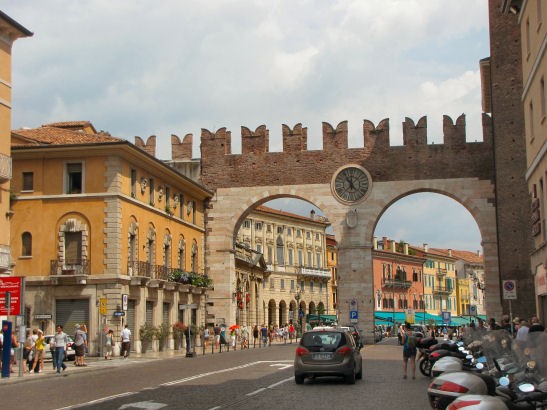
The gates leading into Piazza Bra
We started in Piazza Bra and the Arena in the city center, then wandered side streets to Casa Giulietta, where one can enter the courtyard to see the famous balcony (from which the storied Juliet spoke ‘O Romeo, Romeo…’) for free, but can ascend the stairs and stand on said balcony for a fee. It was shoulder-to-shoulder crowded, and so we headed on to Piazza Herbe, which was also crowded with its tourist market and cafes. (tip: take a right turn out of Juliet’s courtyard and enter the gelato place on the right; cones-to-go for - 1.50 euros each.) The Piazza dei Sigmori was less crowded, and we caught our breaths and admired the Venetian-Renaissance buildings surrounding the square before continuing to the river.

"O Romeo, Romeo! whereforth art thou Romeo?"
It is possible to cross the bridge on the north side of the peninsula and climb the stairs of the Teatro Romano to the terraces, which offer great views of Verona. However, although some of the stairs are stroller friendly, Roberts had quite a carry up the rest. With Lauris growing, the stroller is increasingly a better city-tour choice, even with the stroller-carrying stair-climbs that would be much easier with a baby backpack.

One tired mom and toddler after the climb to the terraces
With stops for snacks and coffee we eventually ended up at Castelvecchio and Ponte Scaligero, a castle complete with stone bridge over the Adige. The art museum is on one side, but we opted to cross the bridge and enjoy the views. Roberts was the first to notice a family furtively looking around with GPS in hand, and after watching them circle for at least twenty minutes I couldn't resist thinking of the times that I had been geocaching in similar circumstances. After they finally left, we made the find for ourselves, then backtracked to a restaurant we had seen on our walk in. After a last look at the ampitheatre in the fading daylight (which was now filling up for an opera), it was back to the hotel and a good night's sleep for this Romeo, Juliet and Lauris.

A delicious dinner
PS. Today in France is a public holiday, feast day of Assumption of Mary. Wishing everyone bon fête!

Saturday, August 13, 2011

Torino, Italy and Sacra di San Michele

Just as the French love their roundabouts, the Italians love their toll roads; our welcome to the country was a 36-euro toll for the use of the 13-km Tunnel du Fréjus that took us under the mountains. This was followed in succession by at least four more tolls, ranging from 5 to 15 euro each. We were prepared for this, as the Michelin trip planner calculated our tolls before the trip, but it still came as a shock to fork over money in such a short time.

Not three hours later we arrived at Sacra di San Michele. To reach it we took an exit before Torino, then a small winding road that took us up to the mountaintop where the Benedictine abbey was built at the end of the tenth century by Hughes de Montboissier from the Auvergne. The views of the Alps were a bit hazy, but still impressive, as the abbey is perched on a rocky spur with views in all directions. A 12th century sculpture by Nicolò framing the "Zodiac Doorway" was beautifully intricate, and the flying buttresses over the ascent to the church were especially impressive. Lauris had an applesauce snack on a terrace overlooking the valley, and a bit later mom had a coffee "snack" at the local café.
 

Sacra di San Michele

After arriving in Torino, we checked in then headed to Piazza Carlo Alberto, right smack-dab in the center of the city, for dinner. The hotel concierge recommended a restaurant right on the piazza, and we learned our lesson; delicious food, prices reflecting the prime people-watching, but VERY small portions. However the piazza with its view of San Carlo and San Cristina churches was a terrific first impression of a city best known for the automobile factories.

We began our sightseeing in the same piazza the next morning, and headed north past the Museo Egizio, which supposedly houses one of the richest Egyptian collections outside of Cairo, and through the courtyard of the Museo Nazionale before arriving in Piazza Castello, bordered by the Royal Palace and Teatro Regio. We chose not to visit the Shroud of Turin in the Duomo, in which Christ had been rumored to have been wrapped after the Descent from the Cross, but admired the Duomo from the outside, as well as the 2nd century Roman ruins across the street.

I loved the auseklīts accents in the courtyard of the Museo Nazionale
Eventually we found ourselves on Via Po, created between the 17th and 18th centuries to connect the historic centre to the River Po, with its palaces and arcades. The arcades are really a beautiful part of Torino, and they serve a very functional purpose as well; we could have spent the entire day walking and never had to emerge into the hot sun except to cross the occasional street, but even most streets had covered pedestrian walkways. I admired the frescoes on the arcades while walking, it seemed like no two buildings had the same designs. A two hour coffee break while Lauris napped refueled the parents as well, and we emerged on Piazza Vittorio Veneto, according to the hotel receptionist the largest piazza in Europe, ready for more walking. From the piazza there was a good view of the surrounding hills and the church on nearby Monte dei Cappuccini.

Does it still count as the largest piazza in Europe if there is a road running through it?
Back near the hotel we found a playground with a perfect combination of children, shade and playground equipment Lauris's size, and stayed until a thunderstorm threatened. After the storm we zigzagged the streets nearby, searching for a restaurant to satisfy our appetites. Our find, Ristorante Sorriso was perfect; great pasta (even if a little salty), attentive waitstaff, and an owner that chatted with Lauris and personally brought him a book in Italian, although Lauris wouldn't let him read it aloud, he wanted to read it himself. And we all know who is in charge, which is why the following morning we made one more stop before hitting the road: the playground.
Related Posts Plugin for WordPress, Blogger...