Showing posts with label Belgium. Show all posts

Monday, November 10, 2014

The Latvian holiday Mārtiņi and its equivalent across the world

Priecīgus Mārtiņus! (Warning, this is a dense post - but I promise you'll learn about a bunch of really cool holidays and traditions you've probably never heard of before!)


Mārtiņi (Martin's Day) is the name of the festival celebrated in Latvia on November 10th, marking the end of the fall and the beginning of winter. Halfway between the autumnal equinox and the winter solstice, in ancient Latvia Mārtiņi marked the passage from veļu laiks (season of the spirits) to ledus laiks (season of ice). By Mārtiņi it was expected that all preparations for winter were finished, such as salting meat and fish, storing the harvest and making preserves. This day also marked the beginning of mumming and sledding, among other winter activities. Mummers, also called ķekatas and budeļi, are costumed and wearing masks, traveling from home to home bringing their blessing, encouraging fertility, and scaring away any evil spirits.

The seasons and their associated deities and symbols - source here

As with many of the ancient Latvian holidays, there are certain ways to tell your fortune for the following year. For example, young, unmarried girls must toss their skirt into the middle of the room before going to bed; the one she dreams picks up the skirt is the one she will marry. Superstitions were also numerous; supposedly to guarantee the health of the horses through the harsh winter a rooster should be killed in the stables. Coincidentally it is tradition to sacrifice a rooster in Ireland as well; the blood was collected and sprinkled on the four corners of the house to bring fortune in the following year.

Everything you might need to know about the holiday can be found in this book

For Latvia’s neighbor to the north, Estonia, Mardipäev symbolizes the merging of Western European customs with local Balto-Finnic pagan traditions. Mardipäev marks the end of the period of All Souls in the Estonian popular calendar - the season when the souls of ancestors were worshiped, which lasted from November 1 to 11th). On this day the end of the agrarian year & autumn is observed, and the beginning of the winter period is celebrated. Children disguise themselves as men and go from door to door singing songs and telling jokes to receive sweets, similar to the processions occurring in Austria, Germany, Belgium and the Netherlands, where children go through the streets with paper lanterns and candles.

Source here

Historically a widespread custom in Germany on Martinstag was to have a bonfire, called the Martinsfeuer. Still lit in a few cities and villages throughout Europe, it symbolizes the light that holiness brings to the darkness just as St. Martin brought hope to the poor through his good deeds. It is believed that the procession of lanterns replaced the large bonfires over time. Traditional foods include Martinsgans (St. Martin’s goose) and Martinshörnchen, a pastry shaped in the form of a croissant symbolizing the hooves of St. Martin's horse.

Source here

As we see with the German version, the day has blended the pagan with the Christian; the resulting variety of traditions is something we see across the continent. November 11th is the feast day of St. Martin of Tours, honoring the friend of children and patron of the poor. In Slovakia, the Feast of St. Martin is like a 2nd birthday for those named after the saint; they are given small presents or money. However it is also a day of foretelling the future, as if it snows then there will be snow on Christmas. This is a theme that repeats itself in the Czech Republic where the first half of November is the time when it often starts to snow. Czechs roast goose and drink Svatomartinské vino, a young wine from the recent harvest. Wine, a symbol of the harvest, is a recurring theme also; in Slovenia and Croatia the “must” (considered impure and sinful) is baptized and turned into wine, while in Austria Martinloben is celebrated as a harvest festival with wine tastings, art exhibitions and live music.

St. Martin, source here

In Denmark Mortensaften is celebrated with traditional dinners, most often goose as in many other countries on this day, such as Sweden, where the entire day of Mårtensafton is a celebration of the goose. Other Martin’s Day foods abound, such as the rogale croissants in Poland. In Portugal magusto (chestnuts roasted under the embers of the bonfire) and água-pé (an alcoholic beverage which is a byproduct of wine) are consumed, as St. Martin's Day is the celebration of the maturation of the year's wine. However in Spain the goose is replaced by pork, in that St. Martin's Day is the traditional day for slaughtering fattened pigs for the winter. In Switzerland the 5+ hour long Repas du Saint Martin includes all the parts of freshly butchered pigs, while the Auvergne region of France (our home while we lived in Clermont-Ferrand) traditionally hosts horse fairs instead of feasts on this day – bringing us back full circle to the Latvian association of Mārtiņi to horses; on Mārtiņi we pass from the influence of Ūsiņš, the horse deity of summer, to that of Mārtiņš, a winter deity.

The preparation of magusto in Portugal, source here

In the United Kingdom, St. Martin's Day is known as Martinmas, when historically cattle were slaughtered and preserved for the winter. However November 11th in England is now better known for being Remembrance Day, commemorating the end of WWI and honoring those that serve in the military as Veteran’s Day (US) and Armistice Day do.

The American cemetery in Normandy, France

Whatever it may be that you observe, Martinmas or the Danish Mortensdag, Martinpäivä in Finland or the Feast of Saint Martin, I wish you a beautiful day. Although we will be honoring our veterans tomorrow, today we will celebrate Mārtiņi – the first of many, as now we are blessed with a Mārtiņš of our very own, little Vilis Mārtiņš!

The Mārtiņš symbol, source here


Saturday, September 20, 2014

Mannekin Pis goes Latvian!

This weekend the city of Brussels hosts the Festival of Folklore, Folklorissimo. During the festival there will be several events occurring in Vismet and on the square containing Manneken-Pis, the landmark bronze sculpture depicting a little naked boy urinating into a fountain's basin. We visited the famous statue in 2012 during our tour of the Netherlands and Belgium, but it wasn’t outfitted in such familiar clothes while we were there!

Source: Liga R, here
Source: here

The country chosen as the guest of honor this year at Folklorissimo is Latvia! Some of the events taking place over the weekend will be Latvian folk dance demonstrations, a Latvian crafts show and a sampling of Latvian food and culture. Little Manneken-Pis (the symbol of Brussels folklore) wears a costume at big events, and so in honor of Latvia being the guest of honor at Folklorissimo he will be wearing a new Latvian folk costume. There will also be a tasting of Latvian beer, served in a most unusual manner; on special occasions such as this one the fountain is attached to a keg and Manneken-Pis pees beer…

Source: here

Friday, June 15, 2012

Brussels

We arrived in Bruxelles, Belgium in the late evening after a day spent in the Delta region in the Netherlands and in Brugge. The Basilique nationale du Sacré-Cœur greeted us, the waning light reflected in the stained-glass windows. Oskars, friend and host awaited our arrival and we excitedly discussed what we would see the following day over a beer. Then the two older boys headed out to go meet some of the local Latvians, leaving the two younger ones with me to catch up on some sleep in preparation for a long day of seeing the sights.

Originally Flemish, the city today speaks mostly French although English is commonly spoken as well. The name comes from the original 10th century settlement in the area, Bruocsella, a Frankish word meaning “the village in the marshes.” No marshes in evidence for us! The city has a long and fascinating history which I will not retell, but will suggest you have a read.

The Maison de Brasseurs on the Grand Place

Our official tour guide brought us right to the very center of town via subway, and we emerged to see that Brussels had its very own fête taking place that day, the Red Bull Zeepkistenrace – similar to a pine-car derby that almost rivals Queen’s Day in Amsterdam… almost. Or not at all.

But as the cars weren’t rolling yet, we headed straight for Grand-Place, the humongous square that was built after the French destroyed the town in 1695. The guildhalls were restored in the 19th century; this is when they received the ornamentation and gilded motifs. All the merchants had their hall: the haberdashers, the tallow merchants, the archers guild, the bakers, the butchers and the cabinet-makers. With gorgeous Baroque facades in the three architectural orders (Doric, Ionic and Corinthian), there are legends and stories galore to match each and every building that faces the Grand Place. The most intriguing is associated with the Hôtel de Ville and its construction which took place over several centuries. Looking closely one sees that the front entrance doesn’t line up, and it was this flaw among several others that supposedly drove an architect to commit suicide from the beautiful tower that is topped by a copper statue of St Michael.


What would be a trip to Brussels without a look at Manneken Pis? The fountain, which was sculpted by Jérôme Duquesnoy the Elder in 1619 provided the district’s water supply. The current copy (as the original is under safeguard after being stolen several times) was wearing a costume, but I can not tell you which one. One day when I have some free time I want to explore his online “closet” which has pictures of the 800 outfits that have been presented to him over the years.


We returned to watch a portion of the derby, and Lauris even got a backstage tour. The carts were hilarious and the hilarity contagious.

* Note - I did not accompany the boys behind the scenes... *

As by this time we were thirsty and two members of our party were asleep, we headed for Délirium Café, famous for the thousands of varieties of beer available there. And what would be a visit to Brussels without a meal of moules and fries, so we crossed that off the list too.


That evening we were lucky enough to be invited to a folk dancing exhibition in the Latvian EU building, but soon we were on our way back to the center of town for dinner at the Fin De Siècle. Our host described the restaurant as having big portions of local fare, and as one of the top spots of the year. With no sign outside, the menu printed in a careful hand on a blackboard, and an owner that bounces around the table talking to everyone, we found the place to be our top restaurant experience on the entire trip. Four local dishes were suggested by the owner: rabbit, sausage, beef stew and a giant serving of ham. Along with a glass of Belgian beer the dining experience was not only worth the wait (spent sitting outside at a table with a couple of local beers until the owner came to bring us to a table) but I wanted to run after the people who were turning away seeing the line out the door to tell them it is worth every minute! If you’re in town, go to Fin De Siècle, Rue des Chartreux 9, in Brussels, Belgium.

Finally, a trip up to the top floor of a parking garage to take in the city at night. It pays to have a local tour guide, as the 360° view was free and included not only the center of town but we could see as far as Atomium, the relic from the1958 World Fair.


The following day we hopped on the subway to a brocante, but on our way passed the massive Palais du Justice. From all the amazing architecture we saw on our trip, this immense structure (in the style of Assyro-Babylonian) was the most impressive in my point of view. Belgium’s supreme court of law is situated high on a hill, giving it a great panoramic view of the city below, and measuring 20,000 square meters, the building is about 3 times the size of the Royal Palace. Commissioned by Leopold II, one of the first Kings of Belgium, it took 20 years to complete and cost about $300 million in today’s terms. The architect was Joseph Poelaert, who died 4 years before the building’s completion in 1883. Between the 3,000 homes that were demolished to provide the land, and the source of the funds (Leopold II was famous for acquiring the Congo for his personal possession and over 20 years looting it for rubber, ivory and other commodities, killing millions in the process) the building has caused quite a bit of controversy, and is still in the limelight. Currently on the UNESCO World Heritage "maybe" list, the building is badly deteriorated. "Under renovation" since 2003, "actual renovation" must soon be started or the building may become too decrepit to restore.


Then a quick meal, a stop at Leonidas, the chocolatier, and before long we were off to our final destination on this trip, Fountainbleau. A huge thank you to Oskars for playing host and tour guide, it wouldn’t have been the same without you!

And this is how we roll...

Monday, June 11, 2012

Brugge


The city of Brugge creates the illusion of a medieval village, complete with horse-drawn carriages and swans in the dark canals besides ancient churches. Although the horses may be pulling carriages of tourists, there is something about the town – it’s been listed on the UNESCO World Heritage list along with cities like Lyon, and Venice. Two of the traditions that made the town famous (the production of bobbin lace and the Holy Blood Procession on Ascension Day) survive to this day, and Bruges (in French, Brugge in Dutch) is considered the center of Flemish painting.

Minnewater - the "Lake of Love"

After a tour of the storm surge barrier of the Netherlands that morning, we arrived in Belgium ready to explore Brugge and its romantic town center. What better place to start than the Minnewater, known as the “Lake of Love”? An old legend explains the swans in the waters of this lake next to the Beguine Convent as a directive from Maximilian of Austria. He was imprisoned in 1448 by the citizens of Brugges and his councilor (whose crest featured a swan) was even beheaded, so when he was freed he ordered the town to keep swans on their canals from that day on, to remind them of their crime forever.


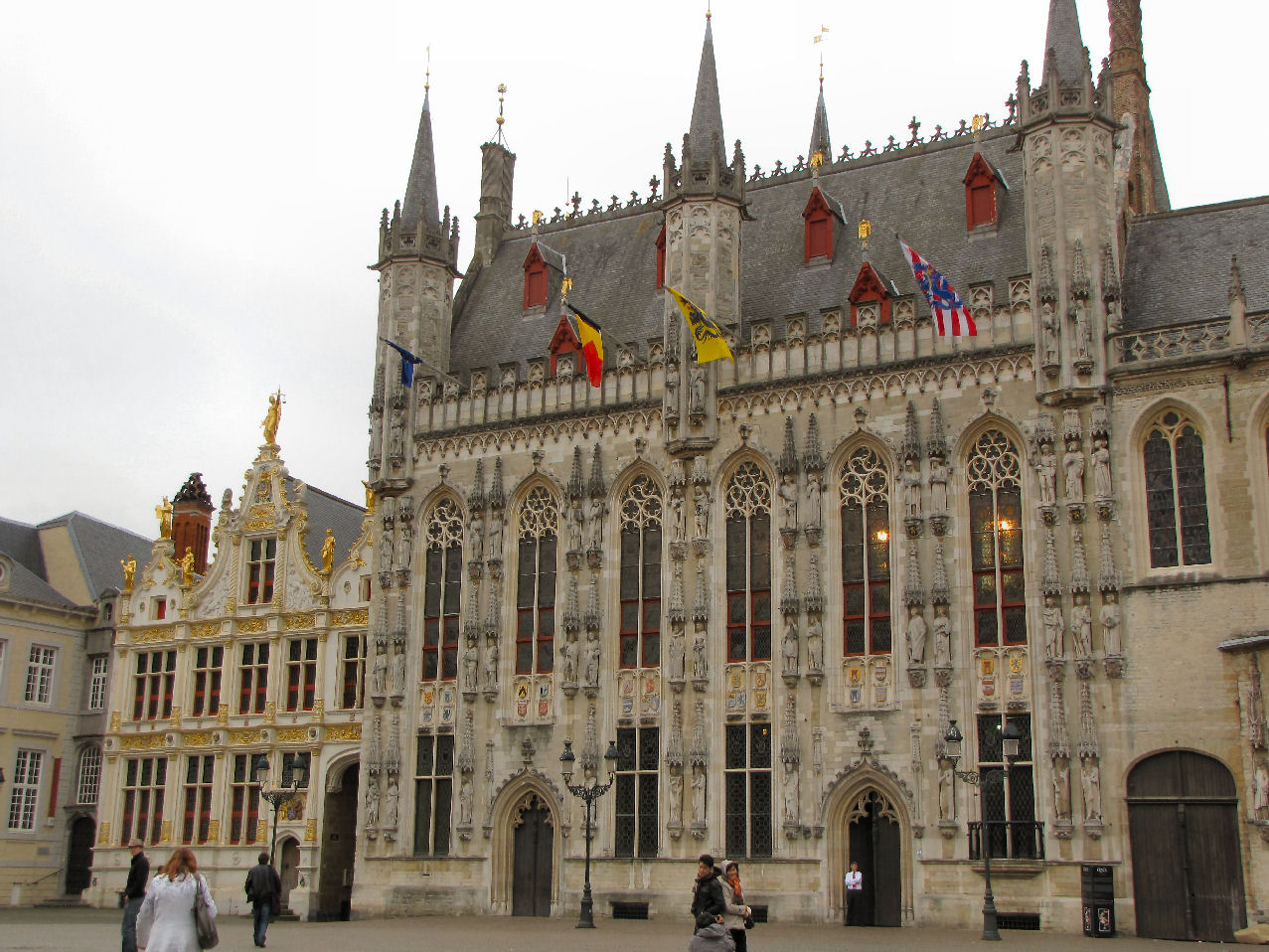
We strolled through the Beguine Convent (Begijnhof) in the shade of old oaks, returning to canal to find ourselves a lunch of moules. Then it was just a matter of following the canal north, past the 13th century Onze-Lieve-Vrouwekerk that houses Michelangelo’s white marble “Madonna and Child,” past the Oude Griffie, the Renaissance buidling that was the municipal records office in the 16th century, and finally reaching the Stadhuis. Built in the 14th and restored in the 19th, the town hall has a beautiful façade.


At this point we left the canal to wind our way to the Markt, the central market place. We passed the Belfort and Hallen, the belfry and covered market. The tower of the belfry dates to the 13th century and we remained long enough to hear the 47 bells chime the hour.


Our friend Oskars was awaiting our arrival in Brussels that evening and so our time in Brugges was short. But, I would like to believe there will be a “next time” that will allow us to further explore the storybook canals and time-worn cobbled streets.

Thursday, May 24, 2012

Hautes Fagnes, Belgium

The trip from the Petite Suisse Luxembourgeouise to the Hautes Fagnes went quickly as we cut through Germany to reach the moors, and most of the time was spent cruising on the autobahn watching the scenery flash by. Less than an hour east of Liège, Belgium, is the Parc Naturel Hautes Fagnes-Eifel that ecompasses the Hautes Fagnes, the valley of the river Our, several lakes, and the Eifel. It runs into the German Nordeifel nature park, and the combined Deutsch-Belgischer Naturpark covers an area of 926 square miles.


The view of the high fens from the tower


Our destination was the Signal de Botrange, which at 2,277 ft is the highest point in Belgium. After stopping at the Centre Nature de Botrange to learn about the ecology of the area and grab a few maps, we found ourselves walking through the restaurant to find the unmarked door to the tower that stands guard over the area. The view over the non-native conifers to the moors that stretched all the way into Germany was desolate but beautiful, and with enthusiasm we bundled up for a short walk to experience the nature reserve.

Created in 1957, the reserve protects a very delicate ecosystem. The windy, harsh climate attracts and supports plant and animal species from high mountains and northern latitudes, and the peat bogs are unique as well. Fire can be fatal for the entire area; I remember how fire would travel underground through the duff and live on for weeks in the southern US where I fought fires, I imagine a peat bog fire would be similar in that it would burn incredibly hot, deep and travel underground.


We set out on boardwalks laid out over the bog, and I found an intense calm in the absence of sound other than the wind. Few other people had ventured out which might have been due to the weather; although it was overly warm in the sun, as soon as we were in the shade it seemed cold and the wind cut right through.

The wind turbines provided high contrast to the nuclear power plant to the north
Clumps of beech, oak and birch broke up the landscape as well as the plantations of spruce. As we walked, we saw evidence that the reserve was attempting to eliminate the non-native species and replace the middle ground between road and moor with native seedlings. Other than the boardwalk and a few informative placards, this was the only evidence of people. Practically deserted now, however the Hautes Fagnes have at some point been home to humans as traces have been found of the Via Mansuerisca, a road thought to date back to the 7th century.

Just south of the Park Roberts found his ville...

Once back in the car we wound our way north, soon crossing the border into the Netherlands. With tired feet from a long day of hiking and climbing we found a roadside restaurant to fill our stomachs before shooting the rest of the way to the next destination on our trip, Amsterdam.
Related Posts Plugin for WordPress, Blogger...