Showing posts with label Latvian traditions. Show all posts

Saturday, December 21, 2019

Baltic Christmas Day 21 - Winter Solstice!

Today is winter solstice: the ziemas saulgrieži, shortest day of the year, heralding the arrival of winter! It is also Yule (in Estonia jõulud), the winter festival with roots in the pagan solstice celebrations and the precursor to modern Christmas. Jõulud and the winter solstice were of great importance to the Baltic peoples, as many of the pagan traditions and rituals are the foundations of the modern day Christmas celebration.


As Daina wrote in her post on the winter solstice, “Latvian winters are traditionally cold and - most of all - dark. In Riga on December 21, the sun will rise at 9:00am, and set at 3:43pm, which calculates to a mere six hours and 43 minutes of daylight. Before Latvians were converted to Christianity, they celebrated winter solstice on the year’s shortest day with festivities that included songs, food, fire, and various traditions. After all, if you are experiencing 17+ hours of darkness on a daily basis for several weeks, it seems only natural to create a celebration to look forward to.”


Imanta wrote about one of those celebratory traditions in her post Čigāni. The tradition of čigāni, budēļi, ķekatnieki (the name depends on the region in Latvia and the time of year) “all symbolize the procession of noise making, dressing up in costumes, visiting homes and making a ruckus for others. Some might find it similar to the American tradition of Mummers, but the costumes are far less extravagant... These months of winter are very dark and dreary in Latvia, so, for the most part in the past it was a way to keep entertained. It is also believed that evil spirits roam the dark months and so, by being visited by budēļi, čigāni or the like, you scare away the evil spirits. This is also why it’s important to make a lot of noise when going on these costumed travels. By making noise, you scare away the bad energy. These special guests also are believed to bring good luck, good health and fertility. So, you better let them in and you better have something ready to give them! In addition to inspecting your house and your quick wit, budēļi expect to be given food and drink. This is to give them energy in their continuing quests.”


This year the students of Krišjāņa Barona Latvian School of Chicago will be donning handmade masks at the annual Christmas event, “KBLS Ķekatas.” In addition to a well-attended market there are also a Christmas lunch and bake sale, but the central event is always the pageant. This year artist Lāsma Maher led the students in preparing paper mache masks that will be worn for the performance; they started their preparations in October/November, and over the weeks carefully added layers of newspaper, paint, and later raffia, string and other accents to create their masterpieces.


Lāsma writes “Masku gatavošana, pārģērbšanās un svētku svinēšana ir daudzu tautu tradīcija visa pasaulē. Latvijā sena tradīcija ir rīkot gājienus ar pārģērbšanos lielā grupā, kas apciemo vairākas mājas pēc kārtas. Maskētos gājējus sauca dažādos vārdos, atkarība no Latvijas novada, piemēram: ķekatas, budēļi, bubulnieki, spokstiņi utt.

Vistipiskākie masku tēli bija: Dzērve, Kaza, Zirgs, Lācis, Nāve, Garā sieva, dažādi mistiski meža gari, gadalaiki, dārzeņi utt. Čikāgas latviešu skolas bērni vairākas nedēļas pēc kārtas gatavoja sejas maskas no papīra. Katram skolniekam bija iespēja izvēlēties kādu konkrētu dzīvnieku vai putnu, kā ari izdomāt pašam savu mistisku tēlu.

Sestdien, 21. decembrī skolā ir Ziemassvētku priekšnesums, kuŗā bērni pārģērbsies pašdarinātās maskās un ies rotaļās.”

Dzērve (crane), lapsa (fox), vilks (wolf), garā sieva (tall woman)... who or what will we meet next?!


A big thank you to Lāsma for the photographs of the students’ creations and her apraksts! I’m inspired by the results, and am already planning how we could have our own ķekatas here in South Carolina next year... Hopefully we will be able to post some photographs from today's KBLS Ķekatas on the 24 Days of a Baltic Christmas Facebook page, where you will also find links to other articles about the Baltic winter solstice traditions and videos of budēļi.


With Christmas fast-approaching, we are winding down the series. However, make sure to take a break from your holiday preparations tomorrow on Day 22, when Nikolajs Timrots returns with his impressions of this year’s Vilnius Christmas market!

Friday, December 21, 2018

Baltic Christmas Day 21 - Winter Solstice!

Today is the winter solstice, the shortest day of the year; add to that a full moon and meteor shower, and it is bound to be a magical night! Many seasonal Latvian traditions originated in the ancient pagan celebrations of the winter solstice, and over the centuries these old pagan traditions not only survived, but have been incorporated into the Christian celebration. From pulling the log to decorating the house, we’ve compiled a list of resources of things you need to know to usher in the New Year and herald the return of the sun!

Photo: Wikipedia commons, credit Spekozols

To ward off the darkness, cold, last year's mishaps, bad work and thoughts, people pull a Yule log from one farm to another and then burn it, symbolizing the beginning of a new year. Baņuta gives us the details in her post Dec. 21 – Lighten Up!, and the article Day 22, Winter Solstice features additional options for the bluķa vilkšana. For those living in the city, the Light 'n Go Bonfire Logs from Home Depot are from the Baltics, burn quickly, and have handy pre-cut slots. 


In ancient Latvia, Ziemassvētki celebrated the rebirth of the Sun Maiden. Traditional celebrations included participating in ķekatas (also known as budēļi kaļadas, similar to mumming), when people dressed up costumes and went from house to house singing, dancing, and playing games. The traditional costumes varied, but popular choices were animals such as a horse, bear or crane. The ķekatas are believed to bring luck to the households that they visit, scaring away evil spirits in the process with the loud singing and carousing, and are warmly welcomed with food and drink. More on the budēļi tradition in Imanta’s post A Baltic Christmas Day 4 – Čigāni!


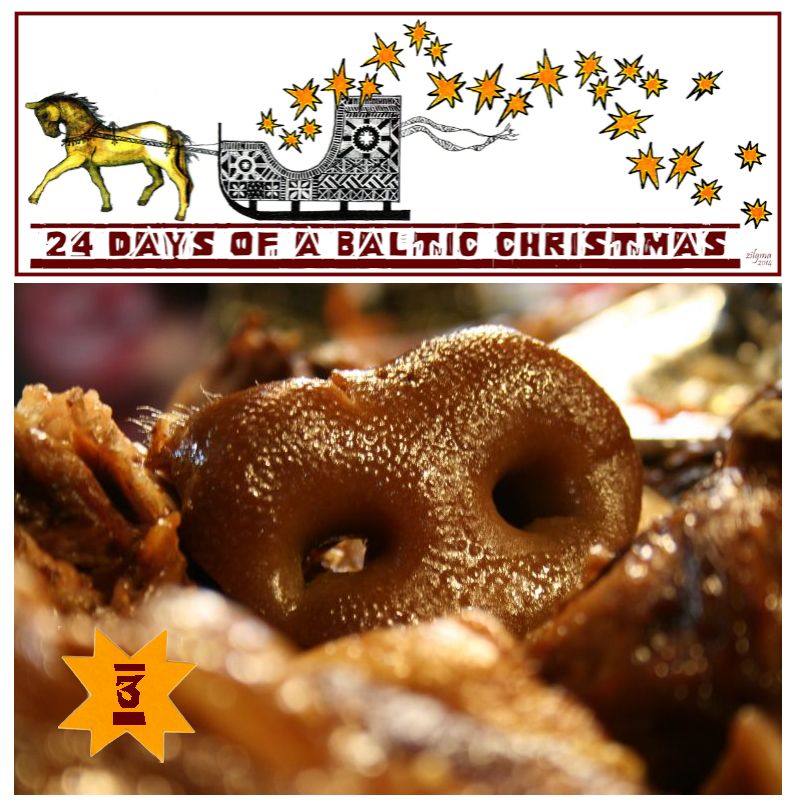
The saimnieks and saimniece at each house would treat the guests – whether they be ķekatnieki or log pullers – with food and drink. One traditional food that was served was the pig’s head; learn to make your own with the article A Pig’s Head for a Winter Solstice Dinner.

Christmas and the winter solstice is traditionally a magical time in all three of the Baltic countries, and nowhere is this magic more evident than in the natural world and the Baltic customs surrounding animals. Read more about these traditions in the post Christmastime Animal Stories and Superstitions.

It is also a time for fortune-telling, merrymaking and games. Here Daina discussed the role of ziemas saulgrieži in her holiday celebrations: Day 16 and the Winter Solstice

Daiva addresses some of the Lithuanian traditions in her article Lithuanian Pre-Christian Rituals and Superstitions in Today’s Catholic Celebration


May you have a wonderful winter solstice celebration, and please join us tomorrow for debessmannā


Sunday, December 16, 2018

Baltic Christmas Day 16 - The Kūčios vs. Ziemassvētki table!

Latvian tradition dictates nine dishes on Christmas Eve, ensuring fellowship and wealth in the New Year. Traditionally twelve dishes are to be served on Lithuanian Kūčios, symbolizing the twelve months of the year. Not only do both countries count the dishes served, but there is also some overlap of what is found on the Latvian/Lithuanian holiday table…


The Lithuanians often have multiple dishes containing herring, while Latvians will also serve fish dishes to ensure you’ll have money in your wallet in the coming year. One source mentioned that the larger the scales, the larger the wealth, however after reading Margaret’s article “On the pitfalls of buying a carp for Christmas” I believe we might skip the carp this year! Remember that Latvians place dried fish scales in their wallets on New Year’s Eve (to make sure their wallets are full in the New Year), so save those scales after cleaning the fish... 

It isn’t Kūčios without the traditional Christmas Eve Cookies (Kūčiukai) and poppy seed milk for Lithuanians, while Latvians insist that piparkūkas be served, guaranteeing much love in the coming year. We featured June’s kūčiukai on the series here, while Victoria discussed poppy seed milk in her post High on Christmas. The 24 Days of a Baltic Christmas piparkūkas post can be found here: Piparkūkas!

From article Piparkūkas!

Another staple of the Kūčios table is a cranberry Kissel drink. Parallels could be drawn to the Latvian tradition of serving beets and carrots, thought to ensure health in the New Year. However, cranberries are a popular choice for Latvians as well, in the form of a sauce to pour over everything from meat dishes to a buberts dessert. Tomorrow on 24 Days of a Baltic Christmas we’ll have the recipe for Cranberry Sparks, a treat for the sweet tooth.

Catholicism is the dominant religion in Lithuania (while in Latvians are predominantly Lutheran), which is why sharing communion wafers during the Christmas Eve dinner is a common practice in the southern Baltic country but not Estonia or Latvia. As Daiva wrote in the article Kūčios, the Connection Between the Dead and the Living, a wafer is passed around the table and each family member breaks and eats a piece, wishing the others a happy New Year. This year’s Baltic Imports 24 Days of a Baltic Christmas gift guide featured Oplatki Christmas wafers.

From article Medus torte

Latvians believe it will bring good fortune to have something round on the holiday table, as this will bring sunshine in the coming year. The medus kūka (honey cake) is one option – it symbolizes the sun (recipe here). Grey peas are another seasonal favorite; see the post Pelēkie zirņi and bacon for more on this. If all the grey peas are eaten, then there will be no tears in the New Year...

Photo credit: Zilgma

In my opinion (and probably that of many a Latvian), Christmas wouldn’t be the same without pīrāgi (see 24 Days of a Baltic Christmas pīrāgi recipe!). Others might argue the same of sauerkraut, which is a favorite on the Lithuanian table as well (see post Sauerkraut, Two Ways!). Mushrooms, porridge, biscuits, nuts, dried fruit, and apples are common in both countries. See the Beatos Virtuves post with her family recipe of a traditional Christmas Eve dish and holiday dessert with cereals, cranberries, honey and poppy seed milk: Kūčia.

From article High on Christmas

One major difference is that the Lithuanian table was traditionally meat-free. On the other hand, Latvians didn't shy away from the cold cuts and pork dishes; a pig's head was a common winter solstice dinner! 

Photo credit: Visi svētki vienuviet

As for the remaining dishes, I think many Latvians and Lithuanians would gladly share a table, potato salad and meat in aspic being popular choices. (Andrējs contributed a Beginner's Guide to Galerts to the series last year...) Traditionally Latvian Christmas offerings can also include pork roast with oven baked potatoes, salmon, turnips and beets. This Estonian Rosolje á la Polli Talu beet salad from Marika Blossfeldt could be on any Baltic holiday table!

Over the decades new dishes and flavors have worked their way onto our holiday tables, but the passion for delicious dishes and a richly-laid Kūčios and Ziemassvētki table remains.  The table set for a feast brings blessings and fertility for the coming year, the rich foods symbolic of a year full of love, wisdom and prosperity!
 
Photo credit: Lithuanian Home Cooking

Whether you set the table with nine or twelve dishes; whether you’re drinking poppy milk or buttermilk; whether you are eating herring or carp… may your holiday table be rich not only in the foods upon in but also the company around it! 

***

For more on the traditional Kūčios table, please read Daiva Venckus's contribution to the series, "Kucios, the Connection Between the Dead and the Living." Another invaluable resource is her post "Lithuanian Pre-Christian Rituals and Superstitions in Today's Catholic Celebration." You may also be interested to read Barbara Tedrow's article, "Kūčios, the Longest Night." 

Saturday, December 15, 2018

Baltic Christmas Day 15 - A Lantern

The legacy of the ancient Balts is reflected in symbols, from the sun and moon, to earth, water and fire. These symbols tell a story, one dependent on Mother Earth and her bounty, of using the natural world as a guide to live a life ruled by the changing seasons and weather.


Light is a recurring theme, as it is in many cultures due to the necessity of light to live. From the sunlight that nourishes crops, to the fire that warms the hearth, light is woven into the fabric of our ethnic heritage. The sign of the Sun, dating back to the Early Iron Age. The tree of Sun, which represents reaching upward, growth. The Indo-European fire cross; a symbol of fire, thunder, light, fortune, health and prosperity. The sign of the Moon, the symbol of warriors. The Sign of Auseklis (Morning Star); a protector, woven into blankets and coats to safeguard travelers.

As we await the winter solstice the days keep getting shorter, and to warm the long nights we bring lights into our home. We string them in our Christmas trees, we light candles in the windows; we warm ourselves around the fireplace and we keep the Baltic fires burning.


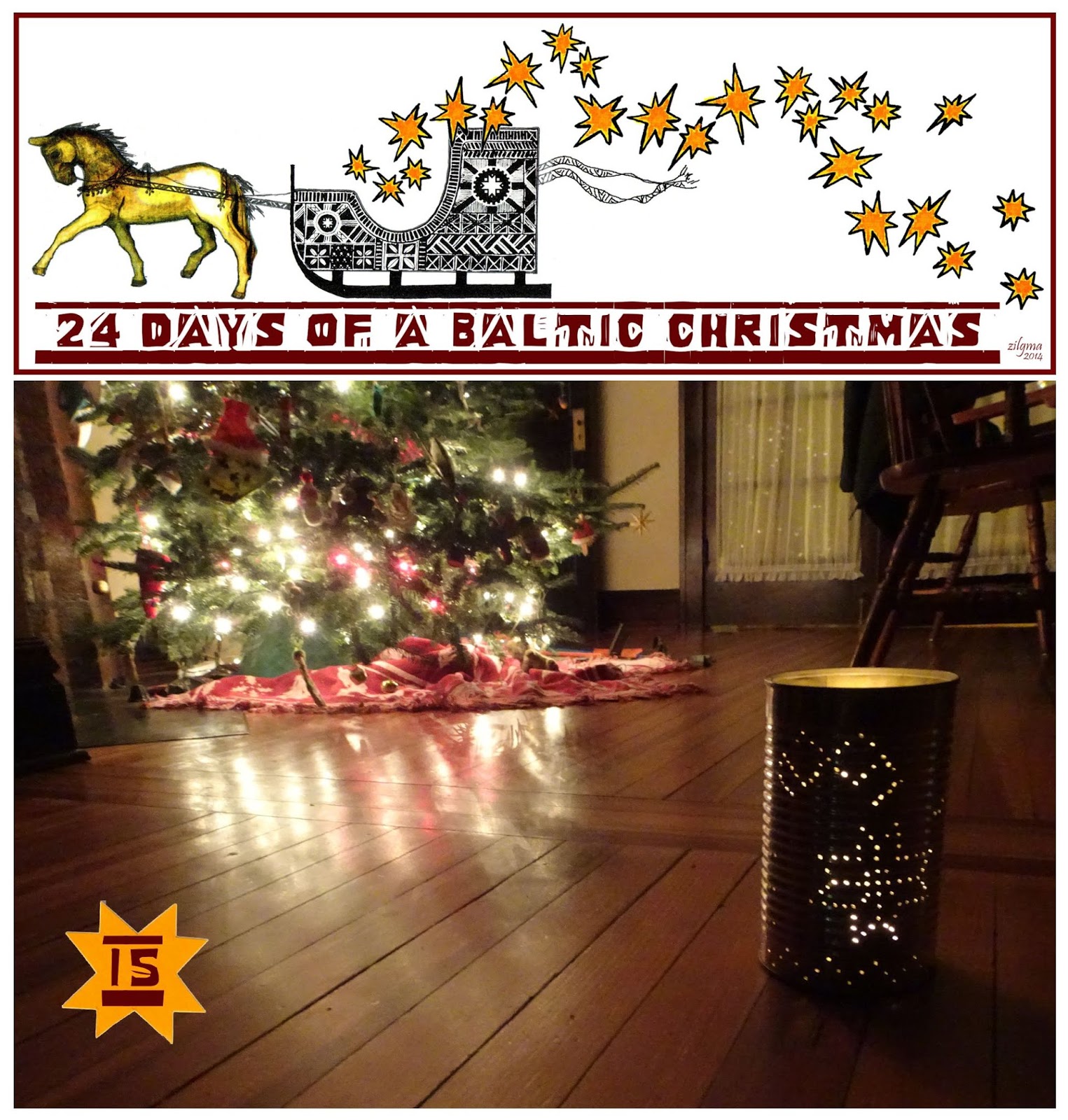
A modern-day tradition that our family keeps is the Peace Light. This year the Peace Light has arrived in our home, a symbol of hope and light, traveling the world spreading its message. We celebrated with our scout troop, making lanterns to home the Peace Light during its stay in our lives.

It’s really so simple, and the results so beautiful. Save a tin can headed for the recycling bin and stick it in the freezer after filling with water. (We learned that sticking a straw in it will keep the pressure from pushing the bottom out, although if this happens it’s just a matter of hammering it back in once the lantern has been finished.) Once the water has frozen, use a nail, hammer, towel and safety glasses to make holes in the can in the shape of symbols or pictures. Put two larger holes near the top and affix a wire to hang the lantern, and finally light a tea light in it, once the ice has melted. 


Dear readers, I wish you light and warmth during these longest nights! May you find joy in the simple things: a tealight in a tin can, the shadowplay from a lantern, the light in a child’s eyes. May your days be filled with anticipation, not stress: the smell of piparkūkas and kanēļmaizītes, the arrival of the postman, the sound of bells, the daily 24 Days of a Baltic Christmas article. And may winter solstice arrive and the days start growing longer, as the sun starts on its annual journey of venturing higher into the sky.

Please join us tomorrow on 24 Days of a Baltic Christmas as we take a closer look at the similarities and differences in the Latvian and Lithuanian Christmas/Kūčios dinners!

Thursday, December 13, 2018

Baltic Christmas Day 13 - Dec. 21: Lighten Up

Please extend a warm welcome to Baņuta Rubess today, on Day 12 of 24 Days of a Baltic Christmas! Baņuta joins us with everything you need to know to pull the log this winter solstice...


December 21: Lighten Up

Here’s the way to make the sun shine and get rid of all your sorrows: cut a log, tie a rope to it, drag it around your house or City Hall. Take a bunch of friends with you. One of them might wear a wolf mask; another, dress up as a pig or a devil. You drag the log around the house, maybe even walking backwards, and singing all the time while banging loud instruments. Do it three times. Once you’re finished, burn the log. By doing this, you will have helped the sun to return and cleansed yourself and your community of all the lies and disappointments of the year.

You might be one of those people who like to turn on the television and keep a fire on the screen all day. Oddly enough, there’s a connection between you and this ritual. Wood and fire are not just a source of heat invoked in the winter. For the Latvians, a block of wood is like the heaviness in your heart. Anything bad you’ve done to someone, or they to you, the end of the year is the time to get rid of it. You can do it any time before Christmas, but the best time is December 21st, on the shortest day of the year, the winter solstice. That’s when it’s time to symbolically bring back the sun. The way you do it is by Dragging the Log: vilkt bluķi.

That heavy piece of wood was the ritual centrepiece for many Northern European cultures celebrating Jul: until the Christians stepped in, the Germans dragged a Julklotz, and the French turned into a confection of chocolate and whipped cream, the Bûche de Noël. The Catalans dress up their log and stuff it with presents, the Tio de Nadal. The English tradition focuses on the burning of the Yule Log.


The Latvian log can be any type of wood, but oak is preferred. It’s important for everybody in the community to take part in the pulling or rolling of the log at some point. The worst things are, the more times you should drag the log around the house. (I can think of some capital cities where one might need to do that for 24 hours.) The ritual can be repeated in many places before the log is burned. These days, you might even drag it over to your neighbours’, attached to a car.

You can interpret the Latvian tradition of vilkt bluķi in many ways: the log is heavy, as is your heart, as is the state of the world, and so it is a sombre event. Dragging the darn thing builds up a sweat and makes you feel warm in minus zero degrees, which makes for good exercise before all those heavy meals. The melodies of the songs you sing, with their refrain of kalado, kalando, kaļadā, olilo, are incantatory: you’re literally singing enchantments and spells that have a history reaching far beyond Hogwarts. As the folklore specialist Zoja Heimrāte has pointed out, in Latin, kalenda means change: change feeds your soul. After pulling that log, and burning it, you can spread the ashes over your fields as fertilizer, a practice forbidden by the early Christians in the sixth century, by the way, and later appropriated (the log became the ‘Christ log’.) Burning the log taps into one of the deepest joys humans have — the discovery of fire and the ability to create your own mini-sun in the midst of vast darkness.

“All the roads are full of fires” is the traditional song to sing while dragging the log, and it’s an easy one, because the melody is very simple (see link below). The roads are full of fire, but people are in control of the fire; the fire is not a threat. The song goes on to say that the roads are also full of keys, meaning that a resolution, or a revelation is near at hand. As the song develops, it says that you’re going to have to go through a lot of stuff, through ‘everything’. You can’t avoid the trials and tribulations of life. But ‘ dieviņš’ – Little God, the divine spark of life – will stand by you and help you get through the darkness.

Photo credit: 2x2 2016

You can wear your old parka while pulling the log; you can pull on full Latvian folk costume gear; or you can go as a mummer. Budeļi – dressing up as a mummer — is a different ritual and I won’t describe it here at length. But it’s part of a deep indigenous tradition of taking on the spirits of the natural world, of transformation. It’s no coincidence that the ritual of dragging the log is meant to end with various dancing games, played by everybody, young and old, no matter how cold, around the bonfire. The names of the games describe the world the Latvians lived in: dancing around the bear, or the game of the Wolf chasing the Goat, a round which ends with the Wolf and Goat linking arms and spinning with glee.

I was lucky enough to be living in Rīga the first time I experienced this ritual, nearly twenty years ago. My son was maybe eight years old and the two of us went to Bastejkalns, a hill in a nearby park, right on the edge of the old town. All the snow had turned to ice and the pathway winding its way up the hill was impassable. We literally got on all fours and crawled up that hill. Somehow, the intrepid Skandenieki, one of the most renowned folklorist groups in Latvia, were up there, ready to sing and celebrate. We dragged a log around, and sang and danced around the fire in the nearly pitch dark night. It really did lighten things up.

So, what are you waiting for? Call up your friends and family; get yourself a log; drag it around your house three times, and lighten up your heart. Although, it wouldn’t be Latvian to be that optimistic: the way the log burns will tell you what the future brings. If it’s bright, things will be good; if it’s weak, reach for the aspirin. In other words, choose your log carefully. Once you’ve burned it, you’ve done your part in the recurring battle between the light and the dark.


Song to sing:
Visi ceļi guniem pilni

  Visi ceļi guņiem pilni, 2x
  Visi ceļi atslēgām. 2x

  Jaš būs ieti visam cauri, 2x
  Ar dieviņa palīdzīb’. 2x

  Visam gribu ieti cauri, 2x
  Ar dieviņa palīdzīb’. 2x

  Visam varu ieti cauri, 2x
  Ar dieviņa palīdzīb’. 2x

This is the tune: (the Stutes website)

Pulling the log in Rīga:


And finally, here’s another verse you can recite, especially if you want to be the Log Mother!
  Bluķa māte bluķi vēla,
  Pašā Bluķa vakarā.
  Lai veļ bluķi trīsi reizi,
  Nenāks mošķi caur sienmāli.
(The Log Mother rolled the log on Log Night. Roll the log three times, Evil spirits won’t come through the hay.)


Paldies Baņuta, for the informative look at the winter solstice tradition of pulling the log! Years ago the Chicago Latvian scouts and guides put on a winter solstice show at the Museum of Science and Industry. I’ve forgotten a good bit of what we performed, only that the most popular line was always “Look, there’s the log!” In recent years we have shared this tradition with friends, and it is always a rowdy, pot-banging good time!

Baņuta Rubess is a writer and theatre artist, who has spent a lot of her time in Latvia. Currently, she lives in Toronto. You can connect with Baņuta on www.banuta.com.

Tomorrow on Day 14 of 24 Days of a Baltic Christmas – an ode to blood sausage!

Monday, December 10, 2018

Baltic Christmas Day 10 - The Infinite Manifestations of Home

Please welcome Ērika Veidis to 24 Days of a Baltic Christmas! You might have read her article Cultural Wealth, which was published this August soon after the #LV100 song festival. A Latvian living in the US, she joins us today on Day 10 with this essay sure to pull at memory threads of your Baltic tapestry...


Woolen mittens. These I stitched with black thread, closing the hole worn in the right thumb. Made by someone in Latvia, a gift for the holidays. Maybe originating from a pine home in the frosty countryside, maybe from the bench of a factory lit up by large and streaked windows, like the one I visited when 11. Maybe from the tips of cold needles in a cold Rīga apartment. Mindfully woven, mindfully repaired. I wear them on the icy walk to work in Cambridge, Massachusetts.

The gleam of my laptop screen, from which I hardly tear my eyes until darkness (the sun sets early in December in Cambridge). Seas of logistics and projects stuffing my inbox, happily sufferable when laden with meaning -- how do we affect the natural world, and how does that, in turn, impact us? Weaving together a story of human demographics and consumption and production, environmental change, and health. Pontificating on theories of change -- what is the role of research, of policy, of education, of public outreach? What is the balance of top-down versus bottom-up? Can we speak of revolution, and what does that entail? Maintaining academic and scientific rigor for profoundly simple conclusions -- we are inextricably connected with the world around us.

A web of lights, seen from the plane window flying from New Jersey back to Boston. I've always wondered whether the flickers and glimmers are caused by flipping switches in apartments and offices and homes or by some trick of the atmosphere. The hypocrisy of my own travel. Justifying carbon by the puniness of my individual actions (free riding). The perpetual car troubles necessitating (and credit card points facilitating) air travel this time around. The subtle doubts about environmentalism being the latest outlet for the intensity and perfectionism once channeled into middle distance running.

The feeling of moving from one home to another. The love for family in rural New Jersey and the love for individuality and career and youth in Boston.

"Yes, I'll have a tomato juice, please." And then the plastic cup.

Singing Latvian folk songs in the shower. "Stoking a fire, melting silver, predicting the future, unknown." Remembering my mother and grandmother singing these to me growing up; musing about singing them to my own children someday.

Musing about the future, unknown; about the balance between taking action and relaxing in the face of what is. The Serenity Prayer: "God grant me the serenity to accept the things I cannot change, courage to change the things I can, and wisdom to know the difference" (Reinhold Niebuhr). Perhaps metaphorically pouring molten silver into my human interactions -- if connection is possible, then so is co-imagination, and so is a better path ahead.

Laughing with my housemates about my strange expressions, which, despite being born and raised in New York/New Jersey, might be manifestations of Latvian being my native tongue, my soul language, what automatically slips through my pen in occasionally-kept journals, albeit fragmented, elementary. "Your expressions are object-focused," observed my housemate. Maybe the kale stays here. The chair can move there. The rain is starting. Attributing greater agency to the things in the world around me. Imagining personality, animation, soulfulness. Direct translations from the small Baltic state.

We are not the only inhabitants of this world.


Silver rings. One worn by my mother at my age, etched symbols eroded, two silver tassels missing. One worn in common with my Latvian high school classmates, holding the now-subtle markings of the life tree, the god of horses, the snake. One gifted by my relatives in Latvia, multiple intertwined strands representing the nation's underground waters, soil, and tree roots. One worn in common with my two brothers, bearing the symbol of home. One gifted by my parents, silver tassels intact. I carry on my hands metaphors to keep me grounded, safe, connected to the past, to friends and family, to ancestry, to heritage, to land.

The dense yellow saffron cake rising in the oven. Kliņģeris. Baked at holidays and celebrations -- this time at Christmas. A festive December 24, lit by candles, lilted by voices and an out-of-tune organ wafting "Silent Night" (in Latvian) into the chilly darkness of Yonkers, New York. And then back at home: lots of food, the reciting of Latvian poems or performance of musical pieces (at least when we were young), the midnight exchange of gifts. Last year, a divergence from tradition with a loving-kindness meditation -- first round punctuated by snickers and giggles and sounds from someone (supposedly) sliding on the couch; second try resulting in a deep, pervasive peacefulness. My grandfather, hard of hearing and not able to heed the instructions of the guided meditation, still blanketed by the heavy, warm, quiet air.

Finding the same sacredness that I access through Latvian culture reflected in the songs sung together by inhabitants of Sparta, New Jersey, gathered around a Christmas tree waiting to be lit. "Sleigh bells ring, are you listening? In the lane, snow is glistening." Strangers united by melody and the ineffable holiday spirit.

And here, the root of it all. The entanglement of voices. The feeling of peace. The experience of groundedness, held in tradition and family and sanctity of space. The melting of individuality, the smell of warm cakes in the oven, the goofy laughter that spontaneously springs most easily from the closest of social ties. A tree dressed for the occasion. Feeling like everything is possible, perfect.

The infinite manifestations of home.


Thank you Ērika, for this heartfelt reflection on your Latvian roots! You’ve touched on so many of the things that stoke the Baltic fire within us during the holiday season…

Ērika Veidis is an American-born Latvian currently living in the Boston area, where she works in environment- and health-related research, policy, education, and public outreach. Before starting at the Planetary Health Alliance, Ērika studied Government and Mind/Brain/Behavior at Harvard, ran track, and conducted research around social movements and environmental economics. In her free time, Ērika spends time with her New Jersey-based family (and dog, Harley), writes, hikes, and plays guitar. You can read Ērika’s article, Cultural Wealth, here, and can find her on Instagram and Medium.

Tomorrow on Day 11 we welcome Estonian food blogger Annika, with a photographic journey through Yule feasts!

Related Posts Plugin for WordPress, Blogger...