Showing posts with label New York. Show all posts

Friday, December 15, 2017

Baltic Christmas Day 15 - NY Latvian Concert Choir

Today on 24 Days of a Baltic Christmas we welcome Kristīna with her article on the NY Latvian Concert Choir's annual Christmas concert!


Along with the much awaited and various Christmas craft markets (Ziemsvētku tirdziņi) in the New York metro area, the New York Latvian Concert Choir’s annual Advent concert has become a tradition of the holiday season for many. I began attending the concerts when I had four young children, and one Sunday just needed a break, or as my husband called it- “a walk-about.” It was my chance to get away from stressful pre-holiday preparations and simply sit & absorb the joyful celebration surrounding the season. I returned home inspired and calm, thus beginning a personal tradition that continued as solo excursions for a number of years, but grew to include family members, and finally, to joining the choir as a singer.


Many Latvian choirs prepare for a concert during the Christmas season, reaffirming the idea that abundant joy is found in intangible things. As often happens during holidays celebrated by the Balts, we enjoy a unique blend of Christian themes and images, a bright star and the manger in Bethlehem alongside snowy woods and energetic, slightly rowdy budeļi, or mummers.


The NYCC Advent concert takes place at the NY Latvian Lutheran Church in Yonkers on the first or second Sunday of the Advent. It follows a brief service and a seasonal chorale sung by everyone present. The choir often commissions works by Latvian composers specifically for this concert. In the past, composers such as Uģis Prauliņš, Ilona Rupaine, and Ēriks Ešenvalds have composed pieces for the choir. Most often the commissioned work is a Christmas cantata with compositions for poetry by Latvian authors or arrangments of traditional folk melodies. The commisioned works usually include accompaniment by a chamber orchestra. Thanks to grants from the New York Council for the Arts, a small orchestra has been a part of the concerts for as long as I have attended them. Flowing passages by violins, wall trembling percussion, and mysteriously dreamy notes on a harp, undoubtedly make for a richer experience for both singers and audience. In addition to the commissioned cantatas, the program has included familiar Christmas carols arranged for a choir and works by Baltic composers such as Estonian Urmas Sisask.

While the music of the Advent concert is the focus of the day, the luncheon following the concert encourages folks to stay and enjoy friendships. A characteristically food- laden buffet including salmon (smoked or as gravlax), various meats, sauerkraut, and plenty of potato salad, is the centerpiece of the church’s social hall. For a number of years a small Christmas market with a handful of vendors squeezes into an adjoing conference room and onto the stage of the hall, providing the “shopping fix” for those who are so inclined.


We may associate the Latvian singing tradition with song festivals, but of course it extends further. The New York Latvian Concert Choir’s Advent Concert is a fine example of the fact that singing in general is good for the body and soul. What better time than heading into Christmas to give both body and soul a gift?

Paldies, Kristīna, for your beautiful post on this NYC Christmas tradition! Kristīna finds singing along with CDs in the car or with friends around the campfire one of the best ways to de-stress. She is hoping the activation of otherwise unstimulated areas of the brain that is required in choral singing will postpone the effects of age on her brain by a few minutes... Oh, Kristīna, of course singing keeps one young, especially at heart!

A side note, one of our favorite holiday albums is Christmas Joy in Latvia: Latvian Christmas Cantatas (2012) by the NY Latvian Concert Choir (conducted by Andrejs Jansons), which was named as one of the 'Top 25 Greatest Christmas Albums of All Time' by Rolling Stone.


Tomorrow we travel to Lithuania for a cup of coffee... Hope you'll join us!

Wednesday, May 17, 2017

Brooklyn Bridge Park - Pier 6

My last visit to Brooklyn Bridge Park was some time ago: Mikus was still flying for free and One World Trade still stood unfinished across in Manhattan. We explored DUMBO, saw Jane’s Carousel, stopped in at Jacques Torres Chocolates for hot chocolate, and even spotted a piece by Banksy in a construction site. As far as the Brooklyn Bridge Park goes, we didn’t make it past Pier 1, and I’m not sure if they had started work on 3 yet, much less 5 and 6.

See related post: Mikus and the Big Apple 


Brooklyn Bridge Park is an 85-acre post-industrial waterfront park that stretches 1.3 miles along Brooklyn’s East River edge, affording great views of Manhattan and the Brooklyn Bridge. Spanning from Jay Street (north of the Manhattan Bridge) to Pier 6 & Atlantic Avenue, it includes the reclaimed piers (1-6), Empire Fulton Ferry, John Street, Main Street, Civil war-era Empire Stores and the Tobacco Warehouse. Sports fields, playgrounds, boat launches and greenways today fill piers that at one point were slated to be sold for commercial development.

New works of art are introduced to the park every year, and as part of the Public Art Fund’s 40th Anniversary season Pier 1 has welcomed Anish Kapoor’s Descension. Kapoor is known for sculptures like Cloud Gate in Chicago’s Millennium Park. We had caught a glimpse of Tom Fruin’s Watertower 3 from the interstate our first morning in NYC, but had a much better view of the piece from the park. On display at 334 Furman, the 1,000 salvaged scraps of acrylic are illuminated by the sun during the day and by solar-power at night.


For our last adventure in New York City we set our sights on Pier 6. With a dog park, 3 sand volleyball courts, Fornino’s wood fired oven pizza and the Governors Island Ferry, Pier 6 is a popular destination for families – and did I mention the playgrounds? Five destination playgrounds kept the boys busy exploring for hours, and the hideaway-style play spaces were geared for all ages, so I can imagine coming back again and again and never tiring of it.


Our first stop was Slide Mountain, with 2-story slides and jungle gyms on a dynamic playground with plenty of seating for caretakers. Vilis slept through this one…


Once he woke up we headed for Sandbox Village, the largest sandbox in New York City. Lauris and Mikus loved the little houses on stilts!


The Water Lab is considered the park’s most popular playground, but it was closed for the season. Despite the spring temperatures there was still a chill in the air, and while the kids would have had a ton of fun, I’m sure they would have gotten soaked as it appeared super hands-on. I want to build something like it in our backyard.


Ten swing sets of all sizes in Swing Valley are set in little hidden spaces. It was a race against time to try each and every swing in the park…


The final park is Marsh Garden, an opportunity for children to immerse themselves in the natural environment. But the fun isn’t over, because back behind Fornino’s and the volleyball courts are large grassy areas, perfect for picnics and games of Frisbee. We walked through the flower field to reach the end of the pier where we encountered the grandiose finale of our visit.


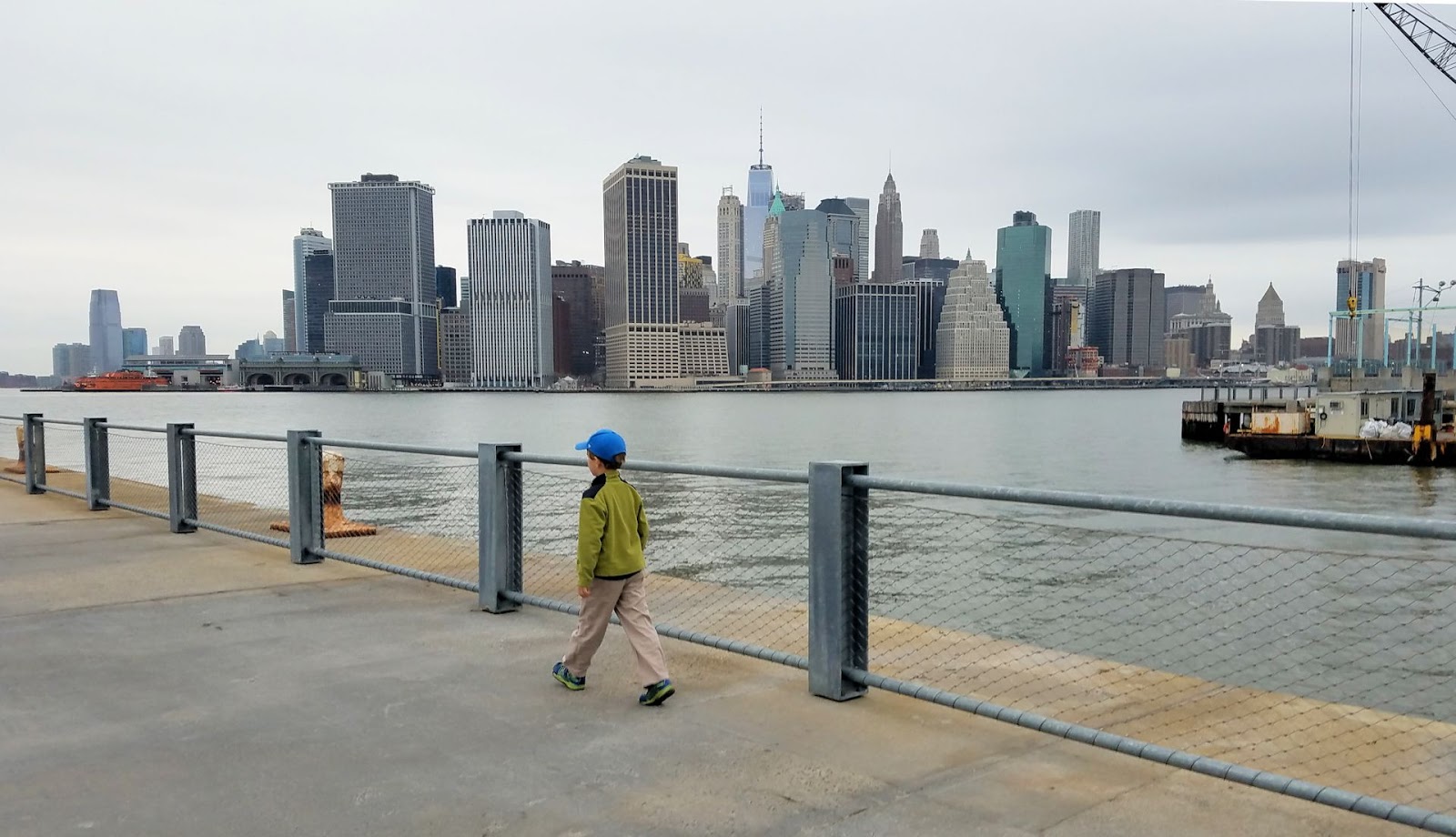
The view of the Manhattan skyline and all the ship traffic was breathtaking. The boys caught a glimpse of the Staten Island ferry, and behind Governors Island we could see the Statue of Liberty, torch raised high. Even after snapping dozens of photos we still lingered, the scenery not allowing us to leave.


The chill that accompanied the sunset finally urged us on. All the playing and the boys had worked up an appetite, and so we headed over to Brooklyn Farmacy & Soda Fountain, my favorite dining experience of the whole trip. The old-school soda shop has a full menu, but the sundaes, shakes and ice cream can’t be beat. The waffle was the size of the entire plate, buried under ice cream, whip cream, caramel and who-knows-what other toppings. This might just be the friendliest spot in Brooklyn to boot, with treats handed out to the boys for being on their best behavior on the way out the door. Brooklyn Farmacy is worth a trip, and whether you sit at the counter or one of the old-fashioned booths, you’ll love the experience.


The vacation in NYC had come to an end, and only a long car ride stood between us and a return to daily life. We’re so lucky to have family in the city, to show us the best spots and to put us up. What an incredible spring break, and how nice to spend it with the fam! Paldies A² for a memorable trip – your turn, see you in Greenville!

Monday, May 15, 2017

Central Park - from Hallett to Belvedere

I could spend an entire NYC vacation in Central Park and it wouldn’t get old. Every time we visit, I get a new perspective of the 842-acre refuge: sometimes seasonal, other times depending on the area we visit or the company we bring. We returned to southern border of Central Park on this particular visit, but skipped the crowded paths for a visit to the newly-opened Hallett Nature Sanctuary – read about it here.

View from 5th Ave Subway Station stairs

From the Sanctuary we headed north past the Dairy Visitor Center and Gift Shop, one of the Central Park Conservancy's five visitor centers. Park architect and designer Calvert Vaux originally created this Victorian cottage as a retreat for children and their parents, the Dairy becoming a source of fresh milk and snacks in the 19th century. By the 1950s the neglected building was an eyesore, and the Parks Department tore down the loggia and turned it into a maintenance shed. In 1979 the building was restored and became the Park's first visitor center, and in 1980 the loggia was recreated from historic photographs.


After crossing Center Drive we found ourselves on the Central Park Mall. The Mall, a quadruple row of American elms, is one of the largest and last remaining stands of American elms in North America. The majestic trees form a cathedral above the Park’s widest pedestrian path, the only straight line within Central Park. At the south end of the mall lies the Literary Walk, with statues of well-known figures such as William Shakespeare, Sir Walter Scott and Robert Burns. At the north end of the mall is Bethesda Terrace (see my post Central Park, Mussels and More). The stretch provides some of the best people watching in the entire park. In addition to the visitors out for a stroll, you’ll find vendors and entertainers of all sorts; we stopped to watch a student from Japan advertising haircuts with a sign indicating that his goal is to cut hair in 100 countries. He quickly found a taker and soon had a line of customers, not to mention the crowd that established to watch him work.


Once we reached Bethesda Terrace it was just a matter of finding a seat at the fountain for more people watching. The fountain sculpture was the first major public commission for a major work of art in NYC to go to a woman, Emma Stebbins. A bronze, winged angel carries a lily in one hand, and with the other hand blesses the water below which flows from an upper basin to the pool surrounding the four cherubs, Temperance, Purity, Health, and Peace. Also called the Angel of the Waters, the statue refers to the Gospel of John, where there is a description of an angel blessing the Pool of Bethesda, giving it healing powers.


The arcade in the lower passage features Minton tile ceiling, the only known example of Minton encaustic ceramic tiles used in a suspended ceiling. The majority of the nearly 16,000 tiles had been in storage for more than 20 years before the 2007 unveiling of a $7 million restoration by the Central Park Conservancy.


Adjacent to Bethesda Terrace is Cherry Hill fountain, a Victorian-era stone water fountain. It was the perfect time to visit as the cherry trees were in full bloom, and among all the visitors taking photos was a couple taking their wedding photographs. From this vantage point there is also a great view of The Lake and Bow Bridge, the 60ft cast iron bridge with a walkway constructed of ipe, a South American hardwood that turns a deep red when wet.


We ended up doubling back to The Mall for a short spell, and the boys found a performance artist with a tub full of soapy water and enormous bubble wands. If you ask them, it was probably a highlight of our visit.


Passing through Bethesda Terrace once more, Lauris spotted a man writing personalized poems and got his very own literary souvenir of the day in Central Park. Not a bad way to spend a day – sitting on the terrace and writing poems for tips...


Past the Boathouse is the border of the formal gardens with The Ramble, 38 acres of winding pathways through what was described by creator Frederick Law Olmsted as a "wild garden." Famous for urban bird watching opportunities (approximately 230 species have been documented), visitors can find a secluded spot for a picnic, listen to the gurgle of the man-made stream, or just enjoy a stroll through the woods. Or, if you're like us, take a break in  a grassy area to test dozens of paper airplanes...


North of 79th Street is Belvedere Castle overlooking Turtle Pond. Named for the Italian meaning "beautiful view," the panoramic views of the Delacorte Theater, the Great Lawn, Turtle Pond and the Ramble are exceptional.


The 1869 castle was originally designed to be a Victorian Folly, a structure without a real purpose. However, in 1919 the National Weather Service began taking measurements from the tower, and the castle is still used for this purpose today. Rainfall, wind speed & wind direction are recorded and sent to the weather service's forecast office at Brookhaven National Library on Long Island.


From Belvedere we headed west through the 4-acre Shakespeare Garden, where spectacular blooms and landscaping are accompanied by plaques featuring quotes from the garden’s namesake. The garden features plants mentioned in Shakespeare’s poems and plays (such as columbine, primrose, wormwood, quince, lark’s heel, rue, eglantine, flax and cowslip), and is designed to resemble the Bard’s native English countryside.

Fritillaria imperialis, a charming fence, and snowdrops

We emerged from the park at the Museum of Natural History, and although the boys would have loved to stop at the Diana Ross playground, we still had a subway ride back to Brooklyn ahead of us. Having settled for a snack, we descended to the subway (with its mosaic depicting the nighttime constellations), tired but in wonderment of all that we had seen that day. The next day we would be celebrating Easter, our final day in New York before returning home.


Friday, May 12, 2017

Easter in Brooklyn

 “How will the Easter bunny know we’re in New York?”

“Where will the bunny hide the eggs?”


When Easter morning rolled around, the bunny had done its job; plastic eggs had been hidden all around the apartment, and hunting them all down took a good part of the morning. The rabbit also did some research, as the boys’ Easter baskets had a couple of NYC-themed cars and trucks, New York City chocolates, and LEGO keychains


Next we ‘unwrapped’ our onion skin-dyed eggs, colored the traditional Latvian way. The ones dyed in cabbage also came out beautifully.


While sisters worked at setting the Easter table, the boys all ventured out into Brooklyn to do who-knows-what.


They made it back in time to get dressed up and take some serious photos.


The Lieldienu mielasts. Not a laughing matter.


The eggs were brought out again. I call this the photographer – photographed series.


For dessert out came the paska.


Hearts and stomachs full, we had one final adventure waiting for us in New York City before we would have to head home...

The whole gang

Wednesday, May 10, 2017

Back to Manhattan: 30 Rock to Hallett Nature Sanctuary

We lucked out in that krusttēvs was able to shuffle his schedule around a bit and join us on one of our daily explorations of New York City. Everyone had a yen to return to Manhattan, and so we once again hopped on the subway and soon found ourselves back at Rockefeller Plaza.

The Latvian flag on Rockefeller Plaza
  
30 Rockefeller Plaza is an American Art Deco skyscraper that forms the centerpiece of Rockefeller Center.The building, nicknamed "30 Rock," is famous for housing the NBC television network headquarters as well as the Rainbow Room restaurant on the 65th floor, and the famous photograph Lunch atop a Skyscraper was taken during the construction of the 69th floor. The skinny: At 850 feet tall, the 70-story building is the 14th tallest in NYC and only 400 feet shorter than the Empire State Building. The “Top of the Rock” observation deck has the best panoramic city view of NYC, as it includes the Empire State Building (which cannot be seen from its own observation deck). The timed entry system and larger observation deck also result in shorter wait times than Empire State, so this would have been our choice for a birds-eye view of the Manhattan if it hadn’t been slightly overcast.


Instead we ventured into 30 Rock to admire the Art Deco interior, and eventually wandered into Bill’s Bar & Burger, the bustling burger spot known for disco fries & their shakes for lunch. Fortified with energy, we emerged back onto 6th Ave. and continued north past the legendary Art Deco theater, Radio City Music Hall. In 1978 Radio City Music Hall was saved from demolition and placed on The National Register of Historic Places.


Robert Indiana's Love sculpture is an iconic piece of pop art that's instantly recognizable from album covers, film spots, and even postage stamps, and makes for a cool photo-op in Midtown. The skinny: The line for photos often stretches down the block, but don’t wait – just circle around and take your photo on the back-side of the statue, flipping your photo afterwards. The statue is at the corner of 6th Ave and W 55th St, just around the corner from the Museum of Modern Art.


Just a short distance further you’ll emerge to Central Park. (For more on the park in general, see my post Central Park, Mussels and More!This southern end of the 843 acre park has some of the busiest paths in the park and popular destinations such as Central Park Zoo and Heckscher playground. Our explorations at the beginning of the week were cut short when Mikus took a tumble from one of the sections of exposed bedrock, but despite the bump still present on his forehead, he and the other boys immediately continued adventuring where they left off.

The view from the promenade in Hallett Nature Sanctuary

The skinny: If you are looking to get away from the crowds without venturing far into the park, head to the four-acre Hallett Nature Sanctuary in the southeast corner of the park. Partially bordered by the pond, the area was closed to the public and preserved as a bird sanctuary from 1934-2017. It is one of the Park’s three woodlands (along with the Ramble and North Woods), and in 1986 was named in memory of George Hervey Hallett Jr. who was a birdwatcher, naturalist and civic leader.


In 2001 the Central Park Conservancy commenced with the restoration and maintenance of the area, as over the years the ‘wild’ habitat had become choked with invasive plant species. By 2013 the Conservancy was giving private tours, and as of April this secret section of Central Park is once more open to the public. The result of the removal of all the invasive, non-native vines and shrubs, and the re-introduction of native plants, is that the sanctuary today carries an incredible diversity of plants. While the boys liked the views from the high points overlooking the park and the pond, I enjoyed spotting the spring wildflowers blooming on the forest floor. Please check the website for hours before visiting, and be aware that there is a limit on the number of visitors allowed in the Sanctuary at once. Keeping on the trails is enforced.

A cardinal, celandine poppies and purple trillium


While there was plenty blooming in the Sanctuary, the flowers weren’t confined to these 4 acres. Spring flowers and shrubs were blossoming along the paths, in formal gardens and in planted borders. What turned out to be a sunny, blue-sky day together with the light greens of spring buds made for an essentially Central Park kind of day, and as we headed deeper north into the Park I was thankful we still had plenty of time left to explore…


Monday, May 8, 2017

NYC and Jamaica Bay

The next day in Brooklyn arrived cool and overcast, and instead of hopping on the subway to go east into Manhattan, we elected to go west, to Jamaica Bay. After our two days in Manhattan and trip on the Staten Island Ferry, these would be the third and fourth boroughs explored on our trip, as Jamaica bay is split in half between Brooklyn and Queens. Our destination was Gateway National Recreation Area, a 26,000 acre national park that includes the Sandy Hook Unit in New Jersey, the Staten Island Unit (Great Kills Park, Miller Field and Fort Wadsworth), and the Jamaica Bay Unit. My advice is to concentrate on one of the three units in a day, as even travel from one end of Jamaica Bay to the other can take an hour.


Our first stop was Floyd Bennett Field, New York City’s first municipal airport used by famous aviators in their quest to break records in the early days of aviation. At one point Floyd Bennett was one of the country’s most important naval air stations. We stopped by the visitor center for maps, junior ranger workbooks and itinerary suggestions, and checked out the exhibits before continuing on. Activities at Floyd Bennett field include biking, birding, camping, hiking, fishing, kayaking and picnicking, and it is an interesting stop for those interested in aircraft restoration and military history.


Continuing south on Flatbush Avenue will take you to across a toll bridge to Jacob Riis Park, Fort Tilden and Breezy Point. Jacob Riis Park was created in the early 1900s as a seaside recreation area, and today features basketball, biking, golf, volleyball and swimming during the summer months. Fort Tilden leans more heavily on the historic, as it had the important role of protecting the NY Harbor in the time period from WWI through the Vietnam War. With rain in the forecast we chose to skip this end of Gateway, instead returning to the Belt Parkway, and circling the bay to Jamaica Bay Wildlife Refuge, the only National Wildlife Refuge managed by the National Park Service (and not the Fish & Wildlife Service).


On our way to the Refuge we passed Canarsie Pier, reputed to have some of the best fishing on the bay, and then turned south on Cross Bay Boulevard. After cutting through Howard Beach and passing Frank Charles Memorial Park, the bridge crosses onto Broad Channel Island, and the Jamaica Bay Wildlife Refuge occupies the northern half of the island.


One of the largest bird sanctuaries in the northeastern US, over 330 species of birds pass through the area in migration along the Atlantic Flyway. Bats, butterflies and fish also stream through the Refuge in their migration up and down the coast, and in the fall, thousands of hawks migrate south along the dunes. In spring, horseshoe crabs return to the park’s shallow bays, and several pairs of osprey nest in what is for them a fertile hunting ground. The unique ecosystem includes grasslands, wetlands and dunes, and hosts a myriad of plants that vary from holly and oak, to wildflowers, to prickly pear cactus. While there are multiple trails that cover the area, it is prudent to start your visit at the Visitor Center where you will learn which trails are currently open and seasonally most interesting. (See trail map here)


As it was lunchtime upon our arrival we settled in at one of the picnic tables near the parking lot to fuel up before venturing out on the trail. The boys were delighted by a visit from a park ranger with a diamondback terrapin (Malaclemys terrapin), a turtle species native to coastal tidal marshes in the eastern and southern US. The terrapin had managed to gain entrance to the refuge office, and was being relocated back to the marsh. The diamondback’s population in Jamaica Bay has declined by more than half in the last decade, and as the terrapin plays a crucial role in the ecosystem’s health and resiliency, research is underway to determine the root cause of this decline – which up until now is a mystery.

photo credit: Anna

no terrapins harmed in the making of this photo (photo credit: Anna)

Just as we were finishing up our lunch it began to rain, and even with our rain gear on we decided to spend some time in the Visitor Center to see if it would let up before starting a hike. The timing couldn’t have worked out any better, and just as we had finished viewing the educational exhibits and movie (and stamping our Park Passports) it stopped raining and we could head out on the trails.


In 2012 Hurricane Sandy breached the south shore of West Bay, introducing saltwater to what was a freshwater marsh, and destroying a portion of the West Pond Trail. While it currently is not possible to walk the entire way around West Bay (as the trail is closed past North Garden and Black Bank), the short walk to view the osprey platform was perfect to get a feel for the dune and marsh ecosystems. We admired the osprey, explored the South Garden, and returned to the Visitor Center with completed Junior Ranger booklets.


As the boys were still craving access to the water, we made one last stop in the Refuge, just short of Joseph P. Addabbo Bridge. The fishing area on the north end of the island has a gazebo and two parking lots, and seemed a rather popular spot with the locals. It wasn’t until we had ventured out across the sand to the water a short ways that we noticed all the strange items that had washed up on shore, and realized that it might not just be the fishing and birdwatching bringing New Yorkers to this point. Religious icons, small bowls and other offerings littered the sand, providing a treasure hunt for the boys but giving us an uneasy feeling about what truly goes on in this seemingly remote location. Across the bay are what were formerly the Pennsylvania Avenue and Fountain Avenue landfills – today an example of restoration creating a multitude of recreation opportunities for the local community. However it seems that the dumping has just shifted to this side of the bay, and after letting the boys have some fun in the surf we scrubbed their hands, changed their clothes, and herded them to the car for the return trip home… for a bath!


Our visit just scratched the surface of Gateway NRA, the Staten Island and Sandy Hook Units left unexplored. However, with its proximity to the city and unique dune and marsh habitats, the Jamaica Bay unit made for a great day trip. The trip was a breath of fresh air – just a short distance from the popular Brighton and Manhattan Beach areas, as well as Coney Island.  Our boys had a chance to splash around a bit, while we also got our fix of nature and saw what the area might have looked like 500 years ago before the Dutch first lay claim to the land. We returned to the Belt Parkway and spent some time fighting traffic back towards Upper Bay, but the memories from our day in the Gateway of America have stayed with us even after our visits to far more famous spots in New York City…


Related Posts Plugin for WordPress, Blogger...