Showing posts with label Estonia. Show all posts

Friday, December 20, 2019

Baltic Christmas Day 20 - Christmas Eve in Wentorf DP Camp

Today, on Day 20 of 24 Days of a Baltic Christmas, I am delighted in to introduce artist Krista Svalbonas, her husband Lars Alverson, and Dzintra Alverson! I recently met Krista and Lars while Krista’s most recent project, “Displacement” was featured at Spartanburg Art Museum in the exhibit up[route]d, and was fascinated by the work she is doing documenting the displaced-person camps that the Baltic peoples called home for years post-WWII. Please make sure to read on towards the end – Krista and Lars are still seeking DP’s from many of the camps to interview…


“Born in Latvia and Lithuania, my parents spent five years after the end of World War II in displaced-person camps in Germany before they were allowed to emigrate to the United States. In the series “Displacement,” I set out to retrace and re-imagine that history. My parents’ childhood homes were structures appropriated from other civilian and military uses to house thousands of postwar refugees. They had always described this housing as temporary; I never expected to see these buildings myself. But after intensive archival research, I was able to locate, visit, and photograph many of the actual buildings on the sites of former DP camps in Germany. I have documented 47 former Baltic DP camps in Germany and am currently traveling the US and Canada, interviewing former DP’s from these camps.” (Krista)

“Here is my mother’s little story about Christmas in the Wentorf DP camp. The still life below reflect the central objects of her story; the gnome pictured is the original that is described in this story.” (Lars)


(English version follows below)

Ziemas Svetku Vakars Wentorfas Nometne, Dzintra Alverson

      “Šo jauko notikumu esmu bieži stāstijusi un aprakstījusi skolas domrakstu uzdevumos un vēlāk, saviem berniem.  Bija Ziemsvētku Vakars Wentorfas DP nometnē.  Mūsu ceļojāmā koka kaste un brūnais grumbuļainais koferītis no Latvijas bija sapakoti pilni.  Viss mūsu istabā bija sapakots un nokrāmēts, lai agri no rīta mēs varētu doties ceļā uz Gronas nometni, no kuras mēs kāptu kugī, ceļā uz Brazīliju.  Mammiņa bija pat nokristījusies par Baptisti, lai mēs dabūtu sponsorus Baptistu kolonijā. Te pēkšņi pienāca ziņa no nometnes valdības ka viss otrais stāvs ir slēgts ar karantīni, jo vienam zēnam esot masalas.  Nekāda iešana vai braukšana visiem otrā stāva iedzīvotājiem uz divām nedēļām. Tā visa cerība braukt rīt prom zuda. Kuģis uz Brazīliju rīt aizbrauks bez mums.

      Mēs palikām istabā, bez Ziemsvētkiem, dāvanām, svētku priekiem.  Uz tukšā galdiņa stāvēja  stikla pudelīte, kurā Mammiņa bija ielikusi egļu zariņu, lai mums būtu kaut kāda Ziemsvētku sajūta. Zariņā dega viena svecīte.  Mēs sēdējām ap galdu un dziedājām Ziemsvētku dziesmiņas savā ģimenes korītī.  Brālis Vilnis dziedāja basu, māsa Ilga ar Mammiņu otro balsi un mēs abas ar māsu Aiju, pirmo balsi. 

      Te pēkšņi pie loga dzirdam kādu balsi.  Mammiņa piegāja pie loga.  Lejā stāvēja svēša dāma un angļu valodā lūdza lai Mammiņa nolaiž lejā groziņu ar kaut kādu virvi. Tā kā mēs  bijām nupat pakojušies, Mammiņai bija groziņš un virve pie rokas.  Viņa nolaida virvi.  Kad viņa uzrāva groziņu augšā, mums visiem palika mutes vaļā.  Tur bija četri lieli apelsīni, un maza kastīte, kurā bija mazs, trīs collu metāla rūķītis kurš, kad viņu uzgriež ar metāla atslēdziņu aizmugurē, griežās apkārt un tur savās rokās vēl mazāku rūķīti . Izrādijās ka viena angļu dāma no UNRAs bija dzirdējusi ka otrā stāvā esot ģimene ar četriem bērniem, kuri sēž karantīnē, bez Ziemassvētkiem, jo viņiem bijis paredzēts rīt braukt prom. Kas viņa bija par Ziemsvētku enģelīti tai vakarā! Kas tas bija par prieku un pārdzīvojumu mums visiem!!

      Mēs lēnām un ar lielu baudu lobījām katrs savu apelsīnu vaļā, kur beigās viņa izskatījās kā udensrozīte. Šo lobīšanas veidu mums tikko bija iemācijis viens ļoti jauks un laipns kungs no nometnes, jo apelsīni mums bēgļiem bija nesen atklāts jaunums. Viņš bija bijis muzikas skolotājs Latvijā, un bieži arī nāca pamācīt mums dziesmiņas. Man liekās ka viņu sauca Janis Lubinš. Ar viņu arī iemācījāmies dziedāt uz balsīm ”Tec saulīte tecēdama”, “Saulīt vēlu vakarā” un “Trīcēj kalni skanēj meži”.  Lietojot viņa iemācīto apelsīna lobīšanas veidu, sēdējām ap galdu, lēni ēdām dārgo apelsīnu, pa gabaliņam vien, un katrs gaidījām savu reizi uzvilkt mazo rūķīti, lai viņš mūs iepriecina ar savu griešanos. Pēc tam manā dzīvē ir bijuši daudz Ziemas svētki, bet nevieni nekad vairs neatstāja tik lielu iekšēju iespaidu un prieku kā šie.”


Christmas Eve in Wentorf DP Camp, Dzintra Alverson

            “I have often narrated and described the following event in school assignments and later to my children. It was Christmas Eve at Wentorf DP Camp. The steamer trunk and the little brown suitcase we traveled with from Latvia were packed full with our belongings. Everything in our room was packed away so we could head out to Grohn Camp early in the morning, from where we would board a ship to Brazil. Mommy had even allowed to be baptized in order to get sponsors in the Baptist colony there. Suddenly a message came from the camp government that the entire second floor was quarantined because a boy had contacted measles. There was no travel for all upstairs residents for the next two weeks. All hope for leaving in the morning was gone. The ship would embark for Brazil without us. 

            We stayed in the room, without Christmas, presents, or any celebration. There was a glass bottle on the empty table where Mommy had placed a sprig of a evergreen tree to give us some Christmas feeling. A single candle burned on one of its twigs. We sat around the table, singing Christmas carols in our family choir. Brother Vilnis sang bass, sister Ilga with Mommy sang alto, and my sister Aija and I sang soprano.

            Suddenly we heard someone calling at the window. Mommy walked to the window. Down below stood a unfamiliar woman, who, speaking in English, asked us to lower a basket with some rope. Having just completed our packing, Mommy had a basket and a rope accessible. She lowered the rope. When she pulled up the basket, our mouths were agape in astonishment. There were four large oranges, and a small box containing a small, three-inch metal gnome who, when wound-up with a metal key in the back, marched in a circle as he held an even smaller gnome in his hands. It turned out that the English lady was from UNRA and had heard that there was a family on the second floor with four children, in quarantine, without Christmas, and stranded as they were supposed to leave the next morning. What a Christmas angel she was that evening! What a joy and experience for all of us !! 

            Slowly and with great pleasure, we meticulously peeled the orange rinds back like flower petals, making it look just like a waterlily. This skill had been taught to us very recently by a very nice and kind gentleman in the camp, for the delicacy of oranges was a recent discovery for us refugees. He was a music teacher in Latvia and often came to teach us songs. I believe his name was Janis Lubin. With him, we also learned to sing in harmony songs like "Tec saulīte tecēdama", "Saulīt vēlu vakarā" and "Trīcēj kalni skanēj meži". We sat around the table, slowly eating the precious oranges, piece by piece, and each of us waited for his turn to play with the little gnome, watching as he would delight us with his animated march. Since then, there have been many Christmas holidays in my life, but none have ever left such an inner impression and joy as this.”


Krista is still seeking Estonians, Latvians and Lithuanians from the following DP camps, with the hopes of interviewing and photographing them: Altenstadt, Braunschweig, Dillingen, Braunschweig, Detmold, Emden, Erlangen, Eutin, Ingolstadt, Insula, Itzehhoe, Kleinkotz, Lauingen, Lubeck Riga, Lubeck Waldersee, Memmingen, and Paderborn. Krista invites anyone interested in this project to please contact her!
Krista Svalbonas, Newtown Square, PA, USA
krista51@me.com

You can also find Krista on Facebook, Instagram and Twitter. For a limited time you can purchase a painting by Krista, with all proceeds going to funding her refugee/DP project; she has interviewees scheduled next year in Seattle, Portland, LA, Grand Rapids, Chicago, Cleveland, Minneapolis, Winnipeg (Canada) and Toronto (Canada)… Click here to go to the store!

Mīļš paldies Krista and Lari, for sharing your project and your family Christmas story! If you have the opportunity to see Krista’s art in person, do it – she currently has work on exhibit at The Art & Design Gallery at FIT in NYC as part of “Picturing Space: artists imagine architecture." Coming next year, a "Displacement" solo exhibition at Latvijas Fotogrāfijas Muzejs in Rīga, followed by a European tour of Kaunas, Vilnius and Germany!


Thursday, December 19, 2019

Baltic Christmas Day 19 - Want to cut down a Christmas tree in Estonia?

Today on 24 Days of a Baltic Christmas we welcome Adam Rang, of  Estonian Saunas, for a look at cutting down a Christmas tree in Estonia...


Want to cut down a Christmas tree in Estonia? There’s an app for that
We only take trees that need to be removed anyway.

We’ve just chosen our Christmas tree for our home here in Estonia.

In most parts of the world, choosing a Christmas tree just means popping down to the local shops for either a plastic tree or one that’s already been chopped down by someone else.

Here in Estonia though, we have a better (and very Estonian) option.


In addition to good saunas, there are two things Estonians particularly like: nature and digital services. And quite often, they all work together here.

Estonia’s state forest management centre, known as RMK, has a really cool mobile app to help you explore the Estonian wilderness throughout the year. It works in Estonian, English and Russian.

At Christmas time though, the app has an additional purpose. You can use it to find a Christmas tree in a state forest that you can cut down for yourself.

It includes a map of where to find them, all the advice you need, and how to pay for your one-time tree cutting license.

RMK began inviting Estonians to cut down their own Christmas trees from state forests in 2008. Their main objective is to simply maintain the tradition and encourage Estonians to spend more time in the wilderness. Several state institutions and companies choose this option over shop-bought alternatives and sometimes even see it as a team building exercise.


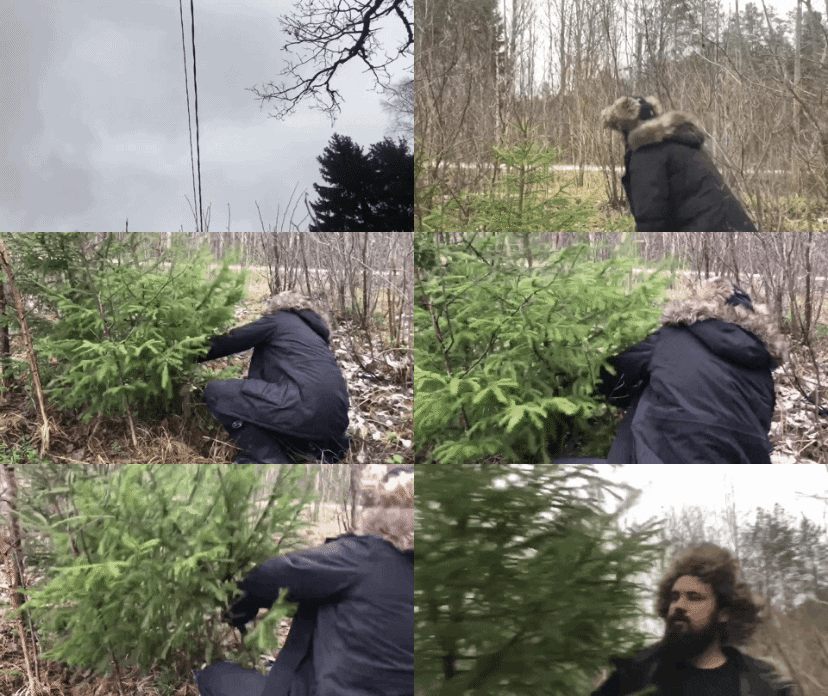
There are a few sensible rules to protect our wilderness though, which are all explained in the app. Most importantly, you must choose a tree that wouldn’t be able to grow to full height anyway, such as one underneath power cables.

According to Estonia’s Forest Act, you are also allowed to take ornamental branches, such as for a Christmas tree wreath, as long as you do not harm the rest of the tree. Taking just the top off a tree, for example, is prohibited.


The state forests where you can cut down trees are marked in dark green, while private forests (where you can only cut down trees with the permission of the land owner) are marked in light green, and nature reserves (where taking trees is strictly prohibited) are marked in brown. Most helpfully, power lines are marked as blue lines. Your own location is shown on the map too so it’s easy to navigate.

We found our tree near Saku, underneath those power cables marked above. After asking the tree if it would like to come home with us, we cut it down and took it back to Tallinn to be decorated.


I confess that I made one mistake. You must pay for your Christmas tree before cutting it down, not afterwards like I did.

The app lists prices for trees up to 5 metres, which you can pay straight from your phone bill by calling a number listed in the app.


You can pay for trees above 5 metres too, although only by bank transfer. In case you are interested, a tree larger than 20 metres will cost you €640. Our tree was a modest 1.5 metres tall so it cost us €8.

Although this payment is difficult to police, it’s possible that authorities may stop you when carrying a tree and ask to see your proof of payment. And you can’t get away with saying you couldn’t connect to make the payment because even the forests of Estonia tend to have good connectivity.

RMK began inviting Estonians to cut down their own Christmas trees from state forests in 2008. Their main objective is to simply maintain the tradition and encourage Estonians to spend more time in the wilderness. Several state institutions and companies choose this option over shop-bought alternatives and sometimes even see it as a team building exercise.

You can watch the full video we made about this whole process below here (and don’t forget to subscribe to our Estonian Saunas YouTube channel if you enjoyed it).


…But where’s the sauna?
We usually just write about Estonian saunas on this blog, but there are actually a few similarities between Christmas trees and saunas.

Both traditions are enjoyed around the world, yet rooted in the prehistoric culture of peoples living around the Baltic sea. Believe it or not, the Christmas tree can also be traced back to Estonia.

About 500 years ago, Tallinn joined the Hanseatic League and a lot of German merchants settled here. They saw local Pagans ceremoniously burning a tree during their winter festival and decided to adapt the tradition for themselves. The House of Blackheads in Tallinn erected their own tree in 1441 and then did the same in Riga in 1510.


Admittedly, this story is a little murky. The prehistoric tradition isn’t well recorded and it’s unclear how this adapted version of the tradition evolved into the decorated trees we use at Christmas today.

Estonians and Latvians still both argue each Christmas season that theirs was the first Christmas tree. The Latvians even put up a plaque and a monument to their first Christmas tree, which they insist (incorrectly) was in Latvia. We might be a little biased of course.

The sauna tradition also comes from prerecorded history and has been adapted a lot over the years. For one thing, there’s an app for that too! We can control our modern Estonian saunas by using a HUUM app to switch them on remotely. That’s what we did after choosing our tree so that it was heated for us by the time we got home from the forest.


(This article was first published on medium.com/estoniansaunas, on December 15, 2019)

Thank you Adam, for your comprehensive guide to the Estonian Christmas tree app! I’ve actually utilized the Latvian version of this program; we cut down our own tree from a Latvian National Forest ten years ago while visiting my brother-in-law in Rīga during the holidays.

Adam runs the blog Estonian Saunas together with Anni. Their global online store will be launching soon, but in the meantime take a look at EstonianSaunas.co.uk if you are in the UK, and if you’re visiting Estonia stop in to see the two saunas that are open to visitors: the Tallinn smoke sauna and the Tallinn Airbnb apartment with an e-sauna. Estonian Saunas is also a sponsor of the European Sauna Marathon, which will be February 15, 2020! In addition to the blog, you can follow Adam and Anni’s adventures exploring and exporting Estonian saunas on Instagram, Facebook, YouTube and Twitter. You can also join the Facebook group for fans of Estonian saunas.

With less than a week to go until Christmas, we here at 24 Days of a Baltic Christmas want to wish you patience and endurance to finish your last holiday preparations! As my brother (maybe?) says, “the storm before the calm!” We hope you’ll join us tomorrow on Day 20, for a Christmas story from the DP camps...


Thursday, December 20, 2018

Baltic Christmas Day 20 - Tāle's Sunshine Coast Black Balsam

This week on 24 Days of a Baltic Christmas we read about a black currant liqueur and Lithuanian krupnikas, but the series would be neglectful in not mentioning the Latvian drink, melnais balzāms. Joining us today is Tāle, to tell us more about this drink that has become well known even outside of Latvia…


As an Australian Latvian-Estonian (1st/2nd generation), I have always been involved in the Australian Baltic Community. My family & parents (Dad is Estonian & Mum Latvian) were heavily involved in the Brisbane Baltic Community as I was growing up. As it is with little ones, we always went with them and as such you cannot help but soak up the culture and traditions. By choice I started playing the kokle at 11 (1988) in the Brisbane group ‘Zigrīda,’ and started folk dancing the same year with ‘Senatne’. My oldest & bestest friends are Baltic, as that is who I grew up with. My first trip back to the Baltic States to visit family was in 1993, just after they gained their independence. Our family was fortunate enough to celebrate a true Jāņi with our Latvian family - an experience I will never forget!

My Vecmāmiņa & Vanaema were both wonderful cooks and taught my Mum, Dad, sisters and I how to cook all the traditional Latvian & Estonian dishes. These were usually at or before big family event days to make for celebrations. Although they both rarely wrote down their recipes, I am forever thankful we ‘pestered’ them to verbally tell us what they used and then wrote them down - as they truly are a family legacy to be passed down to future generations. Nowadays my Mum, sisters and I each have our ‘specialities’ and that in itself lends to expertise. These recipes from my Vecmāmiņa and Vanaema were the start of my own Baltic Recipe Book I use to this day.


As we got older, as you do in life, we all drifted into new adventures, had our own families and being close to our Latvian/Estonian Community hall was just not as feasible anymore. But I have missed the Latvian/Estonian community and have sought out ways to keep my sense of ‘Baltic Spirit’. Throughout the years I have tried to keep all the Latvian/Estonian traditions alive by teaching my children how to cook the traditional dishes, kept up my kokle playing, I have added to my own cooking skills and have also branched out into making modern Baltic pottery - Oak & Sea Ceramics. My Mum & I have taught my children about the annual celebration days and also some of the history (including the old gods). It is important to teach heritage and traditions to the next generation. I very much hope my kids will pass what they remember on to their children.

Over the years I have added to my Baltic Recipe Book with my own recipes. My version of the Riga Black Balsam (Latvian: Rīgas Melnais balzāms) started about 5 years ago from an obvious shortage of the drink in my household - and no one we knew going over to Latvia any time soon to bring some back! I spent some time researching on the internet, found some articles, and came up with credible and accessible ingredient list. So, I started with that.

The original Riga Black Balsam recipe was made by a pharmacist in the 18th century, and was most famously used for Queen Catherine the Great upon a visit to Riga, Latvia where she became ill. The original recipe was lost in WW2. After the war the recipe was carefully restored by a joint effort of former employees, and since then the recipe has remained unchanged. The recipe in itself is incredibly full of healing ingredients for colds and flu.


After many annual batches, I have fine-tuned my recipe so it tastes almost as good as the real thing – the last batch sold out at the recent Brisbane Latvian Christmas Markets! So here is my recipe that I would like to share:

Tāle’s Sunshine Coast Black Balsam


1. Fill a glass jar to 2/3 full with a combination of dry and fresh ingredients from this list*:
- Elderberries (a must for colour and taste)
- Cloves
- Lavender
- Nutmeg
- Star Anise
- Cinnamon
- Orange & Lemon rind (no pith as it will make it bitter)
- Vanilla Bean
- Rosemary
- Black Peppercorns
- Raspberries
- Cranberries
- Mint
- Ginger
- Lemon Myrtle (Aussie Touch!)
- Valerian
- St. John’s Wort
2. Add a 1/2 + 1/2 combination of 40% proof unflavoured vodka and brandy to completely cover ingredients
3. Leave to macerate for 8-12 weeks, shake daily
4. When ready, strain though a chux (muslin cloth) and sieve
5. If you like, add honey to taste & whisk through
6. Bottle in sterilised jars and keep for 12 months

* As with any recipe, you can tweak it to favour any flavour you would like, for example by adding cherries to make Cherry balzāms etc...

I hope you have enjoyed my article, Merry Christmas to my wider Baltic Community and wishing everyone a Happy & Safe New Year!

Cheers, Tāle Kai Liiv 😊


Thank you Tāle, for joining us on the series with your recipe! We’ve tried making krupnikas and the black currant liqueur, I think the next logical step is balzāms! Now about the lemon myrtle, we’ve got wax myrtle over here in our neck of the woods, why do I think I will have to find a substitute...?

Tāle posts photos and recipes of her Baltic cooking to @tkl1977 on Instagram. Her pottery, Oak & Sea Ceramics, can be found here.


Tomorrow is the shortest day of the year; let's celebrate the return of the sun on this winter solstice! Please join me tomorrow, for Day 21 of 24 Days of a Baltic Christmas!

Friday, December 14, 2018

Baltic Christmas Day 14 - An ode to verivorstid

Day 14 of 24 Days of a Baltic Christmas brings another new contributor, Andres Simonson, with his ‘ode to blood sausage.’ A big thanks to Estonian World for the courtesy of allowing me to feature this article on the series; it was originally published here


Sappho gave us Ode to Aphrodite. Beethoven composed the musical setting for Ode to Joy. John Keats praised a songbird in Ode to a Nightingale. But seemingly nobody has paid poetic homage to those odd little Estonian verivorstid (blood sausages). And frankly, that’s a tragedy.

Traditionally the centerpiece of the Estonian Christmas Eve meal, verivorstid are a mixture of pork, barley, animal blood, and spices. The filling is stuffed in casings and the links are boiled until firm and then roasted to a crispy crimson black. A rather unique treat, they deserve a bookmark in poetic lore. So with all apologies to the masters, let’s recognize these Estonian oddities with an Ode to Verivorstid.

Verivorstid, verivorstid you are so very
Dear to me on each Christmas Eve
Such a treat next to the lingonberry
Without you a Yule I could not conceive

Best washed down with a Saku brew
‘Cause suds so complement your spices
To verivorstid I pledge my love anew
Truly, you are one of my vices

And so I ask, what Christmas fool would eat plain ol’ ham
Instead of barley, cow blood, and marjoram

My verivorstid epiphany, when I realized what those freakish little links were truly about, occurred one early December morning in my childhood. Leaving my toys behind to fetch a drink, innocent and unaware, I wandered into the kitchen. And there they were: my mother, godmother and grandmother had gathered around the table. Three ladies, with blood-coated hands and blood-splattered aprons, mixing some unknown concoction in a small tub. Kitchen utensils, gleaming on one end and dripping gore from another, lay scattered like a surgeon’s tools in an operating room. The witches of wurst carefully added ingredients and stirred their mysterious stock.

My first reaction – there had been a murder. No, an accident. No, definitely a murder. How else to explain all the blood everywhere coupled with the blatant lack of concern. Why wasn’t anyone calling an ambulance?

Stifling a scream, I watched. One lady would stretch a flat hog casing over the small end of a funnel. Another would hold the funnel steady against the slip of a bloody hand. The third accomplice would pack the other end of the funnel with the sausage filling, slowly stuffing the intestinal wrapper. An assembly line most macabre, like some sort of low-budget Henry Ford inspired horror movie.

For many years, I was ruined. No verivorstid on my Christmas Eve plate. I would pass over the serving platter with a suspicious eye. Potatoes, yes. Sliced pork, sure. Pirukad(pies), bring them on. Bovine hemoglobinwurst, no thank you. And so it went – me with a conspicuously empty spot on my plate, and my parents assuredly wondering if their Estonian child had been switched at birth with some southern European.

But years later, after much soul searching and a convenient mental block of that dreadful December day in my childhood kitchen, I came around. It probably started with a nibble. Maybe a small forkful followed by a long drink from my glass, later progressing to timid helpings. Enthusiastic mouthfuls and requests for seconds followed later still.

Verivorstid with sauerkraut and lingonberry jam

Today, I look forward to verivorstid. I typically get at least two helpings, one at our local Estonian clubhouse Christmas party and another on a cold and dark Christmas Eve. I feel a connection to the old country when the oven opens and the sausages appear, bursting and charred, under a layer of crispy bacon. In an instant I can imagine peasants of yore, culinarily efficient and creative, not wanting to waste any part of the animal. I am transported back in time, to a farmhouse in Elva, and I embrace the scene, grab my fork, and acknowledge both my appetite and my ancestry.

It’s always fun to explain this tradition to my friends with roots in other parts of the world. They typically ask a few questions about taste and texture. Some ask about the source of the blood. Others ask for more information about the sausages’ history. None ever ask to be invited over for a sample.

And then there are my vegetarian and vegan friends. When exchanging stories of Christmas traditions the reaction to verivorstid is not quite revulsion, but something pretty close. What’s one to do though? I suppose a vegetarian recipe for blood sausages could be concocted. But as I’m sure true verivorstid enthusiasts would agree, soy sausages infused with a beet juice reduction and served under a layer of tofu bacon just wouldn’t cut it.

So this Christmas Eve, sing the “Ode to Verivorstid” before enjoying a plate full of Estonian blood sausage links. They are as much a part of the holiday as Christmas Eve mass, jolly fat guys in fuzzy red suits and decorated felled trees.

But be forewarned – as the old saying goes, sausages are like laws, you should never watch either being made.

Häid jõule kõigile! (Merry Christmas to all!)


It’s actually a funny coincidence; after receiving permission to publish this piece from Andres and Estonian World, I googled ‘vegetarian blood sausage.’ Wouldn’t you know I came up with what ended up as Day 6 of a Baltic Christmas, VeganSandra and her vegan blood sausage! Andres, if it’s any consolation, no tofu or beet juice reduction to be found… (And thank you, for introducing me to verivorstid!!!)

Andres is first generation American of Estonian descent. An enthusiastic estophile, he is an environmental consultant holding a bachelor's degree in environmental science and a master's in city and regional planning, concentrating in environmental planning. He resides in east Long Branch, NJ, with his loving wife and three darling daughters.Thank you to Andres for this witty article! 


Also, thank you to Estonian World for granting permission to reprint this article, which was originally published on December 23, 2013 on Estonian World. Please visit Estonian World on facebook and on Twitter. Photos courtesy of Visit Estonia and Wikimedia Commons.

Tomorrow on Day 15 of 24 Days of a Baltic Christmas: a light-filled craft...

Tuesday, December 11, 2018

Baltic Christmas Day 11 - [what I ate] Yule edition

Please welcome first-time contributor to the series, Annika, of the blog Tulen Loobin Su Katusele Kive! Annika has been documenting what she eats on her blog since 2009, providing a fascinating glimpse into the world of Estonian food in easy-to-digest morsels. Today on Day 11 of 24 Days of a Baltic Christmas, Annika is taking us on a photographic journey through time and cuisine…


9 Years of Yule Dinners


Most Estonians are not religious, in fact, we are often labelled to be the “least religious” country in the world. However, Christmas, or more appropriately Yule (in Estonian – Jõulud) is still a big holiday for us. It’s a time when families come together to share food, and Jõuluvana (Old Man of the Yule in direct translation) brings all the well-behaved children some nice presents. It is true that some families still go to church during this time to celebrate the more religious aspect of the holiday, but my family belongs with the non-religious celebrators.

I have been photographing and documenting the food I have eaten for the past 9 years and that includes my family’s Yule feasts. So, I invite you, dear reader, to go down on a trip to memory lane and rediscover 9 years’ worth of traditional and not so traditional Yule dinners of my family with me :)

2009 – Traditional meal at grandparents’ house


Boiled potatoes and gravy, blood sausage, marinated pumpkin, sauerkraut, roasted pork… This was quite a traditional dinner at my grandparent’s place. Usually the blood sausage is also accompanied by lingonberry jam, but I have never been a big fan of it.

2010 – Another family Yule at grandparents’ house


Meat pastries, one of my grandmother’s specialties and a staple of the Yule feast table in our family.


Cooked pork and duck, sauerkraut, boiled potatoes, marinated pumpkin. Another quite traditional dinner, with the addition of duck that year.

2011 – Once more at grandparents’ house


Roast duck and pork, blood sausage, sauerkraut, boiled potatoes, mead.


Chocolate ice cream with wild strawberries. Dessert hasn’t usually been a part of our Yule dinners, but that year the ice cream and strawberries were a fantastic treat.

2012 – a Yule lost to time


There are no photos from this year, because I had my camera malfunction and I lost a few weeks’ worth of photographs. Such a shame. Memory is a fickle thing. I don’t even remember where I spent Yule that year… I imagine it was still at my grandparent’s place, but was it? I can’t be sure, and this is sad.

2013 – A Yule feast for two


I spent that year's Yule alone with my boyfriend at our apartment. It was the first time I cooked the entire Yule dinner on my own. I don’t quite remember why I decided to break from tradition and didn’t make any usual Yule dishes. Instead I roasted a chicken, and made a salad and pumpkin soup.


Pumpkin soup with sour cream, salad, roast chicken, marinated pumpkin.


I also made peanut butter cheesecake. Notice the table cloth? It’s a hand-me-down from my mom and is most likely older than I am.

2014 - getting even more non-traditional


Beef wellington, brie cheese, gnocchi in cream cheese-curry sauce, fresh salad, nuts, fruits. This was another Yule dinner I put together for myself and my boyfriend. I suppose work and school again kept us from joining family festivities, but things like that happen.


Pumpkin pie cheesecake brownie. There wasn’t a single element this year that would have been considered traditional on an Estonian Yule table.

2015 – A step even further away from tradition


Just together with my boyfriend again. I made garlic fried rice and spring rolls with shrimp. I am not certain if this could be considered a proper Christmas/Yule dinner anywhere in the world, but this is what we decided to have xD It’s not that I dislike traditional Estonian Yule foods, but for some reason when I have been in charge of putting together the menu, the usual dishes have been the furthest from my mind.

2016 – Yule with the other side of the family


We spent that Yule with my boyfriend’s side of the family and their relatives. It was a big party instead of a simple small family gathering - a new experience for me. Not only were family and relatives gathered, but friends as well which was also new, because for me Yule has always been a very family centric holiday. It was all quite merry, and the food was plentiful.


Blood sausages, pork schnitzels, boiled potatoes with cream sauce, sauerkraut, meat rolls.


Coffee and delicious delicious condensed milk-chocolate cake.


A very funky Jõuluvana made an appearance at the gathering, bringing laughs and many gifts. Here you can see my boyfriend cheating and reading a poem to Jõuluvana off the internet.


We also made gingerbread cookies that day and I helped to decorate most of them.

2017 – To semi-traditional on our own


Last year during Yule we were busy with work again, so I celebrated with my boyfriend. I made garlicy mashed potatoes, blood sausage and salad, and roasted some beef cuts.

So, these have been my Yule celebrations and dinners for the past 9 years; many fond memories and delicious foods. Thank you for joining me on this trip down the memory lane.


And thank you, Annika, for this look at Estonian holiday dinners – traditional and not-so-traditional! I wish I had a record of what was served during the last decade of our Ziemassvētku dinners!!

Annika blogs at Tulen Loobin Su Kausele Kive! I think you’ll enjoy scrolling through her feed; it’s somewhat voyeuristic, but wholly fascinating. In addition to being interested in what the average person in Estonia eats, it’s also fun to see familiar foods (to us Balts) pop up here and there... Please visit her on Instagram at @roadwafflez, and tell us in the comments – which one of her annual Yule meals looks the most like yours?

Tomorrow, on Day 12.... carp!

Related Posts Plugin for WordPress, Blogger...