Wednesday, December 19, 2018

Baltic Christmas Day 19 - Black Currant Liqueur


My earliest summer memories are of my great grandfather’s farm: impatiently waiting for the apples to ripen in the orchard, the dust motes floating in the sunshine filtering through into the loft of the big red barn, the wooden slats on the floor of the shower in the old pumphouse. Although he had moved to the city and the chicken coop was no longer full of hens, my family were still regular guests. I’m sure we also made the trip in winter, though the most vivid memories are of summer.

While we had plenty of adventures exploring the big barn, most of our time was spent outdoors: setting up house under the low-hanging branches of the big pine trees, excursions to the small spring and creek, fishing the bugs out of the enormous (at least it seemed so to pint-sized me) temporary pool which had to be moved every two days so as not to kill the grass. However, it was the garden that most often attracted our attention. My sister and I would hunt for snap peas, dig the compost piles for worms, forge paths in the adjacent corn field, and count the days until the berries would ripen.

My vecpapiņš had planted rows of red and black currants, raspberries, and gooseberries, and years after he had ceased his annual plantings of corn and beans, the bushes still bore fruit - hundreds of berries dripping off the branches. At harvest time the adults would pull stools out to the field, choose a bush, and converse among themselves as they filled giant bowls with ripe berries, their hands stained and their necks tanned from the effort. Children were asked to come help, and we would hurriedly pick for a little while (placing more in our mouths than in our bowls) before disappearing into the tall grasses to weave dandelion crowns, or hunt sticks for the evening’s bonfire; reappearing only when the adults returned with their harvest.

It would be hot in the pumphouse, full of people and large pots simmering on the stove. In one pot were the mason jars, sterilized for the raspberry preserves. A second pot would be filled with the red currants which were boiled then placed in giant presses, the resulting ‘cakes’ of berry skins abandoned under the bushes for us to do with as we pleased. While gooseberries were my favorite to eat (but least favorite to pick due to the thorns), I’m unsure of how those were canned as I only remember eating them straight from the bush, the satisfying pop as they burst in my mouth. Finally, the black currants tasted bitter to a child, so although they were also preserved I mainly remember the smell of their leaves emanating from the jars filled with dill pickles lining the counter.

Fast forward thirty years, to my children exploring my grandmother’s garden. Lily of the Valley & tulips bloom in the spring and a large maple provides a jungle gym for the boys, but on one side are the black currants, descendants of those my great grandfather planted. Every year the berries are harvested, carefully rinsed then placed in special jars, covered in grain alcohol, and left to steep. When deemed ready, my grandmother  separates the alcohol, and places the berry jar in the sun. Over the coming weeks my grandmother ‘feeds’ the berries sugar, gently tilting the bottle to mix, observing the sugar dissolve over time. The berries give up their juice to the resulting syrup, which eventually will be mixed back in with the alcohol resulting in a delicious upeņu liķieris.

On Christmas evening my extended family gathers at my grandmother’s home after the church service, where we feast at a long table and then recite our pantiņi by the Christmas tree. The adults return to the table afterwards (while the children play with their presents and consume far too many piparkūkas), and at some point a bottle of the black currant liqueur is placed on the table. The syrupy drink brings a warmth low in the stomach, serving as a digestif after the meal, but also a portal into summer, those sunny harvest days full of green grass and ripe berries. We sit around the table and smile and laugh with our aunts, uncles and cousins gathered from across North America. As we sip from an īsā glāzīte we’ll nibble on sweets, sing a kaladū song, and then long after midnight bundle up for the trip home.

This summer we visited my grandmother just as the black currants ripened. In return for helping to harvest the berries, we departed with a jar full of black currants. Once home I poured alcohol over them and set them aside, and two months later carefully sniffed the result. That month I fed berries sugar for the first time in my life, fretting over the amount of sun, speed of dissolution, and whether they were ready, calling my grandmother more than once for advice. At one point it seemed time; I mixed the syrup back in with the alcohol and set aside a bottle of dark purple liquid. Two months later my husband and I sampled the result, toasting to the Latvian centennial with a drink that might not be known as traditionally Latvian, but for me is as Latvian as my family tree. As with krupnikas or balzāms, the flavors meld over time and it’s recommended to let sit for a while to mellow, but the essence of black currants is as true as the memories that come with the smallest sip.


It’s almost as if that Ziemassvētku spirit can be bottled, notes of my childhood summer days and more recent snowy winter nights comingling in that bottle of upeņu liķieris. My husband has declared that we must plant black currant bushes so as to be able to continue the tradition of making the liqueur, and although our climate is not conducive, we will give it a try. We tuck away the bottle of liqueur to continue ageing, and discuss what occasion might merit a taste: perhaps a toast to the New Year, or a birthday, or a wedding. But as I imagine the berry bushes growing along the blueberries, raspberries and blackberries in our yard, I dream of hands stained with black currants, of cucumbers pickling in dill and upeņu leaves, and of time spent with family Ziemassvētki past...


Tomorrow is the final post in the libations mini-series during this 24 Days of a Baltic Christmas - I hope you'll join us for Latvian balzāms

Tuesday, December 18, 2018

Baltic Christmas Day 18 - Krupnikas!

I had my first taste of krupnikas in college, where the Baltic Club celebrated our heritage with an annual Christmas get-together, various tailgating events, a broomball team, and monthly get togethers at some of the more dimly lit pubs. My first impression was somewhere between glühwein, Fireball and Melnais balzāms, warming from the inside out with a sweet, kvass-like taste that made our winter potluck an event to look forward to. Our Lithuanian friend Stepas was responsible for the krupnikas, which he diligently made some months (weeks?) previous and proudly presented each year. Over the years I still occasionally remember the Lithuanian drink, usually on a cold evening when autumn is transitioning into winter as I'm sipping hot tea or the occasional īsā glāzīte my husband has poured.


Krupnikas (or krupnik in Poland and Belarus) is a traditional sweet alcoholic drink similar to a liqueur. With a base of grain alcohol, it is sweetened by honey and flavored by up to 50 different herbs. Legend (or Wikipedia!) has it, that the original recipe was created by the Benedictine monks at a monastery in Niaśviž, Poland sometime in the 16th century or before. Possibly a more affordable alternative to imported wine and mead, it soon became popular among the nobility of Poland & Lithuania… and the rest is history.

 As with many traditional recipes, there are hundreds of variations. Each producer has their personal combination of seasonings and herbs used, and the type of honey and grain alcohol utilized also influences the final product. As a result, the recipe now lives on in thousands of different forms, even produced by a handful of distilleries in the United States.

This year was the year that I finally attempted to replicate the sweet honey notes that I remembered from university. After finding a recipe online (really, I chose at random, there are hundreds!), I immediately realized I would go broke buying the needed spices, of which only a tiny fraction would be used and the rest would sit on the kitchen shelves gathering dust until our next move. Instead, the following week was spent crowdsourcing: one friend had whole nutmeg, another whole allspice. I finally found the required cardamom pods at a specialty store, priced somewhere around $55/pound; luckily I only needed ten, together weighing just a fraction of an ounce. I found a vanilla bean in the cupboard, left over from the last cookbook club, and a friend dropped off a leftover piece of turmeric. Soon my counter looked like potions lab, and I was ready to start my own “Dark Corner” – in the kitchen.


First, I boiled down a mixture of honey, water, and wintery spices. After straining the brew, I added a high-proof, flavorless grain spirit to the liquid, and poured into bottles. It is advised to let the krupnikas sit at least a couple of weeks, but I think it’s usually allowed to meld more like 6 months to a year. Over the first few days the cloudiness settled to the bottom, and some weeks later we poured the first taste of the amber liqueur. 

The result tastes much like I remember it tasting years ago, although wisdom gained over the years might influence serving size. All in all, difficulties of sourcing a few of the ingredients aside, this is a relatively easy recipe to make with impressive results. Krupnikas makes a good cold weather drink however you may choose to drink it - straight, sometimes warm, or even mixed  - and shouldn’t be restricted to the Lithuanian winter table. į Sveikatą


Monday, December 17, 2018

Baltic Christmas Day 17 - Cranberry Sparks (or dzērveņu dzirksteles)!

Today, on Day 17, we welcome Kristīna back to the series! Last year she joined 24 Days of a Baltic Christmas with an article about the NY Latvian Concert Choir's annual Christmas concert, and we were so captivated that I convinced her she was needed for the current edition! Kristīna tells the story of a Latvian recipe unveiled; perhaps we should have titled it “A Baltic Christmas and the Mystery of the Sugared Cranberries”?


During one of those nostalgic moments when our parents are reminiscing about their childhood, my mother mentioned that one of her childhood Christmas memories included sugared cranberry candies. Some years later these candies turned up at the annual Latvian Christmas Bazaar. The woman selling them would not share her recipe… Of course- nothing like owning 100% of the market!

Another Christmas season, my husband Mārtiņš decided to dedicate his efforts to unravelling the mystery of sugared cranberry candies. We did have an inside scoop from someone who had done an ingredient analysis at a food lab; results - cranberries, sugar, and gum Arabic. The first two ingredients were available at the local supermarket. Gum Arabic, not so much. Fortunately a local pharmacy was willing and able to order the needed goods from a chemical supplier, and we were endowed with something like a 30 year supply for the necessary 4 teaspoons per batch. Several evenings of a chemist’s worthy experimenting with various cooking times & quantities and diligent note-taking still resulted in mushy, sweet cranberry goop. Enter the classic “Joy of Cooking”, 1975 edition, which revealed gum Arabic in the index. There in the Candies and Confections chapter the recipe for glazed mint leaves also requires gum Arabic or acacia. Voila! It called for making a simple sugar syrup with the gum Arabic, into which the mint leaves are then dipped. The gum Arabic helped the syrup to harden into a crisp sugar shell. Maybe the cranberries didn’t need to be cooked??


The following recipe is the happy result. Martiņš named his recipe Dzērveņu dzirksteles or Cranberry sparks because the taste sensation of biting into the sweet sugar coating to instantly blend with the tart juice of the cranberry is like a beautifully balanced spark of flavor.

The cranberries last longer than you would think, but it does depend on how ripe they are and where you keep them. Cool is better than warm. A closed container is not good- the moisture in the cranberries seeps out and begins dissolving the coating. An open, shallow dish on a table or shelf that is easily accessible for quick tastes works well!

Dzērveņu dzirksteles (cranberry sparks)


Ingredients:

1 cup sugar
½ cup water
4 teaspoons gum Arabic (you can find it on the internet)
12-16 oz. fresh cranberries, picked over
1 lb. powdered sugar


Recipe: 

Melt 1 c. sugar in ½ c. water on low heat until the liquid is clear.


Remove from the heat. Place the gum Arabic in a small bowl or glass and gradually add a teaspoon at a time of the sugar water, thoroughly mixing between each addition. Using a small whisk, if you have one, works very well. Continue adding the sugar water until you have a rather runny, smooth mixture. 


Mix into the rest of the sugar water until smooth and well blended. It will now be a creamy color.


Put the mixture in the refrigerator until chilled. Stir occasionally as the mixture cools. Give it all a good mix with a whisk to smooth any clumps that form during the cooling process.

Add cranberries to sugar syrup and mix until well covered.


Using a shallow, flat bottomed bowl or pie plate, pour in enough powdered sugar to generously cover the bottom of the bowl.

Pick up 10-20 cranberries (letting excess syrup to drip off) and place cranberries in the powdered sugar.


Begin rolling cranberries in sugar by swirling the bowl in a circular motion similar to panning for gold (something I realize probably no one will have done…).


Continue rolling until all cranberries are thoroughly coated.


If any stick together, gently separate them and nudge them to roll. Once the batch is well coated in powdered sugar and it seems the sugar is no longer being absorbed by the syrup, gently remove them to a clean, dry cookie sheet to harden. Repeat with remaining cranberries, adding, refreshing, or even replacing the powdered sugar as it gets too clumpy. Yes, a fair amount of powdered sugar will get discarded. When all cranberries are covered, leave them in a single, loose layer on the cookie sheet overnight to let the sugar shell completely harden. Sprinkle with additional powdered sugar in case more is absorbed.


Priecīgus Ziemsvētkus!


Paldies Kristīna, for this age-old tradition, divulged! Also a shout-out to Mārtiņš for his diligent work in unraveling the mystery of the sugared cranberries – 24 Days of a Baltic Christmas readers thank you! I sure would like access to this food lab ingredient analysis… Think of all the times a home chef said “oh, it’s so easy, here are the ingredients” and upon a pinterest-fail-worthy attempt you decide a key ingredient has definitely been left out!! I’m ordering up some gum Arabic and these are definitely going on my holiday checklist next year; I think these would make a lovely hostess gift, or contribution to a holiday party.

A little about the author:
Kristīna looks forward to the annual ritual of preparing traditional foods for the holidays and family celebrations. She can produce grandma-worthy
pīrāgi and kliņģeris when the need arises. She still finds that singing along with CDs in the car or with friends around the campfire are the best ways to de-stress. You can direct fan mail to 24 Days of a Baltic Christmas ;)


With one week left until Christmas we are busy wrapping up the holiday preparations, so the series will spend the next days covering an aspect of a Baltic Christmas that is a common feature of the Baltic celebration – the libation. Tomorrow we’ll start with the Lithuanian favorite, krupnikas!

Sunday, December 16, 2018

Baltic Christmas Day 16 - The Kūčios vs. Ziemassvētki table!

Latvian tradition dictates nine dishes on Christmas Eve, ensuring fellowship and wealth in the New Year. Traditionally twelve dishes are to be served on Lithuanian Kūčios, symbolizing the twelve months of the year. Not only do both countries count the dishes served, but there is also some overlap of what is found on the Latvian/Lithuanian holiday table…


The Lithuanians often have multiple dishes containing herring, while Latvians will also serve fish dishes to ensure you’ll have money in your wallet in the coming year. One source mentioned that the larger the scales, the larger the wealth, however after reading Margaret’s article “On the pitfalls of buying a carp for Christmas” I believe we might skip the carp this year! Remember that Latvians place dried fish scales in their wallets on New Year’s Eve (to make sure their wallets are full in the New Year), so save those scales after cleaning the fish... 

It isn’t Kūčios without the traditional Christmas Eve Cookies (Kūčiukai) and poppy seed milk for Lithuanians, while Latvians insist that piparkūkas be served, guaranteeing much love in the coming year. We featured June’s kūčiukai on the series here, while Victoria discussed poppy seed milk in her post High on Christmas. The 24 Days of a Baltic Christmas piparkūkas post can be found here: Piparkūkas!

From article Piparkūkas!

Another staple of the Kūčios table is a cranberry Kissel drink. Parallels could be drawn to the Latvian tradition of serving beets and carrots, thought to ensure health in the New Year. However, cranberries are a popular choice for Latvians as well, in the form of a sauce to pour over everything from meat dishes to a buberts dessert. Tomorrow on 24 Days of a Baltic Christmas we’ll have the recipe for Cranberry Sparks, a treat for the sweet tooth.

Catholicism is the dominant religion in Lithuania (while in Latvians are predominantly Lutheran), which is why sharing communion wafers during the Christmas Eve dinner is a common practice in the southern Baltic country but not Estonia or Latvia. As Daiva wrote in the article Kūčios, the Connection Between the Dead and the Living, a wafer is passed around the table and each family member breaks and eats a piece, wishing the others a happy New Year. This year’s Baltic Imports 24 Days of a Baltic Christmas gift guide featured Oplatki Christmas wafers.

From article Medus torte

Latvians believe it will bring good fortune to have something round on the holiday table, as this will bring sunshine in the coming year. The medus kūka (honey cake) is one option – it symbolizes the sun (recipe here). Grey peas are another seasonal favorite; see the post Pelēkie zirņi and bacon for more on this. If all the grey peas are eaten, then there will be no tears in the New Year...

Photo credit: Zilgma

In my opinion (and probably that of many a Latvian), Christmas wouldn’t be the same without pīrāgi (see 24 Days of a Baltic Christmas pīrāgi recipe!). Others might argue the same of sauerkraut, which is a favorite on the Lithuanian table as well (see post Sauerkraut, Two Ways!). Mushrooms, porridge, biscuits, nuts, dried fruit, and apples are common in both countries. See the Beatos Virtuves post with her family recipe of a traditional Christmas Eve dish and holiday dessert with cereals, cranberries, honey and poppy seed milk: Kūčia.

From article High on Christmas

One major difference is that the Lithuanian table was traditionally meat-free. On the other hand, Latvians didn't shy away from the cold cuts and pork dishes; a pig's head was a common winter solstice dinner! 

Photo credit: Visi svētki vienuviet

As for the remaining dishes, I think many Latvians and Lithuanians would gladly share a table, potato salad and meat in aspic being popular choices. (Andrējs contributed a Beginner's Guide to Galerts to the series last year...) Traditionally Latvian Christmas offerings can also include pork roast with oven baked potatoes, salmon, turnips and beets. This Estonian Rosolje á la Polli Talu beet salad from Marika Blossfeldt could be on any Baltic holiday table!

Over the decades new dishes and flavors have worked their way onto our holiday tables, but the passion for delicious dishes and a richly-laid Kūčios and Ziemassvētki table remains.  The table set for a feast brings blessings and fertility for the coming year, the rich foods symbolic of a year full of love, wisdom and prosperity!
 
Photo credit: Lithuanian Home Cooking

Whether you set the table with nine or twelve dishes; whether you’re drinking poppy milk or buttermilk; whether you are eating herring or carp… may your holiday table be rich not only in the foods upon in but also the company around it! 

***

For more on the traditional Kūčios table, please read Daiva Venckus's contribution to the series, "Kucios, the Connection Between the Dead and the Living." Another invaluable resource is her post "Lithuanian Pre-Christian Rituals and Superstitions in Today's Catholic Celebration." You may also be interested to read Barbara Tedrow's article, "Kūčios, the Longest Night." 

Saturday, December 15, 2018

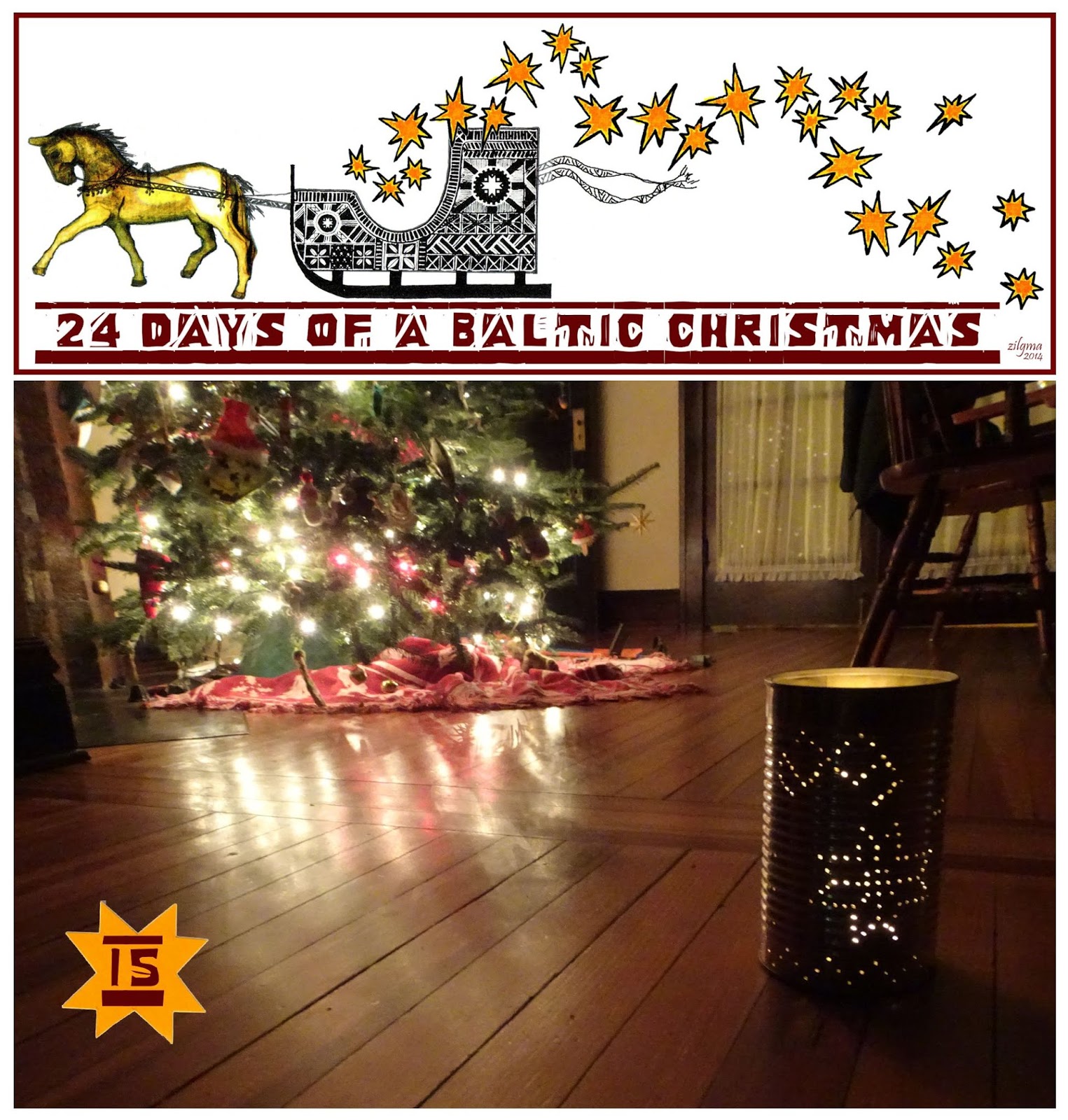
Baltic Christmas Day 15 - A Lantern

The legacy of the ancient Balts is reflected in symbols, from the sun and moon, to earth, water and fire. These symbols tell a story, one dependent on Mother Earth and her bounty, of using the natural world as a guide to live a life ruled by the changing seasons and weather.


Light is a recurring theme, as it is in many cultures due to the necessity of light to live. From the sunlight that nourishes crops, to the fire that warms the hearth, light is woven into the fabric of our ethnic heritage. The sign of the Sun, dating back to the Early Iron Age. The tree of Sun, which represents reaching upward, growth. The Indo-European fire cross; a symbol of fire, thunder, light, fortune, health and prosperity. The sign of the Moon, the symbol of warriors. The Sign of Auseklis (Morning Star); a protector, woven into blankets and coats to safeguard travelers.

As we await the winter solstice the days keep getting shorter, and to warm the long nights we bring lights into our home. We string them in our Christmas trees, we light candles in the windows; we warm ourselves around the fireplace and we keep the Baltic fires burning.


A modern-day tradition that our family keeps is the Peace Light. This year the Peace Light has arrived in our home, a symbol of hope and light, traveling the world spreading its message. We celebrated with our scout troop, making lanterns to home the Peace Light during its stay in our lives.

It’s really so simple, and the results so beautiful. Save a tin can headed for the recycling bin and stick it in the freezer after filling with water. (We learned that sticking a straw in it will keep the pressure from pushing the bottom out, although if this happens it’s just a matter of hammering it back in once the lantern has been finished.) Once the water has frozen, use a nail, hammer, towel and safety glasses to make holes in the can in the shape of symbols or pictures. Put two larger holes near the top and affix a wire to hang the lantern, and finally light a tea light in it, once the ice has melted. 


Dear readers, I wish you light and warmth during these longest nights! May you find joy in the simple things: a tealight in a tin can, the shadowplay from a lantern, the light in a child’s eyes. May your days be filled with anticipation, not stress: the smell of piparkūkas and kanēļmaizītes, the arrival of the postman, the sound of bells, the daily 24 Days of a Baltic Christmas article. And may winter solstice arrive and the days start growing longer, as the sun starts on its annual journey of venturing higher into the sky.

Please join us tomorrow on 24 Days of a Baltic Christmas as we take a closer look at the similarities and differences in the Latvian and Lithuanian Christmas/Kūčios dinners!

Related Posts Plugin for WordPress, Blogger...