Wednesday, April 11, 2018

The peak of spring ephemerals and a waterfall


Invited to view wildflowers on a Conserving Carolina property on the North Pacolet River, I didn’t hesitate – I convinced a few friends to join us, and we headed north a few days later, knowing that there was only a narrow window to catch the peak bloom of the spring ephemerals. I knew we were in for a treat when we started seeing trillium from the car window as we slowly wound along the North Pacolet, and the notion was confirmed upon parking at the small trailhead – enormous trillium among Solomon’s Seal literally just outside the car door.

Jack-in-the-pulpit, Arisaema triphyllum

Sweet white trillium, Trillium simile

Formerly the Pacolet Area Conservancy, Conserving Carolina owns and protects several parcels of land between US176 and decommissioned railroad tracks along the North Pacolet River. A trail was installed to discourage visitors from utilizing those tracks to access a waterfall on a side creek, and that trail has also opened a one-of-a-kind property to those seeking the ultimate spring wildflower experience.

Sessile bellwort, Uvularia sessilifolia

Wild ginger, Asarum canadense

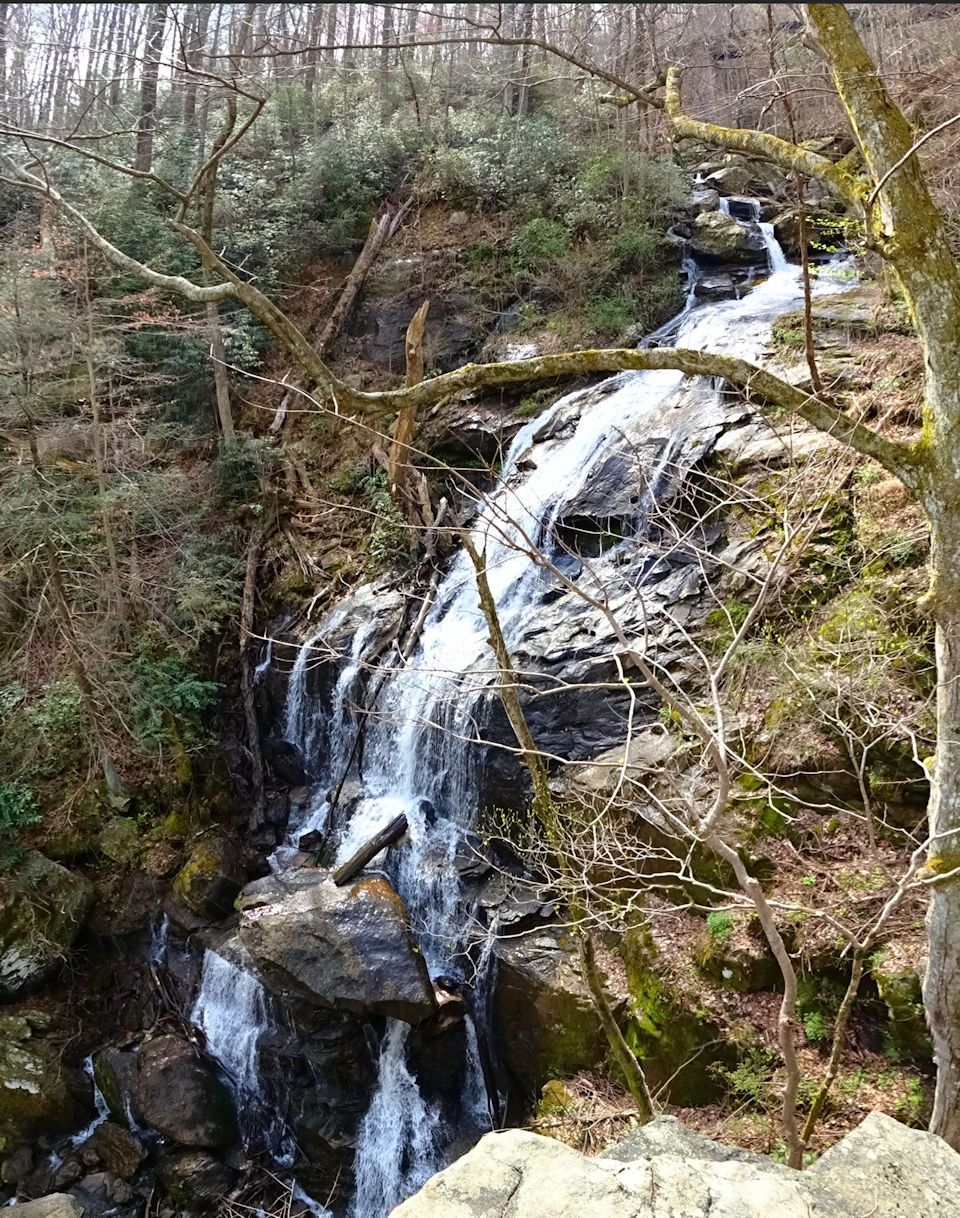
The trail was promoted to me as “the best place for spring ephemerals in the region,” and it didn’t disappoint – this was the most incredible wildflower experience I have ever had. Our progress was incredibly slow as we stopped to look at every new flower we found, and although this tempo considerably added to the total hike time, it also distracted us from the terrain. Though not a difficult hike, there is enough change in elevation to rate this trail moderate. However, the trail ends at a rocky overlook to a 60ft waterfall, and the trail at this end is steep and dangerous. Just last week a local man fell 70 feet at this point, sustaining severe injuries; please know that a slip or moment’s inattention can end in disaster, and use common sense and more than a grain of caution. 

The trail also crosses two small tributaries, both homes to multiple species of salamanders. The streams can be crossed by rock hopping, or getting your feet a little wet – possibly both, if you’re a three year old.


Branch lettuce, Micranthes micranthidifolia

There are also two unofficial trails head down to Big Fall Creek, however both are heavily eroded in steeper sections. The second of the two provides a safer method of access to the bottom of the waterfall (than climbing down from the top), although the falls themselves aren’t completely visible. And finally, closest to the trailhead there is a spur trail that leads past rock outcrops to the railroad tracks.

Dutchman's Breeches, Dicentra cucullaria

Yellow mandarin, Disporum maculatum

In addition to the hazardous cliffs area of this hike, there is also a high concentration of poison ivy; even this early in the year we found vines and budding leaves that could transmit their poisonous oils.

White baneberry, Actaea pachypoda


So, sum total: moderate terrain, creek crossings, dangerous drops, poison ivy, plus the usual hazards (ticks, chiggers, snakes etc.) = the most incredible spring ephemerals in our area… Choose your own adventure!

*****

In addition to the wildflowers pictured above, we also saw: violets, Solomon's Seal, toadshade (Trillium cuneatum), trout lily (Erythronium americanum), mayapple (Podophyllum peltatum), bloodroot (Sanguinaria canadensis), wild bleeding heart (Dicentra eximia) and another dozen that I'm not confident enough to identify...

Monday, April 9, 2018

History Comes Alive at Andrew Jackson State Park

Andrew Jackson State Park is so close to the NC border that it took a visit to Charlotte to get us there the first time. However, this educational destination is really just a little over two hours from Greenville, entertaining both the possibility of a one-day road trip, or a weekend tour if combined with a night at the campground. Jackson was the only U.S. president native to South Carolina, and he was born near the Upcountry, in Lancaster County.


View of the schoolhouse through the historic orchard

Be sure to start your Park tour at the Andrew Jackson Museum, where you’ll find Revolutionary War artifacts and relics related to the Park’s namesake and his presidency. Jackson was the 7th President, elected in 1828 and remembered for winning the Battle of New Orleans against the British in the War of 1812. Through exhibits that portray life in the SC Carolina backcountry during the late 18th century, visitors can explore the impact of the Revolutionary War on the local communities and imagine what Jackson’s childhood was like. Watch a short movie, pick up a park map, and then head out to tour the rest of the park. (Museum hours are 1-5pm/weekends, or by appointment Monday through Friday)

In the museum...

Coming out from the Museum you’ll see the statue Boy of the Waxhaws. Noted American sculptress Anna Hyatt Huntington was the recipient of a letter campaign started in 1962 by the Lancaster County schoolchildren, asking for a statue honoring Andrew Jackson on the 200th anniversary of his birth. A gift to the children of South Carolina, the piece was finished when Huntington was 90 years old. Children from elementary schools throughout the state donated money to provide the base, and together with the statue weighs 25,000 pounds; the granite base bent the crane when it was being installed.

Huntington's Boy of the Waxhaws

“I have Jackson as a young man of sixteen or seventeen seated bareback on a farm horse, one hand leaning back on the horse's rump and looking off over his native hills, to wonder what the future holds for him.” –A. Huntington 

Side note... Horses figure prominently in Anna’s work; you’ll find another equine-themed piece (titled Fighting Stallions, 1950) at the entrance of Brookgreen Gardens in Murrells Inlet, the largest outdoor sculpture garden in the world. Brookgreen Gardens were established by the artist, and the winter home of Anna H. Huntington and her husband Archer Milton Huntington was just across the road; the couple donated this land to found another of South Carolina’s State Parks, Huntington Beach State Park. In the old Moorish castle Atalaya that is located within the park is a big chamber which functioned as her sculpting studio; it was complete with cages and chains to contain live animals such as horses & bears for study while she sculpted.

Beautifully aged picnic shelter


Originally ‘Waxhaws’ was the name given to an Indian tribe that lived in the area, while later it referred to the region of the Carolinas that included the counties of Chester, Lancaster & York along the Catawba River, and the western edge of Union County in NC.

On the steps of the schoolhouse

Also near the Museum are multiple sites of historic interest. Andrew Jackson State Park’s Historic Orchard and Herb Garden features fruit trees and herbs that were sources of food, flavorings, dyes and medicines in the Carolina Backcountry during the late 18th century. An 18th-century replica schoolhouse is open for lessons mid-March to November, 1-5pm Saturdays and 2-5pm Sundays. And next to the schoolhouse is a Carolina Fence Garden, which incorporates natural and cultural elements that have been designated symbols of our state.


In addition, the 360-acre State Park contains a large lake. It is open to fishing with a SC fishing license; try your luck from the banks of the 18-acre lake, from the fishing pier, or rent a boat. You can bring your own boat, however gasoline motors are not allowed on the lake – see park website for more information. Swimming is not permitted.


On the list of must-do things at the Park is the 1-mile loop trail that circles the lake, Garden of the Waxhaws Trail. On a recent visit the redbuds and trout lilies were blooming, and we observed various migratory birds and other wildlife while on our hike. Another trail, the Crawford Trail, takes visitors on a 1-mile loop through the mixed oak, cedar and pine forest behind the Meeting House.

Trout lily and rue anemone on the Garden of the Waxhaws trail

A unique way to experience the park is during one of their annual events. Every year in March there is a birthday celebration (this year was Andrew Jackson's 251st birthday) with traditional artisans, militia demonstrations, museum tours and colonial games for the kids. In fall, visit to view the endangered Schwientz's Sunflower in bloom. Then in November join costumed volunteers for the annual ‘Life in the Waxhaws Lantern Tour’ with storytelling, demonstrations and a 30-minute lantern tour of the park.


A playground, amphitheater, campground and picnic facilities, as well as the living history programs are numerous additional reasons to visit this intriguing midlands State Park. To round out your Andrew Jackson itinerary, visit the Old Waxhaw Presbyterian Church cemetery five miles to the southwest of the park; this is the church that Andrew Jackson attended, and his father and two of his brothers are buried there. Or continue on to Landsford Canal State Park, where visitors can view the well-preserved remains of a canal system to bypass shoals on the Catawba River. Whatever your motivation in visiting this corner of the state may be, know that a stop at Andrew Jackson State Park will offer a fascinating glimpse into the life and times of our 7th President, as well as showcase the natural beauty of the midlands of our state.

Friday, March 30, 2018

Textile Heritage Park


There is a new park coming to Greenville! The Greenville Revitalization Corporation held a groundbreaking Monday morning, marking the start of Phase I of construction. The 6 acres that will soon be Textile Heritage Park are on Smythe Street, across from the Lofts of Greenville at Monaghan Mill.


Greenville Revitalization Corporation is a private, non-profit economic development organization for Greenville County in South Carolina. Their stated purpose is to “strengthen the local economy, particularly the communities of Greenville’s historic Textile Crescent.” (source: GRC website) Other GRC projects include Woodside Mill and the Poinsett Corridor.

During the early days of Monaghan Mill the site was home to a greenspace named “Central Park,” utilized by the mill village for parades, concerts and other recreational activities. During the groundbreaking, the Greenville Textile Heritage Society mentioned an annual spring parade where mothers would promenade with their new babies in the ‘baby parade.’ Later a portion was paved to serve as the mill’s parking lot, and most recently the paved part was an extra parking area for The Lofts of Greenville. Next to the park was the Monaghan School, which burned down in 1954.


The first phase of construction will include putting in a new parking area near the existing pedestrian crossing to Monaghan Mill, and construction of the children’s playground. The playground is the result of a $30,000 grant from the John I. Smith Charities.

Plans show an event building; half is slated to house a textile museum while the rest will be a sheltered space for concerts, outdoor movies, picnics and other activities. A natural outdoor classroom will be situated on the banks of the creek (a tributary to the Reedy River), which the Greenville County Soil & Water Conservation District will be helping to stabilize. There will be a community garden, and a second, smaller parking lot on McBeth Street across from the existing adult day care center. Finally, an open lawn and a natural wildflower meadow will be connected by a “Mill Walk,” featuring 12 alcoves each dedicated to a different mill: American Spinning, Brandon, Camperdown, Dunean, Judson, Mills Mill, Monaghan, Piedmont, Poe, Poinsett, Slater, Union Bleachery, Woodside and Park High School.

Rock wall for the Dunean Mill alcove
“By bringing this property back to its former life as a park, the Textile Heritage Park will serve as a tribute to the history of the textile industry in Greenville,” the GRC stated in the news release.

Phase II is dependent on the finding funding, and to speed this along the corporation is offering brick naming opportunities for the alcoves. For more information visit GRC website. The Greenville Revitalization Corp. is also accepting monetary and service material donations to the park.


Wednesday, March 28, 2018

Spring Wildflowers on Chestnut Ridge


This time of year our hikes are all about the wildflowers. We head to Devils Fork to see the Oconee Bell and to Nine Times Preserve to see the trout lilies. Maybe the botanical gardens to see what is blooming. And while many of our favorite trails in the Mountain Bridge Wilderness Area (for example on Ashmore, Eva Russell Chandler & Wildcat Branch) and the Jocassee Gorges region (the Narrows, Laurel Fork) see the spring ephemerals put on a show, a more recent addition to our rotation is Chestnut Ridge Heritage Preserve.

Trilliums carpet the forest floor in multiple places

Located on Scenic Highway 11 not far north from Campbell’s Covered Bridge, the Preserve encompasses 1,886 acres of wilderness on the shores of the South Pacolet River. The namesake is north of the river, Chestnut Ridge being one south from Hooker Ridge; not much more than Hogback Mountain and Vaughn’s Gap lie between the Preserve and the NC/SC state line.


The trail is 2.75 miles long, stretching north from the parking area (1 mile north of Highway 11 on Oak Grove Road in Landrum, SC) to the Pacolet, for a roundtrip total of 5.5 miles. A kiosk at the trailhead maps several old roadbeds that could be utilized to make a loop, however I prefer the main trail which follows a tributary of Green Creek.

camphorweed

After emerging from the pines into hardwoods you’ll begin to see wildflowers: violets, phlox, chickweed, yellowroot, cranefly orchid, Solomon's seal, spring beauty, squawroot, and trillium, to name a few! The first mile of the hike is rather level, and if you want to shorten the hike the first set of stairs make a good turnaround point; you’ll still see dozens of different wildflowers without the 350 feet of elevation change.

Smooth Solomon's Seal

Or you can continue, the next mile taking you up the southwest face of Squirrel Mountain. On the ridgetop there is an intersection with one of the old roads I mentioned previously, but staying straight will take you all the way down to the South Pacolet River.

The South Pacolet where the trail ends

I’ve read that the area north of the Pacolet has views of Hooker Ridge, Hogback Mountain and the cliffs on Round Mountain as well as several areas of waterfalls, but there are no trails and the terrain is steep. I can suggest Brenda J. Wiley’s blog as a starting point for further exploration. She's got some links to galleries that are worth taking a look at as well.

An unexpected tiger swallowtail

But the spring wildflowers give us enough to explore, and with a hand lens and flower identification book we'll spend all day examining the rich flora of the Preserve. Autumn brings its own show of color, but it’s Chestnut Ridge in March that casts its spell with the ephemerals and vibrant greens that only a Carolina spring will bring.

This flowering ground pine is actually in the clubmoss family

squawroot, a parasitic plant also called bear corn or American cancer root
 ---------------------------------------

Wondering what other Heritage Preserves are in our area? These are my favorites:


star chickweed


Sunday, March 25, 2018

The “Birthplace and Deathbed of the Confederacy," Abbeville SC

Abbeville was settled by French Huguenot settlers in 1758, and together with the county was named for the French town of the same name. Officially incorporated on December 20, 1832, it was the city’s role in the Civil War that has earned it the nickname of “Birthplace and Deathbed of the Confederacy.” The meeting that prompted the state's secession from the Union took place on Nov. 22, 1860 on Secession Hill, and then five years later Jefferson Davis and his cabinet decided to dissolve the Confederacy at the Burt-Stark Mansion. The noteworthy historic district featuring these locations as well as dozens of other historic sites is just a little over an hour from Greenville and the Upstate.


The very center of Abbeville is the Court Square, quaint historic storefronts lining the greenspace that contains the monument that honors those who served in the Civil War. Beginning with the death of J. Allen on Sullivan’s Island in 1861, almost 350 Abbeville residents would lose their lives in the Civil War, close to ½ the male population of the district at this time. The monument is a replacement that was erected in 1996, 90 years after the Daughters of the Confederacy first placed a monument there. The original was replaced after the Christmas tree surrounding the marker burned in 1991, flaking off large sections of stone.


Across the street is a marker that symbolizes the remembrance of the lynching of Anthony Crawford. On October 21, 1916, a white mob lynched a black leader for refusing to sell his cottonseed to a white merchant for a lower price. The marker is located near the Abbeville County Courthouse, the 1908 Beaux Arts building which is on the National Register of Historic Places. 


Facing the square directly next to the court house is the Abbeville Opera House, whose doors first opened on October 10, 1908. The ‘Official Rural Drama State Theatre of South Carolina’ is listed on the  National Register of Historic Places, and is the only "Hemphouse" remaining in South Carolina, the 7,800 ft² stage using the same rope-pulled rigging system as when it was originally built.


The actual spot where the secession speeches were made is a little to the east of the square, near the intersection of Branch Street and Secession Avenue. The location is marked by a stone, historical markers, and the grave of an unknown Confederate soldier.


About ¼ mile northeast from Court Square is the Burt-Stark Mansion, the Greek Revival style home that is now property of the Abbeville County Historic Preservation Commission. It was in this stately mansion that Confederate President Jefferson Davis held the last council of the war of the Confederacy on May 2nd 1865. Fleeing from Richmond with the Confederacy in shambles, Davis was convinced by his generals and cabinet that Southern resources were completely exhausted and that any attempt to continue the campaign would be futile. Davis officially acknowledged the dissolution of the Confederate government.


Another site listed on the National Register of Historic Places is the Trinity Episcopal Church, the French Gothic church built in 1860. The pink hue is due to the locally made bricks (and native clay) which are beneath the exterior layer of cement, and the original bell still hangs in the tower to this day. The historic churchyard beyond contains the graves of several Confederate soldiers and one Union soldier.

McGowan-Barksdale-Bundy House

If you are touring Abbeville with children, make sure to schedule a stop at the park behind the McGowan-Barksdale-Bundy House, headquarters of the Abbeville County Historical Society. The grounds contain three servants’ cabins, two of which date back to 1857; however it is Caboose No. 5759 that draws their attention, built in August 1963 and a testament of Abbeville at a rail-crossroads. The caboose traveled through town on its way to Richmond, Atlanta, Miami, Washington DC, Baltimore and Cincinnati, and as far as Chicago IL, St. Louis MO & New Orleans LA.


Finally, film buffs should plan to drive down Magazine Street. There they'll find the white Victorian which Julia Roberts moved into in the movie Sleeping With the Enemy

404 Magazine Street, Abbeville

The area around Abbeville is home to a number of state parks, as well as the Long Cane Ranger District of Sumter National Forest. Located near the Savannah River Basin, nearby Lake Secession is owned and operated by the City of Abbeville. Abbeville is also part of the South Carolina National Heritage Corridor due to its rich heritage of textiles; the Heritage Corridor stretches from the coast near Charleston to the mountains of Oconee County. It is this combination of the historic with natural that makes Abbeville a great weekend destination from the Upstate.

Gothic Revival style servants cabin
Livery stable built in 1870s after original destroyed in fire


Related Posts Plugin for WordPress, Blogger...