Monday, July 11, 2016

Humans vs. nature

With the start of summer vacation we’re seeing the typical increase of headline news associated with people interacting with animals & nature. From tragic stories such as the children snatched by alligators and falling into zoo enclosures, to tourists falling into geysers and hot springs, there seems to be an abundance of catastrophic, heartbreaking and deadly accidents taking place around the country.

Our National Parks out west have been besieged by people doing stupid stuff all year, many paying the ultimate price for their mistakes. Here’s a video of a woman petting a bison (yes, you heard me, a bison!). Luckily she walked away from the incident.


These tourists weren’t so lucky. And in the case of the Canadians who put a bison in their SUV (thinking it was cold); the animal was euthanized after eventually being rejected by the herd.

In some cases it was a matter of being unprepared. A 38-year-old hiker who was found in Rocky Mountain NP in February was the second fatality this year. And it was just last year the French couple died in White Sands National Monument from heat and lack of water; miraculously their nine-year-old son survived. 

We have incidents of tourists venturing off marked boardwalks and falling into thermal springs – with calamitous results. A 23-year-old man walked about 225 yards from the boardwalk in Yellowstone National Park and fell into the Norris Geyser Basin; authorities soon suspended the search for his body, determining there were 'no remains left to recover'. 

Some tragedies aren’t just a case of staying on the marked path – take the case of the USFS law enforcement officer who was killed by a grizzly bear while mountain biking. He was a long-time employee of the Forest Service, and well-versed in human/bear encounter safety. Luckily this mountain biker vs. bear story had a different ending…


Right here in the Upstate… Despite multiple signs warning people to stay out of the water and away from the falls, one young man found himself needing to be rescued from the base of the waterfall in Falls Park, at the heart of downtown Greenville. Signs are there for your safety; in addition to the hazards of slippery rocks and the waterfall itself, there are the dangers of swimming in contaminated water. The Reedy River is not safe due to high levels of all sorts of nasty stuff, fecal matter (and therefore bacteria), fertilizer and pesticides topping the list. Not to mention most freshwater bodies of water in SC test positive for amoebas in July and August, although to introduce the “brain-eating” amoeba (that’s being blamed for the death of a teen in NC last month) into your nasal cavities, it usually takes an activity like whitewater rafting or water skiing without a nose clip. Just stay out of the water in posted areas.

Many of these incidents can be chalked up to bad luck, such as the shark encounters we’ve already seen up and down the coast. But others are a combination of chance and bad decisions, and there’s been an increase of these right here in the Upstate and surrounding area. The waterfall rescue is just one of a dozen incidents in the region, some resulting in expensive rescue operations and others in death. Is that selfie really worth the risk?

On our recent visit to Little Bradley Falls dozens of people were climbing the steep slopes to the top of the falls, and even more were clambering around on the slick rocks at the base. This seems a rather harmless example of summer fun, until one takes into account the multiple deaths at some of our favorite waterfall attractions in the Blue Ridge mountain area. Wildcat Branch Falls has been the site of two deaths in recent years ; “we've had over the years, probably seven or eight fatalities from the falls here, and dozens of cases of severe injuries," said River Falls Fire Chief David Embry concerning Wildcat Wayside after the death of an Upstate man in 2013. Just a couple of months ago two men died near Raven Cliff Falls, one man trying to reach his best friend who had fallen to a ledge below, both dying in the attempt. In March at Jones Gap State Park, a 20-year-old woman who had hiked to the top of the falls to take a picture fell 45 feet, headfirst, off the waterfall.

So what’s the takeaway message? Use your head. Know the risks of the area you are visiting, and do your best to minimize it. Don’t traverse slippery rocks 100 feet above the waterfall for the sake of a picture. Leave snakes and other wildlife alone. Keep a close eye on the kids, and obey posted signs. Check for ticks when you get home. Know your limits, but most of all, use common sense. What really matters isn’t that Instagram shot or bragging rights; it’s coming home safe after our adventures in the spectacular region we love.

Thursday, July 7, 2016

The Marine Lab at RMSC

We spent one last morning at Roper Mountain Science Center’s Butterfly Adventure. The exhibit will close with this month’s Second Saturday event, the Blueberry Festival: All Things Blueberry! We lucked out with a short line, spent some time with the monarchs & swallowtails, and then headed over to the Marine Lab at the other end of the Harrison Hall of Natural Science.


As doors to the building are only open to visitors during special events and Second Saturdays, a weekday visit to the Marine Lab is a special treat. Not only are there dozens of ocean animals for the kids to interact with, but the aquariums lining the walls are full of wonders, and exhibits provide visitors with an opportunity to discover the many organisms that inhabit our oceans.


We immediately headed to the sink to wash our hands, and then to the tide pool tank. These touch tanks are home to stingrays, horseshoe crabs and a sea snail. All three boys (and mom!) had the opportunity to ‘pet’ a stingray – surprisingly sponge-like, as opposed to the slick surface I expected. We then played peekaboo with the crabs…


The six aquaria were a never-ending movie of movement and color, and although the tropical fish held the boys’ interest for some time, the sea turtles were probably their favorites.


We explored the seashore ecosystem through the giant mural, and then wondered over the hawksbill turtle display. Mikus had some fun with the ocean observation buoy, learning about these instruments through the touch screen information center. We even took a look at the research vessel, a work station utilized by students on field trips.


Although the Marine Lab will not be open daily anymore once Butterfly Adventure ends, it is always open during Second Saturdays. The display near the door alone is worth the visit; hundreds of dried specimens of marine organisms including sponges, sea stars, crabs, corals, fossils and more make for a fascinating exploration of life under the sea – without getting your toes wet. Hopefully you’ll be getting your hands wet (do stop in and meet the manta!), so as Roper Mountain Science Center says, “come sea for yourself” what the Marine Lab is all about!


Tuesday, July 5, 2016

Little Bradley Falls in Saluda, NC

Due to lack of signs and the degree of difficulty, the Little Bradley Falls and (Big) Bradley Falls hikes are usually left to those ‘in the know’; however, judging by the amount of traffic on our recent visit, these gorgeous waterfall hikes have been discovered and are quickly gaining popularity as short, but challenging and rewarding hikes in western North Carolina.


The Green River Game Lands are a relatively undisturbed wilderness area containing narrow gorges, steep ravines, coves, old-growth & mixed hardwood forests, and are managed by the NC Wildlife Resources Commission. The area is named after the Green River, which runs through a rugged gorge on the Blue Ridge escarpment, at one point dropping 400 feet in 1 ½ miles through a six-foot wide crevice known as "the Narrows." Cove Creek, which originates near Saluda (and Pearson’s Falls) flows north and into the Green River, but first flows under I-26 and over two waterfalls, Little Bradley and Bradley Falls.

One of the most difficult sections traverses a rock slide

To reach the falls, hikers can park at a gravel pull-off on State Rd. 1142 (also known as Holbert Cove Rd.), which is a hair over three miles from exit 59 on I-26 less than an hour away from Greenville. There are no signs, but the trail for Bradley Falls departs to the north from the parking area, while the hike to Little Bradley starts on the opposite side of the road, across the bridge on the east side of Cove Creek. Hikers must immediately climb a steep section of trail away from the creek; the second trail that leads alongside the creek is a popular wading and picnic area, and although you can plainly see where hikers have attempted to reach the trail up the steep mountainside, there is consequently significant erosion and damage. It’s simple – follow the red blazes in the two or three places that the trail splits, and you’ll reach the falls.

follow the red blazes!

The boys love this hike as there are several creek crossings, making water shoes a good idea if taking off/putting shoes back on or attempting to rock-hop isn’t your idea of fun. But these crossings and a couple rather dicey sections of trail also bring the degree of difficulty up to moderate, meaning that the older boys require assistance in several spots and Vilis spends time in the backpack carrier.


The trail ends upon reaching Little Bradley Falls; you’ll know you’re close when you pass the old chimney ruins. The 35-foot, triple-tiered waterfall feeds into a large pool at the bottom, perfect for wading and cooling off on a hot summer day. Exercise extreme caution on the slippery boulders, and don’t attempt to climb to the top of the falls; just as with most other scenic falls in the area, dozens of people have been injured, and even killed in their attempt to photograph and explore the treacherous terrain. On our visit a professional rappelling team was practicing waterfall rescue operations up and down the side of the waterfall, and just this May a 20-year-old man fell about 50 feet from the top of Bradley Falls and ended up in the hospital in critical condition.


We retraced our steps to the bridge on Holbert Cove Rd. completing this 2-mile hike. On our way to the car I stared down the trail that leads to Bradley Falls. Although I long for the day that I’ll be able to hike the 1.5 mile there-and-back to the 100ft falls, I realize that it might still be some years before the boys can join me, due to the 30-foot rappel to reach the base of the waterfall. Until then, I’ll be more than happy with Little Bradley Falls! We reached the car, grabbed our lunch, and spent another hour in Cove Creek wading, splashing and catching crawdads before heading into Saluda for ice cream on Main Street.  Summer in the Blue Ridge Mountains doesn’t get much better than this!


For a video tour of the Little Bradley waterfall hike view this video by HD Carolina!

This article also appears on the Kidding Around Greenville site.


Friday, July 1, 2016

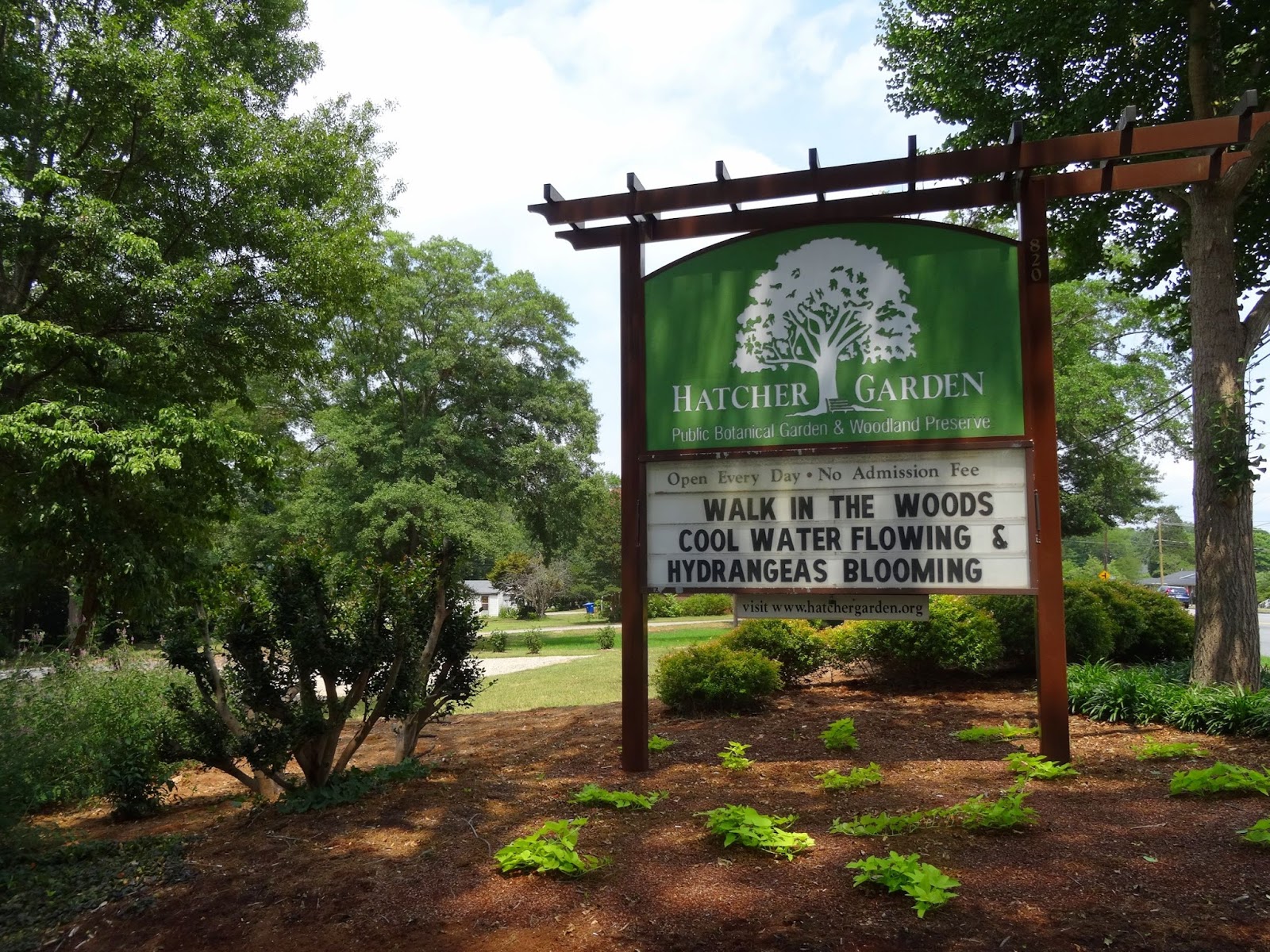
Summer in Hatcher Garden

Spartanburg is a good 45-minute drive from Greenville (up to an hour when driving in traffic); we usually opt to spend that hour driving into the foothills and mountains instead of east. However, we’ve discovered several good reasons to drive I-85, including the International Festival in Barnet Park, Croft State Park, Walnut Grove Plantation and most recently, Hatcher Garden!

a view over the perennial beds

The Hatchers retired to Spartanburg in 1969 from Indiana, where they had lived for over thirty years. From their small lot on the west side of town they had a view of a wooded area; although once home to cotton fields and badly eroded, by the 1970s it had seemingly recovered under a mature pine & hardwood canopy. Harold Hatcher purchased three more acres, and soon the pair was spending all their free time filling in eroded gullies, amending soil, building paths and ponds, and planting over 10,000 trees, shrubs and flowers to fully realize the potential of their little piece of the Upstate.

lilies blooming in the conifer collection

The gardens soon attracted the attention of various garden and community organizations, and volunteers were instrumental in the next phase of the garden’s development after the Hatchers added an adjacent parcel; together they built trails, a series of ponds, planted trees and added a gazebo, wildflower garden and new flower beds.

strolling the Bartram Trail

The garden became a destination for local citizens in the 1980s, and in 1987 ownership was transferred to the Spartanburg County Foundation to give the garden permanent protection from development. At this point it was officially named Hatcher Garden and Woodland Preserve, and when Josephine Hatcher passed away in 1999 and Harold in 2003, both of their ashes were scattered in the gardens to which they had dedicated three decades of work.


The love that has been poured into the gardens over the last forty years was obvious on our visit; from the blooms in the water wise demonstration garden to the beautiful bridges, observation decks and gazebos, the acreage is packed with interesting plants and trees, beautiful flowers and shrubs and endless corners and trails to explore. Despite the timing of our visit coinciding with the hottest part of the day, the shaded forest trails were alive with insects, animals and the sound of the creek as it cascaded down the waterfall and through the woods.


A paved path leads visitors down into the garden, passing first the perennial beds, then the Dr. Sam Orr Black, Jr. Medicinal Garden and the Conifer Collection. From here it loops around, passing the bald cypress pond, the Robert Lawrence Odom Hosta Friendship Garden, the Women Giving for Spartanburg Garden of Hope & Healing, and the Josephine Hatcher Woodland Garden Room. The Bartram Trail (also paved) is an additional loop, curving around the lower pond & Altrusa Native Plant Garden, and through the Walter Soderberg Ericaceous Collection. Finally, a dozen woodland paths crisscross the property leading to additional gems such as the Butterfly Garden by the Spartanburg Garden Club, and to the Garden of Hope & Healing Pavilion.


Our favorite spots were the children’s sand garden at the pavilion, and the waterfall underneath Corrie’s Bridge. If the mosquitoes hadn’t been out in force we would have lingered at both; instead we stayed on the move, winding our way through the preserve with no particular route in mind.

source here


The Hatcher Garden website is a wealth of information, with highlights of visiting during all four seasons, plant descriptions of all nine gardens, a kids corner and a garden map. The gardens can be rented as a venue and scheduled for professional photography sessions, and group tours are available for nominal fees. Unguided tours of the garden are free during daylight hours; see website for more information. For on-site information visit the office & gift shop, and make sure to nursery and greenhouse for seasonal plant sales. Finally, bring a picnic; in addition to the Jess Taylor pavilion near the main parking lot, there are multiple benches, overlooks and patios, and finally the John A. Nevison Teaching Amphitheater which are ideal for a quiet moment of contemplation. 


Wednesday, June 29, 2016

A journey through Storyland at the UHM

June saw the opening of a new exhibit - Storyland: A Trip ­through Childhood Favorites - at one of our favorite museums here in Greenville, the Upcountry History Museum! The GHS-sponsored, bilingual adventure allows visitors to step into the pages of classic children's literature, featuring seven books that include favorites If You Give a Mouse a Cookie and The Tale of Peter Rabbit.


The traveling exhibit is geared towards children ages 0-8, with matching, rhyming, poetry and storytelling activities. All three boys kept themselves occupied during our two-hour stay, which is about how long it took to fully explore all seven books.

All three boys spent a significant amount of time at the Chicka Chicka Boom Boom (by Bill Martin Jr. and John Archambault) palm, sending letters up the tree only to have them tumble back down, just as in the book.


The Snowy Day (author Ezra Jack Keats) had a beautiful snowy vista that encouraged visitors to build snowmen, make snow angels and to walk through the winter wonderland to the sound of their own footsteps crunching through the snow.


If YouGive a Mouse a Cookie (by Laura Numero) featured a station where the kids could write a note to Mouse, and a giant cookie – a sensory station with items from the book hidden in each chocolate chip.

Th­e Tale of Peter Rabbit (book by Beatrix Potter) was my favorite, with a perfect little rabbit (and toddler) sized house. The boys enjoyed gardening with Peter, and searching for the hidden puzzle pieces that fit in various spots throughout.


Where’s Spot (Eric Hill) garnered the most attention from Vilis, who insisted on lugging Spot around to all the other exhibits...

The book Tuesday (author David Wiesner) was previously unfamiliar to me. The story of a Tuesday when frogs took to the air on their lily pads won the Caldecott Medal in 1992, and fit perfectly into Storyland with a percussion wall and clock activity.


Finally we read about Abuela (by Arthur Dorros), with Rosalba and her grandmother flying high above the heads of the children while they wrote shopping lists and helped stock the shelves of the store.


Storyland: A Trip ­through Childhood Favorites will be at the Upcountry History Museum through September 11th, and should be added to your summer bucket list for a visit on one of those hot, southern days. Relive your favorite childhood books while the kids learn the joy and power of reading through play, and don’t forget to stop by the library next door before you head home – maybe you want to take one or two of the featured books home?


Related Posts Plugin for WordPress, Blogger...