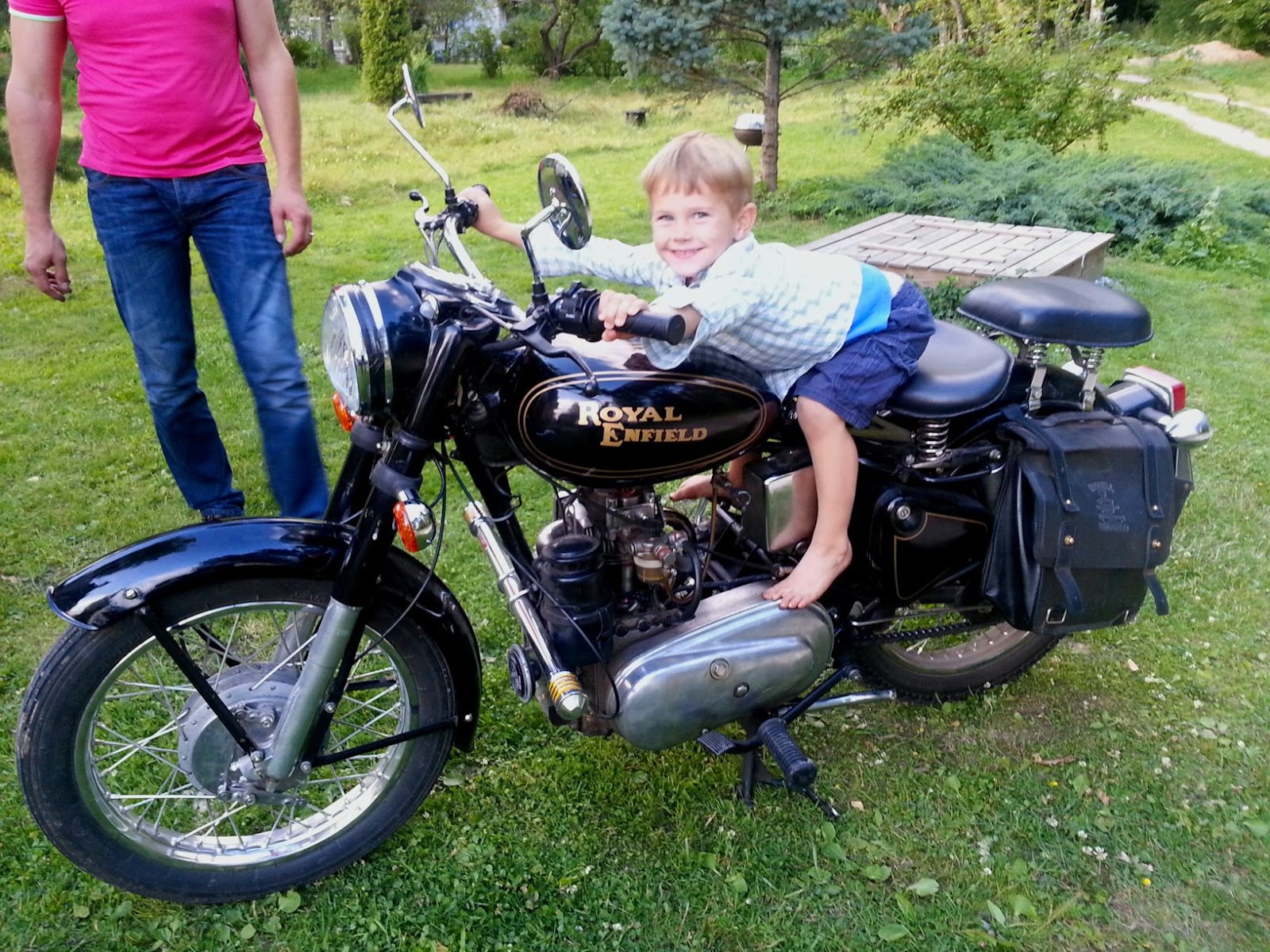
Just a minute away from Rīga you can find yourself in the country. And by a minute, I mean it took us one minute to reach the home of our relatives after passing the giant Rīga sign.
Babīte is south of Jūrmala, and shares a name with Babītes ezers. The Babīte lake is an important ecological area from an ornithological standpoint; of the 184 species of birds that have been documented there, 36 nest within its marshes and 15 are considered endangered within Europe.
Once again our host's gardens were fascinating to wander through, edible kitchen gardens mingling with colorful flower showcases, red and black currant bushes and apple trees.
The boys particularly enjoyed meeting all the resident animals, although the foot powered air-rocket came in a close second to the baby chicks.
It was a soothing, restful afternoon and evening in between all the traveling. What a pleasure to meet this extended family of ours, to learn how the branches of our family tree stretch all over the world!
Friday, September 4, 2015
Wednesday, September 2, 2015
Gneiss rocks {and the giveaway winner}
A big
thank you to everyone who commented and emailed to enter last week’s giveaway
to win a banana bird market tote from Inese’s line daba deva! The winner is
Kristīna! Congratulations, I hope you get a lot of use out of
your new artisan bag!
Kristīna
writes, “man vislabak patīk Pine forest krāsas. Faktiski bieži domāju par Inesi
GNP, jo tur ir tik skaistas krāsu kombinācijas. Man ir atsevišķs foto albums
tikai ar akmeņiem, ko fotogrāfēju ceļā uz un pie Grinnell Glacier…” (…my
favorite is the Pine forest. Actually, I often thought of Inese in Glacier
National Park, due to the beautiful color combinations. I have a photo album
which consists only of rocks that I photographed on the way to and near
Grinnell Glacier...)
With
Kristīnas permission I share these rocks with you – who knows, they may turn
out to be inspiration for Inese’s next collection!
Monday, August 31, 2015
Ikla, Estonia and the erratic (bolder) boulder
The
decision to pass through Salacgrīva and continue on to Ainaži on our search for dinner was a
fateful one, as it meant spending the next hour or so in traffic. The 7.5 miles
between towns was almost entirely one-way traffic due to construction, the
Rīga/Talinn being improved and widened. At each stop we sat for what seemed an unbearably long time, waiting for oncoming traffic to clear, wishing for a
restaurant to be just around the next bend. One failed attempt not far out of
Salacgrīva (the place was closed for a wedding… on a Tuesday!) netted us the
name of a restaurant in Ainaži
that turned out to be open and serving – the only two requirements we had with
three hungry boys complaining in the backseat.
Ainaži is a quiet town, known for the
history of seafaring and shipbuilding; tourists can visit the sea school museum
which also touches on the construction of tall ships in the 19th and
20th centuries. The town was occupied by Estonia in 1919, although
the majority of the territory was returned to Latvia and vacated by Estonian troops by 1920,
with the exception of Ikla.
To
reach the center of Ainaži
we turned off of interstate A1, and it was this business route that
unassumingly dumped us into Estonia – no fanfare, no border crossing, just a
few flags and signs to let us know we were no longer in Latvia. Ikla is a small
village, part of Häädemeeste Parish in Pärnu County, and its claim to fame
seemed to be the Ikla rändrahn.
Per the informative signage: “The Erratic Bolder, whose sad story we are going to
tell you, probably arrived at Ikla already at the end of the 1st Ice
Age. Although the oldest date about the Bolder in the church register goes as
far back as 825 AD. The fate of the Erratic Bolder was gloomy in the dark
middle Ages. But its outer cold hard rock hid tender inner soul (the measure of
which is 26,000m3). During its life, weighing over 60 tonnes, it had to suffer
from local’s continual repression. It is difficult to describe all those horrors.
For example, the Erratic Boulder had to tolerate that superstitious people
continuously heaped a lot of food on it in the hope that fairies would bring
them luck. Actually only the Erratic Boulder saw that several and several
generations of crows and seagulls lived on it. But the Bolder did not tolerate
the birds, because they disturbed and smeared it, not to say anything of
contaminated food which made it feel sick. For centuries the local youth
climbed to the top of it and danced on it, mocking at its enormous
circumference, carving their names and causing wounds and leaving scars in it.
Once local people poked a fir-tree into the body of Stone Landmark who was a
good neighbor of the Erratic Boulder. The Boulder was sad, but it could not do
anything but feel sorry for the Stone Landmark. The nights, when ferns were in
blossom, were the most horrible for the Boulder. Then local people used to
throw a party and light bonfires near it. Because of that the western side of
the Boulder was overheated and it caused extreme pain to it every year on the
shortest night. One day it was noticed that the Boulder had disappeared. There
was nothing in the place where the Boulder had been for centuries. The most
famous scientists in the field were asked to come and investigate measure,
analyze and speculate, but they could not comment on its disappearance. The
Erratic Boulder had become a media star overnight. Journalists arrived,
questioned people, invented their own versions about the disappearance of the
Boulder and published them in their newspapers. In the end the prevailing
opinion was that the disappeared Boulder was a “rolling stone” by its nature
and that is why it had to rollaway. But some people were of the stile of the
opinion that the disappearance of the Boulder was caused by the exchange of the
local authorities and it was deeply insulted as its location was on the border
of the country. Nobody knows where the Ikla’s Erratic Boulder is now. Perhaps
it remains a secret for ever. Every year tens of people go missing who can
never be found, let alone an Erratic Boulder with a stone heart.”
So.
There you have it. The story of the erratic (bolder) boulder. I take absolutely
no credit for the translation!
We
wandered around for a bit (probably looking quite suspicious to anyone paying
attention), checking out the site of the old site of the border crossing
station and the concrete border markers. There was a ditch running between the
two countries, some official looking posts with ģērboņi and emblems, the highway signs
and quite a few maps detailing cycling routes.
And so
it came to be that Vilis had a snack in Estonia.
The
welcome back into Latvia was not nearly half as grand…
On our
way south we kept our eyes peeled for that rolling stone, but you know what? We never did see
it… quite a mystery!
P.S. Today is your final chance to enter the giveaway to win a made-in-Latvia banana bird market tote!
Location:
Ikla, Pärnu County, Estonia
Friday, August 28, 2015
On the shores of the Baltic - the sandstone cliffs of Vidzeme
As I
mentioned in my previous post, the section of Baltic
Sea coast between Tūja and Vitrupe is
known for a rocky seashore, with unusual boulder clusters, rocky headlands,
cliffs, bluffs, small grottos, pillars and other natural formations. As fun and
scenic as the Lauču rocks were, I was unprepared for the fascinating shoreline
just 10 miles north. We cruised up the A1 (the Rīga/Talinn freeway) until
Lapsiņas, where we turned west towards Rankuļrags and Mantiņi. Once again our
destination was well-posted, and about 4 miles later we arrived at the Veczemju
klintis (translates to “Oldworld Cliffs”).
Similar to Lauči, the area has been groomed into a
camping/recreation site. As it is private property you do have to pay to park,
but with the attendant on duty we felt safe leaving the car there for an
extended period of time. A restaurant, snack & coffee shop and other
facilities are available, and picnic tables are located throughout. Visitors
can descend stairs to the beach, or continue along the road to reach the
boardwalk that accesses the cliffs. The boys opted to walk the beach while I
continued down the forest road, inhaling the scent of the rich deciduous and
pine-spruce forest that is so typical of the Baltic seacoast.
The
Veczemju klintis are the most impressive and imposing sandstone cliffs of the
Vidzeme rocky seaside and part of the “Vidzeme stony beach” nature reserve,
which comprises a 7.5 mile-long stretch of shore. The 20 foot-tall, magnificent
red sandstone formations stretch two tenths of a mile, with caves, arches, and
patterns of all colors. This is the only place in Latvia where 350-380 million
year old sandstone outcrops can be seen, and the visible evidence of the last
glacial period dates back 10-13 thousand years. Despite the centuries-old
reputation of these cliffs, the appearance of this section of shore supposedly
changes noticeably with each storm, the relentless waves carving out new
sculptures in the soft sandstone for a unique landscape every year.
I
could have spent days photographing the colors and patterns, watching the
cliffs change hues over the course of the day as the sun passed overhead. We
searched for driftwood and pieces of sea glass among the pebbles, giving the
boys freedom to explore and play. When the sun got to be too much we retreated
into the shade of the cliffs, the cool, salty breeze eventually urging us back
into the sun.
When
it came time to leave, instead of turning the car back around the way we came
we decided to continue north – a fortuitous choice. For Americans, it was the
difference between choosing Highway 1 over Interstate 101 when driving up the
Pacific coast... What we lost in time driving on an unimproved, narrow and
curvy road, we more than made up for with sheer beauty of our surroundings.
With frequent glimpses of the ocean, the cliffs and the beach (so tempting to
forget the evening’s plans and return to the water!), we wound our way through
pine forest and meadow before intersecting the A1 near Meleki and the Lielurga
river. And then we were once again traveling at a good clip, eyes peeled for a
place to eat dinner as we approached Salacgrīva…
Wednesday, August 26, 2015
Lauču akmeņi - a couple of big rocks
It was
on a day trip from Saulkrasti that we found ourselves bouncing down a gravel
road somewhere between Zvejniekciems (‘fisherman’s village’) and Dunte, where
the infamous Minhauzena museum is located. We were following signs for the Lauču akmeņi, the rocks of Lauči,
wondering if were chasing a legend as elusive as the truth was for Minhauzens,
and if it was going to be worth the trip.
Turns out finding the large stones wasn’t going to be a
problem, as signs guided us straight to the parking area for the Lauču akmens restaurant/camping/recreation
area. As luck would have it we arrived while parking was still free, and soon
we were descending the stairs leading down to the beach. And there it was – the
Lauču akmens.
There are actually two rocks, Lielais and Mazais (big
and small), both of which appeared on the Baltic seashore in the spring of 1853
along with a multitude of ice. Lielais
is in the books at over 10 feet tall with a circumference of about 40 feet,
while Mazais is a little over 6 feet
tall and 31 feet around. Worth flying out to Latvia to see tomorrow? Not quite,
but definitely worth the side trip from the Rīga-Talinn highway; although these rocks might not
be the size of Stone Mountain or Bald Rock, the Lauču beach is a gorgeous yet unique
aspect on the shores of the Baltic.
![]() |
| Not Mazais Lauču akmens... but just as fun to climb |
The
section of coast between Tūja and Vitrupe
is known for the rocky seashore, with unusual boulder clusters, rocky
headlands, cliffs, bluffs, small grottos, pillars and other natural formations.
However even south of Tūja
where the Lauču rocks are located the shoreline is interesting, with
the large rocks and steep wooded shores preceeding the beach. The boys found a
tidepool of sorts, and were soon busy stacking rocks, digging channels and exploring
the rock-strewn strand.
![]() |
| The restaurant's playground, restaurant decor and wildlife we spotted on the drive in |
We weren’t the only ones on the beach on a sunny summer’s
day, although we might possibly have been the only ones there to see the
rocks... As morning turned into afternoon we grabbed lunch at the restaurant
(if we did it again I would skip the meal rather than dining there again),
checked out Mazais Lauču akmens (not
as impressive as Lielais) and finally
bid adieu to the the oversize stones
before continuing our trip north – to the Veczemju cliffs.
Labels:
Baltic Sea,
Latvia
Subscribe to:
Posts (Atom)