Friday, February 6, 2015

Playa Hermosa (Jaco) Costa Rica

We couldn’t stay in paradise forever.


After a tour of the Alturas Wildlife Sanctuary the rest of the group packed up the van and departed for San Jose, from where they would fly out the next morning. We had decided to stay a few more days in order to celebrate Roberts’s birthday in Costa Rica, but we only had one more day on the south coast. So after saying farewell to the brother-in-law, his fiancée and the rest of the party, we spent some time in the pool and relaxed, saving up energy for the days to come.


When scouting out a stopping point on our return trip we had settled on Playa Hermosa, the beach south of Jacó. Where Jacó has evolved as a party-oriented beach resort, the strip to the south is less so, with sand bars providing consistently good surfing but only a few hotels and hostels catering to tourists, and therefore little of the nightlife typical of further north up the shore.


We had little interest in anything other than the beach and pool, with plans to arrive in the early afternoon and leave before noon the following morning. Our hotel was directly on the beach, and after a quick lunch we headed out for a few hours in the sand and sun. Surfers were bobbing up and down beyond the break, sunbathers stretched out in the sand watching. The riptides made swimming unsafe and so we stuck to the sand, searching for treasures washed up on the beach.


In addition to the little crabs scrambling to escape our curious boys we saw pelicans flying their formations, skimming across the waves. The highlight was the sight of two scarlet macaws, birds that mate for life and are usually seen flying over the treetops, not cruising by a dozen yards away. Parque Nacional Carara is nearby, and the macaws fly back and forth between the forest and the coastal mangroves, but the sight of their spectacular plumage took our breath away.


With Vilis getting heavy in the carrier and the sun slowly setting we chose to spend the rest of the evening in the pool. The next morning after a traditional breakfast of rice and beans it was back to the beach for one final au revoir before piling into the car and continuing north. We had one last stop after leaving the coast to head inland, the bridge over Rio Tárcoles. The American cocodrilo makes its home in rivers throughout the Pacific lowlands, but at the mouth of the Tárcoles River populations of more than 200 crocodiles per mile have been counted. We preferred a vantage point from veeery high above.


Hunted for over 400 years, the crocodile populations have made a comeback since gaining protected status in 1981. The adults can reach lengths up to 20 feet, and although weights are typically around 800 lbs or so, giants up to 2,000 pounds have been recorded. With a diet typically consisting of birds, fish, reptiles and small mammals, aggression towards humans is rare.


As the highway curved inland away from the shore my thoughts turned to our last days in Costa Rica, for which we would return to the rainforest. First we had to make our way through Alajuela, but soon we were winding our way up into the mountains; the temperature dropped by a good 15 degrees, the rain and fog once more descended, and Volcán Poás loomed ahead…

Wednesday, February 4, 2015

Alturas Wildlife Sanctuary in Costa Rica


As a family with small children it was impossible logistically to be in less-visited areas of the rain and cloud forest in the early hours of the day when we would be most likely to see wild animals in their natural habitat. Other than the night walk during which we saw a sloth and several other nocturnal creatures, we had seen only a few native animals for which the region is famous; a handful of colorful birds, green iguanas, capuchin monkeys and the geckos which seemed to live on the walls (interior and exterior) of our villa. Part of the allure of staying at Villas Alturas was the Alturas Wildlife Sanctuary, located within a stone’s throw of the resort, where we hoped to meet a few of the animals native to the region that we had not yet seen.


With our stay on the southern coast coming to an end we were excited to tour the sanctuary with its Director of Operations, Mike Graeber. With over 40 years of experience rescuing and rehabilitating animals, Mike moved to Costa Rica in 2000 and founded D.A.W.G. - Domestic Animal Welfare Group. After 8 years he stepped down from his leadership role there and returned to working with rescued wild animals. Soon Mike was locally known as someone to take abandoned baby animals or injured creatures to, and in 2011 the opportunity arose to develop and manage Osa Mountain Animal Sanctuary, a wildlife rescue and rehabilitation center. With animals in the region under constant assault from hunters, poachers, loggers, domestication and the illegal pet trade, the needs of the sanctuary outgrew the facilities, and near the end of 2014 Mike and his menagerie made Alturas Wildlife Sanctuary their new home.


The Alturas Wildlife Sanctuary is a facility that receives animals confiscated by the government of Costa Rica, and also abandoned or orphaned/injured baby and adult animals. Not just a sanctuary for those animals that will never be able to be released back into the jungle, Alturas also serves to rescue, rehabilitate and release as many animals as possible back to their natural habitat. The sanctuary is currently home to over 40 animals that have made it their permanent home, and although the type and number of animals at the sanctuary is constantly fluctuating, there are habitats for over 75 animals. An important goal of the sanctuary is also to educate, and a Learning Center allows large school groups to visit by providing a space for presentations and lectures.


As we met each animal we learned how it came to be at the sanctuary, and some particularly horrifying stories stayed with me: the scarlet macaw who had each and every tail feather cruelly pulled out, or the monkeys that had been found staked in backyards with only a few feet of chain, others found partially electrified by power lines and far too many permanently scarred and unable to return to the jungle. Luckily there were many success stories as well, of animals that healed and were released.


Lauris got a little too close to a friendly little capuchin who deftly removed the cell phone straight out of his pocket (a play cell phone, quite realistic looking though!) and proceeded to escape to the higher reaches of his enclosure. Mike gave chase, eventually retrieving the toy once it was dropped – I wasn’t sure we wanted it back… Turns out Lauris wasn’t the first victim, as a few weeks back a visitor lost $50 to the thieving primate.


I was especially pleased to make the acquaintance of a prehensile-tailed porcupine. A nocturnal animal, it is named for the bare tail which can be used as a fifth limb for grasping and balance. These guys are adept climbers, spending most of their lives in trees feeding on leaves, shoots, fruits, bark, roots, and buds. Unless angered, the quills lay rather flat, and I didn’t feel their sharpness at all during our visit – it was more of a tickle.


A tour of the Alturas Wildlife Sanctuary is a great way to see Costa Rica’s animals up close, learn about them and support a good cause all in one. The boys happily chatted about the various things they had learned (and about the monkey’s little misdeeds) during their afternoon swim in the pool, and I gained valuable insight into the realities of the fragile balance of wildlife tourism vs. protection in a tourist hotspot that remains a developing nation. I wish the sanctuary success in their new home, and thank you for introducing us to so many of Costa Rica’s animals! Now if only I knew what creatures we had yet to meet on this trip…


Monday, February 2, 2015

Argh! A Pirate Party

Mikus turned three last week, so as an interlude to the Costa Rica travelogue here’s a post on the pirate party.  I had way too much fun planning, pinning on pinterest and plotting with my party-planning pirate person (my mom, but that didn’t start with the letter p)!


We started off with snacks while the kids arrived, just goldfish and Pirate’s Bounty chips with the table covered by a giant map I had created the previous evening. Lunch was pizza ordered from our local pizza place, with salad and fruit on the side. Of course it wasn’t just a regular fruit bowl, it was a pirate ship! I had difficulties finding a whole watermelon this time of year, and when I finally bought one it seemed rather small for what I was planning, but in the end it was just the right size – not too much work, and not too heavy. I filled it with cantaloupe, strawberries and grapes, and set the boat to sail on a sea of blueberries. ¼ inch dowel rods and toothpicks held up the sails, and carrots provided cannons and the bowsprit. To secure the masts I used twine and shish kabob sticks in the base.


Once everyone had eaten their grub we handed out gear to the kids; a goody bag with a sword, hook, eye-patch and bandana. While getting decked out I steered their attention to the maps on the bags to get them started on their treasure hunt. X marked the spot, in this case next to a train. It took a little nudging, but finally they were off to the train table!


The pirate train was circling, pulling a freight car loaded up with a pirate flag, a key and a picture of the sandbox. Again, some nudging, and then shoes were hastily pulled on and the pirates headed outside. After some serious digging (and I mean serious, mom had to get in there and help!) treasure was uncovered: a pirate chest and little bags of jewels for each pirate. The boys gathered around and sure enough, the key fit the lock on the chest!


Inside were chocolate coins and ring pops, unintentionally enough to distract them from the task at hand…the treasure! Finally they did notice the picture placed in the lid of the chest, but much head-scratching and squinting was taking place. The final clue had been the last thing I planned the previous evening and as a result the poor kids needed a lot of help figuring out what it meant, but eventually we got them pointed in the direction of the living room where a pirate piñata was waiting for them. Hilarity ensued.

Don't forget the safety glasses!

The piñata was a party store find, and instead of paper mache the interior was made of cardboard – which explains why for all their trying (and big brother’s help) the kids just couldn’t bust it open. A little help to Mikus with wielding the stick and finally the contents were unleashed: pirate tattoos, plastic gold coins, Hershey’s nuggets, Rolos. While the pirates filled up their bags with loot I set up the dessert table: kliņģeris and pirate cake!


I got the idea for the cake while looking at pictures of watermelon pirate ships. One mom had set her creation to sail in a sea of jello jigglers and I took the idea one step further and bought a disposable cake pan with a plastic lid; it was the only food-safe clear container I could find big enough to create an ocean for my island. This recipe for butter cake with salted caramel buttercream frosting was chosen mainly because the icing was the color of sand, and I topped the cake off with palm tree cake toppers and figurines from the boys' toy collection: a pirate, crocodile and treasure chest, a dolphin and sea turtle in the water. The ocean required 3 boxes of jello, and I lined the cake with parchment paper to keep the cake from turning blue.


We sang happy birthday and as Latvian custom, lifted him in the air 3 times (plus once for good luck)! There was consumption of cake, sword-play, Playmobil pirate adventures, the opening of presents, more cake consumption, and finally the party moved outdoors to enjoy the sunny (if a little chilly) weather. When asked what his favorite part of the party was, Mikus answered “the piñata.” A lesson to all the parents planning pirate parties out there – a prerequisite for every pirate party is a pirate party piñata for a plethora of pleasure. Period.


The pirate crew and first mate!

Friday, January 30, 2015

Costa Rica part 5: snorkeling and the coral reefs

In Costa Rica, the eco-tourism capital of the world, almost any outdoor activity or tour can be arranged. The area we were staying in offered a wide variety of options including ATV jungle tours, bird watching trips, zip lining packages similar to the one we had chosen in the cloud forest, canyoning tours (a hike down a river with rappels down the waterfalls), dolphin & whale watching, ocean & mangrove kayaking, paddle-boarding, surf school, white water rafting, scuba diving, sport fishing, yoga, horseback riding… you name it, it could be arranged. Our second full day in the Uvita area we opted for a snorkeling and island tour, looking forward to spending some time out on the water, getting off the beaten path and snorkeling a coral reef.

That spit in the distance is the Whale's Tail

Our tour started off in Parque Nacional Marino Ballena, a destination in itself. Created to protect Costa Rica’s largest coral reef, the park stretches for 8 miles along the shore of Bahía Coronado and extends 9 miles out to sea. Named after the humpback whales that gather in the waters during breeding season, there is also a peninsula that resembles the tail of a whale and is accessible during low tide. We picked up our life vests and hiked out to the waiting boat.


The initial ride was longer than we had expected, almost a full hour. The seating wasn’t very comfortable and only a few of us were protected from the sun, but with sea turtle and dolphin sightings the time passed rather quickly. We arrived at Reserva Biológica Isla del Caño and the guide hopped out to take care of our paperwork with the Park officials. The 805-acre island was considered sacred by the pre-Columbian Diquis peoples, and tombs and granite esferas (spheres) are scattered across the area as a reminder of those times. When it was named a protected reserve in 1976 the only remaining inhabitants were relocated to the mainland. Popular for day trips because of the shallow coral reefs, diving and snorkeling are allowed in designated areas. Once our permits had been taken care of we circled closer to the reefs and suited up.


I took the first shift with Mikus and Vilis on the boat while Roberts took Lauris out to try out his mask and snorkel. Garage sale finds, both older boys had been lugging sets around in their backpacks the entire trip, and Lauris was absolutely thrilled for a chance to try his out. It was a rough start, but once he figured it out he was able to see fish and had a ton to tell me about when he returned to the boat. As difficult as it was for Roberts to keep himself and Lauris afloat with masks clear, we decided Mikus would get his turn in shallower waters and I plunged in for my turn with the snorkel.


My expectations for the snorkeling were pretty low; I expected to see a few fish, rocks, maybe a reef. The reality was more amazing than I could have imagined! At a few points I was enveloped by small schools, and very brightly colored fish, ranging in size from tiny to the size of a salad plate, drifted around the reef swaying with the waves. With no underwater camera to document the species I saw, I only remember a few to recite: clownfish, various angelfish, and a bright blue fish with small white spots. However, my time in the water was time in another world; the New Year only a few days old and already I had flown like a bird and swum with the fish!


Another 30 minutes by boat to reach the shore, to Violines Island, part of Humedal Nacional Térraba-Sierpe (Térraba and Sierp River National Wetlands).  Violines is only an island in that is it separated from mainland by a river, but beyond our little tropical paradise and beach was the largest mangrove swamp in the country, criss-crossed by a network of channels and waterways that cover over 125 square miles. We dropped anchor on the north side of the island, in a protected cove that allowed all three boys plenty of time in the ocean.


Our tour included lunch, and so we spent a couple of hours on the beach collecting coconuts, soaking up (a little too much) sun and being eaten alive by some sort of sand flea. We were sad that the tour was coming to an end, but the combination of the sun and sounds on the last leg of the boat ride resulted in a drowsy state of fatigue, and once back on the beach in Uvita we were content to head back to the villas and prepare for another big day ahead.


Wednesday, January 28, 2015

Costa Rica part 4: Manuel Antonio

It was the rainforest, after all. We had burned through the boys clean clothes faster than I had projected, with the mud and rain putting their cold weather gear out of commission as it was too damp for anything to dry. The pants I had hand-washed in the sink the first evening still hung sopping wet on a towel rack and had to be packed into the car like wet swimsuits. Despite the morning arriving rather clear and sunny we were in a hurry to leave the cloud forest behind and explore another region of Costa Rica – the coast.


When planning our trip we had considered the possibilities; the Caribbean coast and Guanacaste (northwest) were out due to distance, so we turned our attention to the shore south of Puntarenas. The resort town of Jacó was the first popular area we would reach driving south, but from friends’ descriptions seemed like more of a surfers’ paradise and party town than a family destination. The area north of Parque Nacional Manuel Antonio was the next stretch that caught our eye, but due to the late hour all the appealing accommodations had been booked. And this is how we ended up between Dominical and Uvita, 45 minutes south of Manuel Antonio National Park on the slopes of the Escaleras Mountains overlooking the Pacific. 


As Manuel Antonio has gained international fame due to its biodiversity and magnificent beaches, it was high on our wish-list of places to see. The next day we loaded up the cars and retraced our steps north to Quepos, the gateway to the park. Traditionally a game fishing base and center for production of palm oil (Highway 34 was flanked by palm plantations almost the whole way north), the town now caters primarily to tourists and provided some serious traffic. The road descends from town down to the ocean with Playa Espadilla Norte beach visible on the right, but our destination was the park, whose official entrance is off a small spur road to the left. As we approached the gates there were what looked to be uniformed locals trying to wave us into parking areas and bumper to bumper traffic. I’m still unsure as to whether these were in fact employees of the park, but we finally pulled into one of the lots and paid a parking/security fee. Next we stood in line at a kiosk a short distance from the entrance to buy tickets to the park, and finally we queued at the park entrance for a backpack check by park officials. Once in the park it was a decent hike of over 1 km following either a paved road or a boardwalk, and then paths split off in all directions to various beaches and viewpoints. (Click here for brochure and map)


We opted to start at Playas Gemelas, one of the smaller beaches with shade trees and rocks providing a spot to relax while the boys dug in the sand. We had been warned about the pickpocket monkeys and the poisonous manchineel tree, but nobody had mentioned the giant iguanas that were browsing the branches seemingly just above our heads!

As the afternoon passed we visited Playa Manuel Antonio, from which Playa Espadilla Sur was a short walk across the peninsula. The white sand beach descended into jade colored waters, calm enough for Lauris and Mikus to get out into the water. A coral reef is located in the bay, with peninsulas extending on either end; Punta Catedral to the west is a former island now connected to mainland, and has tidal pools at the base of its rocky cliffs.


Although Manuel Antonio National Park is Costa Rica's smallest national park, the diversity of wildlife in its 3 square miles is unequaled: 107 species of mammals and 335 species of birds. Both three-toed and two-toed sloths can often be seen, along with three of Costa Rica's four monkey species — the mantled howler monkey, the Central American squirrel monkey, and the white-headed capuchin monkeys we saw. In addition to the iguanas we met at the beach, the park is also home to the common basilisk, the white-nosed coati, snakes, toucans, woodpeckers, potoos, motmots, tanagers, parakeets and hawks. We were told dolphins can be seen from shore, and during whale migrations it is not uncommon to see a humpback – fascinating sights for such a little park.


An important thing to know when visiting the park, is that there are strictly enforced hours. The park closes around 4pm, and at this point the marine patrol chases everyone out from each beach. It is a decent walk from the gate to the various beaches so bring a backpack. Bathrooms with showers for rinsing off after swimming are centrally located in the park, but the lines are long. Beware the toxic manchineel tree, the monkeys who will steal your food if allowed, and the riptides.


There is a limit to the number of visitors allowed per day (600), but the park is still threatened by overuse, pollution and hotel expansion. The Quepos/Manuel Antonio stretch was thick with businesses, hotels and restaurants, and it is easy to imagine the stress on the park from such intense visitation. However I am thankful for the opportunity to experience the park, if only for an afternoon; to meet the resident monkeys and iguanas, and to witness the stunning beauty of the beaches firsthand.


On our way back to Quepos we stopped at El Avión  to feed the boys and watch the sun set. A Fairchild C-123 transport plane used by the CIA in the 70s to run arms to the Nicaraguan Contras was abandoned at the San Jose International Airport  during the Iran-Contra Affair after its sister plane was shot down over Nicaragua. Purchased for $3,000 in 2000, it was disassembled and moved to its present location in pieces via rail, car and boat. Now a restaurant, we had a fun time exploring the plane and had a great view of the sunset while enjoying drinks and an appetizer, but soon it was time to move on as we still had a good 45 minute drive back to the villas.
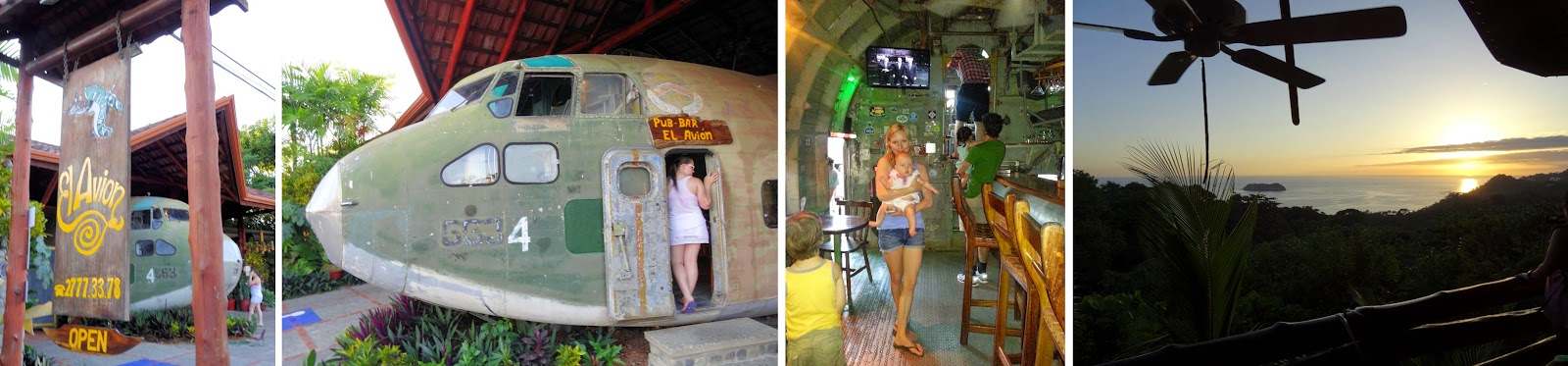


The boys fell asleep not long after getting back on the road, and it was about halfway home that we pulled over at a roadside eatery for dinner. “Rest Club Roncador” – an open-air, no-fuss, pull-up-a-couch for the boys to sleep on kind of place. Sitting around the enormous table we had a delicious dinner, my favorite from all the evenings in Costa Rica. The menus were completely in Spanish, the other tables were occupied by locals, the kitchen was visible and also outdoors, and the food took forever. I had shrimp quesadillas (the shrimp as fresh as it gets and still cooked), and washed it down with Imperial beer, the #1 beer of Costa Rica. It was truly a memorable Costa Rican experience, and as we carried the boys back to the car one-by-one, I wondered what similar adventures we might have in the days to come.

Related Posts Plugin for WordPress, Blogger...