![]() |
| Make sure you get a peek (and whiff!) of the cheese vault (middle) |
Monday, June 10, 2013
High Park in Toronto
Two
weeks ago Friday we found ourselves on a plane headed for Toronto, Canada. My
cousin Līga’s confirmation was that Sunday, and we were joining most of my side
of the family for a couple days. For the boys it was their first time in
Canada, and although we didn’t have time for sights like the CN Tower we did
manage to see a few places and sights that Roberts and I hadn’t yet seen.
A nice
surprise was the Cheese Boutique, a gourmet grocery; “At Cheese Boutique
prosciutto hangs from the ceiling, truffles are flown in every Wednesday, foie
gras sits under lock and key, beef is dry aged 60 days, there are olive oils
from 80 different terroirs and jams
made from green walnuts, the best artisanal breads of the city, not to mention
the chocolate boutique, pastry temptations and daily handpicked produce - but
it is for the cheese that one must really come here.” (From the website) Note
to self - next time you visit Toronto, drive. That way you can fill the trunk
with French cheese.
Our
relatives live in the vicinity of High Park, and that is how it came to be that
Saturday we spent the majority of the day strolling through this 400 acre park.
Originally purchased by John Howard as a sheep farm, the property was donated
to the City of Toronto on three conditions; first, for Mr. Howard and his wife
to continue to live in their house, the Colborn Lodge, second for no alcohol to
ever be served in the park, and third that the park be named High Park and be
free for people to enjoy. Opened in 1876, a large part is natural forest, with
the oak savannah maintained by prescribed burns. With gardens, sports fields,
picnicking areas, a beautiful children’s playground and a free zoo, there is
more to do than can be seen in a day.
We
followed small trails through the woods along the west ravine, which leads past
Wendigo Creek and Wendigo Pond. Named after the wendigo, mythical cannibalistic creatures of Algonquian mythology,
we did not linger long….It was discovered in 2003 that the eastern ravine lies
over an ancient river; when capping two artisan wells a plume of water, sand
and gravel shot fifty feet into the air. Research shows this pre-glacial
Laurentian River System 160 feet below the surface had been undisturbed for
thousands of years.
On the
western edge of the park is Grenadier Pond, covering 35 acres and named after
the local Town of York garrison of the 1800s who used the pond to fish. It is
believed that British Grenadiers fell through the ice when crossing to defend
the city in the War of 1812, and another urban legend claims the pond is bottomless
and that the bottom has never been touched due to layers and layers of mud. On
our visit the shore was dotted with fisherman fishing for bass, crappie, perch,
pumpkinseed, bluegill, bullhead and carp.
We
stopped in the zoo, the home to American bison, emu, llamas, peacocks, fallow
deer, capybara, Highland cattle, yaks, Barbary sheep, and Mouflon sheep. Our
favorite was the little wallaby that was returning to its enclosure from an
outing. Although Lauris wasn’t keen on petting the joey, my cousins Annelī and
Andis were! In 2012, the Toronto City Council discontinued funding to the High
Park Zoo. Luckily the Honey Family Foundation stepped up to sponsor the zoo for
three years, hopefully allowing the Friends of the High Park Zoo time to find a
permanent source of funding.
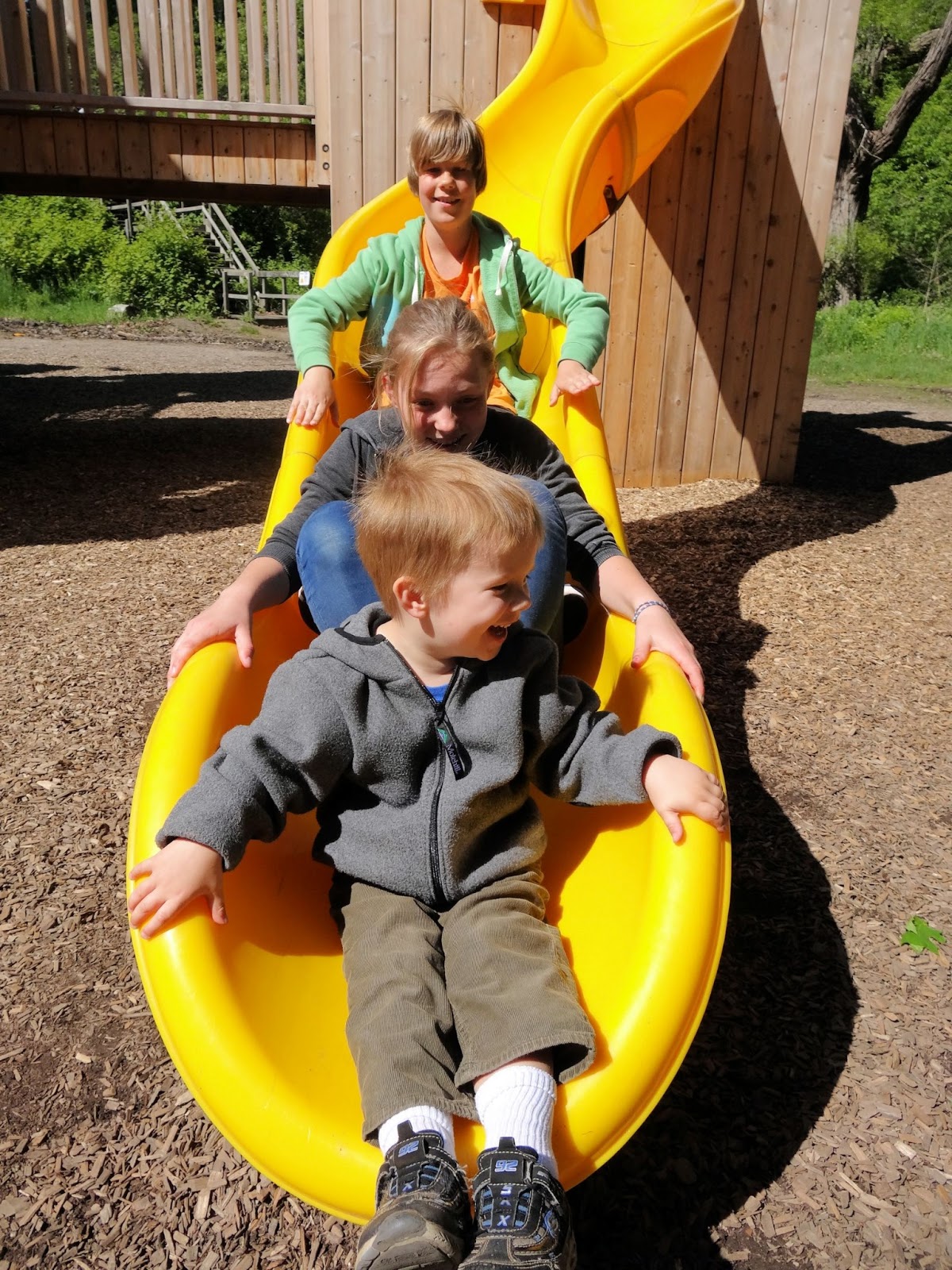
Our
next stop was the children's playgrounds, built in 1999 and named the Jamie
Bell Adventure Playground after the volunteer who initiated the construction. A
little over a year ago a portion was destroyed by arson, but the local
community banded together to build a grand castle as a replacement , and the
combined playground is fun for kids of all ages. The wooden walkways, towers
and bridges brought back childhood memories of Indian Boundary Park in Chicago,
the fieldhouse of which was also destroyed by arson in 2012.
We did
not have a chance to visit the Grenadier Café, nor the produce market, Nature
Center, pool or the Colborn Lodge Museum. We saw the little trackless train
drive by (also free) but going for a spin will have to wait for a future visit,
as will attending on of the Shakespeare in the park plays. The cherries had
already bloomed (the first of which was planted in 1959 by the citizens of
Tokyo), but to me all this just means we’ll have to return again soon. Nevertheless, the boys were
growing tired and there was a long evening of preparations ahead for the next
day’s confirmation, and so we headed back to krusttēvs
Māris’s house
for the evening, leave High Park to the wallabies for the night.
Friday, June 7, 2013
Chicks, trucks & salmon bakes
Greenville is in contention for Outside magazine’s title of “Best
Town Ever.” If you vote for your favorite “active outdoor town” you can be in
the running for a five day vacation grand prize. Voting does require a facebook "like" to vote. You can find Greenville's entry here.
Temperatures are heating up, we’ve initiated pool season at
our house and watermelons are officially back in the diet. Once the boys have
had their fill and I tire of the quarter melon taking up space in the fridge, I
cut the rest up into chunks, toss it and a few basil leaves into the blender
with some lemon juice, and pour the blended result into a pitcher to keep in
the fridge. Also freezes well to make popsicles for the boys!
Our neighbors’ chicks have hatched, and the boys have
already been over twice to see them. Their chicken coop is coming along nicely,
and we believe they might have started a neighborhood trend because the neighbors
across the alley have built their own chicken coop and we've got one or two more broods on the block...
Touch a Truck, the annual free event held in conjunction with the Main Street farmers market is tomorrow, Saturday June the 9th. Kids will have the opportunity to climb, play on and sit in the driver’s seat of almost 20 different vehicles, including large trucks and heavy equipment from the City of Greenville Police, Fire and Public Works Departments. Head to McBee Avenue off Main Street in downtown Greenville between 8 to noon, although I suggest getting there early to avoid the crowds.
We made a foil-baked salmon for dinner, it is a great light
meal for these hot summer days. A plus is that it can be prepared earlier in
the day and then tossed in the oven when dinnertime rolls around. The recipe is
adapted from the one in Williams-Sonoma “Cooking for Yourself,” a gift from my
godmother and also something I haven’t done in ages.
Speaking of my godmother (who lives in Toronto), her
daughter (my cousin) had her confirmation a few weeks ago. We were lucky to be
there and celebrate this meaningful occasion with her, and hopefully I’ll find
the time to put it down in writing this next week. Despite having lived
overseas and visited over ten countries, this was both boys’ first visit to
Canada, eh?
Foil-baked salmon with corn and lime (serves 2 adults, 2 kids)
Ingredients: 4 heads of corn, corn sliced off
1 red bell pepper, seeded and diced
4 tablespoons of chopped fresh cilantro (can probably double this easily)
1 jalapeño chile, seeded and minced
salt and ground pepper to taste
4 teaspoons unsalted butter, cut into pieces
½ lime cut into thin slices, the rest into wedges
1.5 pounds of salmon fillets
1. Preheat oven to 450˚F (230˚C)
2. In a large bowl, combine corn kernels, bell pepper, cilantro, chile, salt and pepper
3. Place a large sheet of aluminum foil on a work surface. It has to be large enough to wrap everything up hobo-style, so use your judgment on size. I put a baking sheet with a rim underneath, just in case.
4. Place corn mixture on foil and dot with half of the butter
5. Place salmon (skin-side down if applicable)on top, squeeze lime juice over and season with salt and pepper. Then top with lime slices and remaining butter
6. Fold two opposing foil sides together and seal well, then fold and seal ends.
7. Bake until salmon flakes with a fork, 20-30 minutes (timing depends on thickness of fillets and packet)
8. Open carefully, allowing for hot steam to escape, transfer to serving dish and enjoy!
![]() |
| The boys active outdoors at the zoo |
![]() |
| That's Blue in Lauris's hands, pardon the camera cord |
Touch a Truck, the annual free event held in conjunction with the Main Street farmers market is tomorrow, Saturday June the 9th. Kids will have the opportunity to climb, play on and sit in the driver’s seat of almost 20 different vehicles, including large trucks and heavy equipment from the City of Greenville Police, Fire and Public Works Departments. Head to McBee Avenue off Main Street in downtown Greenville between 8 to noon, although I suggest getting there early to avoid the crowds.
![]() |
| Touch a Truck in 2010, Lauris's first of many rides in an excavator bucket |
![]() |
| Foil-baked salmon with corn and lime, see recipe below |
![]() |
| If you look veeeery closely you'll see the CN Tower just a little to the right of center |
Foil-baked salmon with corn and lime (serves 2 adults, 2 kids)
Ingredients: 4 heads of corn, corn sliced off
1 red bell pepper, seeded and diced
4 tablespoons of chopped fresh cilantro (can probably double this easily)
1 jalapeño chile, seeded and minced
salt and ground pepper to taste
4 teaspoons unsalted butter, cut into pieces
½ lime cut into thin slices, the rest into wedges
1.5 pounds of salmon fillets
1. Preheat oven to 450˚F (230˚C)
2. In a large bowl, combine corn kernels, bell pepper, cilantro, chile, salt and pepper
3. Place a large sheet of aluminum foil on a work surface. It has to be large enough to wrap everything up hobo-style, so use your judgment on size. I put a baking sheet with a rim underneath, just in case.
4. Place corn mixture on foil and dot with half of the butter
5. Place salmon (skin-side down if applicable)on top, squeeze lime juice over and season with salt and pepper. Then top with lime slices and remaining butter
6. Fold two opposing foil sides together and seal well, then fold and seal ends.
7. Bake until salmon flakes with a fork, 20-30 minutes (timing depends on thickness of fillets and packet)
8. Open carefully, allowing for hot steam to escape, transfer to serving dish and enjoy!
Wednesday, June 5, 2013
Congaree National Park
On our way from Charleston back to Greenville we had
time for one more stop. As Columbia is almost exactly halfway we chose Congaree National Park as our stopping point; less than a 30 minute drive from the
capital of South Carolina, this 26,546-acre National Park preserves the largest
tract of old growth bottomland hardwood forest left in the United States. Due
to intermittent flooding the area was not logged in the first half of the
twentieth century when the surrounding area was cut, and after a campaign by
the Sierra Club and local activists Congaree Swamp National Monument was
established in 1976. Later designated an International
Biosphere Reserve in 1983,the park lost several National Champion trees when Hurricane Hugo hit in September of 1989. However the area retained its significance as an important area for birds (designated Globally Important Bird Area in July 2001) and in 2003 the
National Monument became the nation's 57th National Park.
As we approached the skies gradually darkened, and by the
time we reached the Visitors Center it was raining buckets. We had hoped to
walk the 2.4 mile Elevated Boardwalk, which winds through a diverse old-growth
forest. Passing through a cypress/tupelo stand and ending at Weston Lake (an
old channel of the Congaree River), I could easily imagine the Ivory Billed
Woodpecker still living in these woods. But it was not meant to be, as the rain
only came down harder during our dash from the car to the Visitor Center.
The trees growing in this floodplain forest are some of the
tallest in the Eastern U.S., forming one of the highest temperate deciduous
forest canopies remaining in the world. The Congaree River flows right through
the park, and about 57% of it is designated wilderness area. From the exhibits
we only got a slight feel for the immense forest just outside, although they
provided a good picture of the history of the area and the reasons the forest
managed to escape logging. We helped Lauris start the Junior Ranger activity
book while Mikus stretched his legs, and before we knew it we were sprinting
back to the car, only stopping once for a single photo to prove our visit wasn’t
just a dream.
![]() |
| Bald cypress and water tupelo along Cedar Creek: source here |
![]() |
| Harry Hampton, one of the first champions of Congaree, next to a bald cypress, source here |
Monday, June 3, 2013
Charleston, SC
Crossing into Charleston when coming from the northeast on
Highway 17 you’ll take the Arthur Ravenel Jr. Bridge; also known as the New
Cooper River Bridge, the eight-lane cable-stayed bridge opened in 2005. The
1,546 foot long span can supposedly withstand wind gusts in excess of 300 mph,
earthquake to approximately 7.4 on the Richter scale, and protecting the bridge
from ships are one-acre rock islands, ensuring any ship will run aground before
it can collide with one of the two towers. The bridge cost around $700 million,
and is named after the retired U.S. Congressman who ran for the SC Senate with
a goal of solving the funding problem that had plagued the replacement of the
previous bridge for over 20 years.
Once in Charleston we headed for the 5-acre Waterfront Park
that stretches ½ mile along Cooper River. In 1980 the site was in bad shape
after years of neglect and a fire at a steamship terminal, and mostly consisted
of weedy parking lots. In 1975 the Mayor had began making plans to revitalize the harbor-front, but those were
only realized at the end of the 80s, at which point even Hurricane Hugo could
only delay the opening of the park by one week. We started barefoot in the
fountain at the northern entrance to the park, beyond which Vendue Wharf
extends into the Cooper River.
Continuing on, the esplanade curves in toward Concord
Street, allowing for natural marsh habitat along the edge of the river. Finally, North Adger’s Wharf marks the southern edge of the park. We
opted to go on and follow East Bay, passing “Rainbow Row,” built as merchant’s
houses between 1740 and 1787.
Walking along the Battery we spotted a pair of dolphins in
the bay. The mansions on this street all have a story, from the William Roper
House that has a fragment of a Civil War cannon (not cannonball!) embedded in the roof rafters, to
the William Ravenel House, which lost two stories of its portico in the
earthquake of 1886. At the end where the Ashley and Cooper Rivers meet is the
White Point Garden. The park got its name from the large mounds of white oyster
shells that once covered the point, and the popular name “The Battery” comes
from the fortifications that were placed along the seafront. The cannons placed
around the park represent the wars in which Charleston has played a part.
From the Battery there is a wide view of Charleston harbor:
of Fort Johnson from which the first shot of the Civil War was fired, Fort Sumter
that was recipient of said shot, Fort Moultrie where Edgar Allen Poe was
stationed when he wrote The Gold Bug,
and Castle Pinckney, the 1809 fort that was used to house Union prisoners of
war.
We crossed through the park and headed north on Meeting
Street, passing historic homes left and right. Over the years we’ve played
tourist and tour guide in Charleston, but I never tire of learning more about
these beautiful houses. Thomas Heyward’s (signer of the Declaration of Independence)
18 Meeting Street has a secret wine closet, the Otis Mills House at 37 Meeting
Street (which was headquarters for General Beauregard during the Civil War) is
rumored to have pirate treasure buried in the backyard, and the bells at
Charleston’s oldest church (St. Michael’s Episcopal) have crossed the ocean
five times. My audience was only partially interested.
Our walk was put on hold while we ducked into Hyman’s Seafood. Possibly the best-known seafood restaurant in the historic district,
we have always been happy with the food and this visit was no different. We
started with scallops over fried grits with cheddar cheese and Cajun seasoning,
a bacon and parmesan cheese sauce on top that I wanted to eat with a spoon.
Roberts had the light Cajun stiffed grouper with crab & parmesan cream
sauce, while I had a bowl of She-crab soup and the crab cakes. Absolutely
delicious, every last bite. The icing on the cake - the oysters, although there
is a reason the hush puppies have won awards. The property has been in the
Hyman family for over 120 years, starting out as a wholesale dry goods
business, but in more recent times has been featured (as a restaurant) in
Southern Living to NY Times – it’s certainly no secret they have great seafood!
Just across the street is Market Hall. The first public market on this site opened shortly after the Revolutionary War, and the present Roman Revival structure dates from 1841. The sheep and bulls’ heads pictured in the frieze indicate meat was sold there, and during the 1800s the streets and rooftops were lined with buzzards who lived off the scraps thrown out by the butchers. The Confederate Museum is on the second floor, but the tourist attraction is below in the arcade, which houses the shops.
One hat purchase later we emerged from the market at the opposite end, crossing over to the parking garage to pack up and head towards home. We’ve really seen very little of the city, but it’s still one of our favorites, and I’m positive we’ll be back soon for more seafood, sunshine and history. Who can resist?
At the end of the pier past the many swings is a floating
dock with views of the Ravenel Bridge, Charleston Harbor, Castle Pinckney, the
U.S.S. Yorktown at Patriot's Point, and Fort Sumter. Supposedly charred pilings
from the 1955 fire at Tidewater Terminals, Inc. are still visible too. After a
stroll up the pier we continued south through the park, which is divided into
two parts; a shaded urban portion to the right and a palmetto-lined esplanade
to the left. Halfway down we shucked our shoes once again, this time for the Pineapple
Fountain.
Just across the street is Market Hall. The first public market on this site opened shortly after the Revolutionary War, and the present Roman Revival structure dates from 1841. The sheep and bulls’ heads pictured in the frieze indicate meat was sold there, and during the 1800s the streets and rooftops were lined with buzzards who lived off the scraps thrown out by the butchers. The Confederate Museum is on the second floor, but the tourist attraction is below in the arcade, which houses the shops.
One hat purchase later we emerged from the market at the opposite end, crossing over to the parking garage to pack up and head towards home. We’ve really seen very little of the city, but it’s still one of our favorites, and I’m positive we’ll be back soon for more seafood, sunshine and history. Who can resist?
Labels:
Atlantic coast,
bridges,
fountains,
historical,
parks,
restaurants,
South Carolina
Location:
Waterfront Park, Charleston, SC, USA
Friday, May 31, 2013
Huntington Beach State Park
After our
long day in the sun on Bulls Island I didn’t have much planned for the
following day. I figured we would wake up, see our friends off on whatever
adventure they had planned for the day (you can read about their day trips to Myrtle
Beach and in Charleston here) and see where the wind would take us. Another
sunny day; our luck with the weather so far was holding. Although the
beach house we had rented was comfortable with great views of the Intercoastal
Waterway and coastal marshes, it seemed imperative to do something, we had driven all this way after all.
We had
thought to stop in Charleston on our way home that Sunday, and so instead chose
to head north to Huntington Beach State Park. Another excellent beach, although
this one was quite crowded compared to the experience of the previous day. The
State Park boasts of its surf fishing and bird watching, and within the Park is
a Moorish-style mansion, Atalaya, a
National Historic Landmark which was the winter home of the Huntington family
that also designed nearby Brookgreen Gardens.
We
spent our time on the beach, building sand castles that one by one were swept
away by the incoming tide. Mikus preferred the tidal ponds to the surf, but
both boys squealed in delight when we took them into the waves. The beachgoers
who had so carelessly set up their flotilla of chairs, umbrellas and gear
blocking our view of the ocean hurriedly evacuated when the tide came lapping
at their feet. We would have been content to laze all day, but by late
afternoon the crackers, dried fruit and other snacks I had brought were not enough
to keep hunger at bay.
Benefits
of visiting Huntington Beach SP vs. Bulls Island are the amenities. It was nice
to be able to rinse all the sand and saltwater off before jumping in the car,
and a Nature Center and restrooms are available if needed.
On our
way out we once more crossed the large freshwater lake, full of alligators
sunning on the shores, egrets and herons doing their one-legged dance in the
shallow waters. Continuing north on Highway 17 is Murrells Inlet, which is
where we stopped for a late lunch, and just south of the Park are Litchfield
and Pawleys Island, more beach communities, each with its own distinct flavor.
Visitors to the area could also visit Myrtle Beach, however The Carolina’s
largest motorcycle rally, Myrtle Beach Bike Week was ongoing. We opted to point
our family sedan in the other direction.
After
another relaxing evening spent hanging out with our friends we turned in for
the night, already dreaming of the seafood we would eat the following day in
Charleston…
Entrance
to park: $5/adult, $3 each ages 6-15 and free for children under 5. There is a
separate charge to take the tour of Atalaya.
![]() |
| For McClellanville beach house rentals click here |
Subscribe to:
Posts (Atom)