Wednesday, June 13, 2012

Our most recent guest

The Kalamazoo grandmother’s visit was over in the blink of an eye. She arrived not long after we returned from our Amsterdam trip, but unfortunately missed Lauris’s second birthday and the parties involved. As had happened last year, we celebrated a few times; once on the exact day, just the four of us, then at the IWC mom and baby group May birthday party extravaganza. Finally we had the train party that I went overboard with. To top it all off, Lauris’s friend Beatrice had a party to celebrate her third birthday, so by the time the boys’ grandmother arrived we were all partied out!

Truffade!

On the other hand, she arrived just in time to help celebrate our third wedding anniversary and to enjoy a wonderful weekend with our friends. A day spent by the pool and barbecuing was followed by a visit to Montpeyroux. (Do I spot a trend? Chicago grandmother also got to visit this Plus Beaux Village, although we didn’t hit the petting zoo that time.) She got to know Mikus, as this was her first time meeting her fourth grandson, and was reacquainted with Lauris

The Montpeyroux farm

A little over a week after her arrival we were off to meet grandpa in Germany with a slight detour past Mount Blanc and through Switzerland. Once back home the last week passed unnoticed, and I couldn’t believe when it came time to drive her to the airport! I had all these grand plans of things we would do and projects I wanted to finish, but instead we spent the days enjoying the roses in the park, taking long walks around town and enjoying the things that grandmothers do best (reading books, building towers… that sort of thing!).

Place de la Victoire in Clermont-Ferrand

I was spoiled with opportunities to go to the grocery store… alone. I was also able to spend more time in the kitchen experimenting with some new recipes, and Roberts and I got not one but TWO nights out sans enfants! However the best part was seeing Lauris wake in the mornings to go running off to grandmother’s room to say good morning.

Staubbach Falls in Lauterbrunnen, Switzerland

We had to drive Roberts to the airport for a week of business on the other side of the world and one day later we found ourselves saying goodbye again, this time to the grandmother. One of those really hard weeks followed, just me with the kids who both caught colds and couldn’t sleep because of the congestion. Finally dad has returned home and the runny noses have slowed if not abated. The trips to the grocery store with my entourage have resumed; Monday I was complimented on having “two-stories” of children (at least that’s what I understood with my limited French, I can imagine she was commenting on Mikus in the baby carrier while Lauris was in the stroller). And you know what? Those unfinished projects will just have to wait (until Mikus starts college?), because we have to go to the park to check on the progress of installing the new playground equipment. It’s just a shame grandmother couldn’t stay long enough to see the work completed.

Monday, June 11, 2012

Brugge


The city of Brugge creates the illusion of a medieval village, complete with horse-drawn carriages and swans in the dark canals besides ancient churches. Although the horses may be pulling carriages of tourists, there is something about the town – it’s been listed on the UNESCO World Heritage list along with cities like Lyon, and Venice. Two of the traditions that made the town famous (the production of bobbin lace and the Holy Blood Procession on Ascension Day) survive to this day, and Bruges (in French, Brugge in Dutch) is considered the center of Flemish painting.

Minnewater - the "Lake of Love"

After a tour of the storm surge barrier of the Netherlands that morning, we arrived in Belgium ready to explore Brugge and its romantic town center. What better place to start than the Minnewater, known as the “Lake of Love”? An old legend explains the swans in the waters of this lake next to the Beguine Convent as a directive from Maximilian of Austria. He was imprisoned in 1448 by the citizens of Brugges and his councilor (whose crest featured a swan) was even beheaded, so when he was freed he ordered the town to keep swans on their canals from that day on, to remind them of their crime forever.


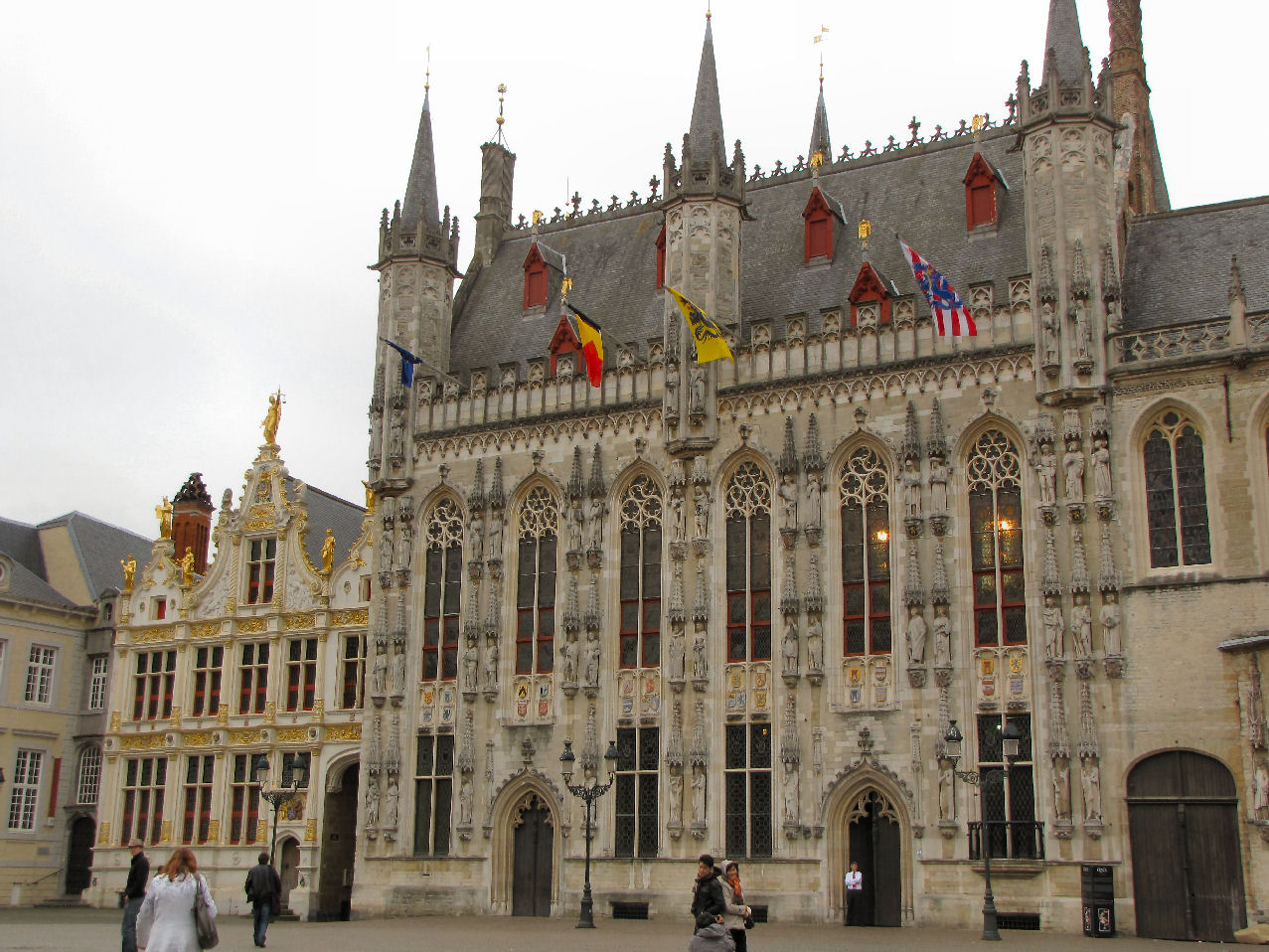
We strolled through the Beguine Convent (Begijnhof) in the shade of old oaks, returning to canal to find ourselves a lunch of moules. Then it was just a matter of following the canal north, past the 13th century Onze-Lieve-Vrouwekerk that houses Michelangelo’s white marble “Madonna and Child,” past the Oude Griffie, the Renaissance buidling that was the municipal records office in the 16th century, and finally reaching the Stadhuis. Built in the 14th and restored in the 19th, the town hall has a beautiful façade.


At this point we left the canal to wind our way to the Markt, the central market place. We passed the Belfort and Hallen, the belfry and covered market. The tower of the belfry dates to the 13th century and we remained long enough to hear the 47 bells chime the hour.


Our friend Oskars was awaiting our arrival in Brussels that evening and so our time in Brugges was short. But, I would like to believe there will be a “next time” that will allow us to further explore the storybook canals and time-worn cobbled streets.

Friday, June 8, 2012

Netherlands be dammed!

After a day spent in a miniature Holland and amongst the windmills we were off to explore the Delta region of the Netherlands. The Rhine, Maas and Scheldt estuaries form a complicated network of islands, headlands and channels which would all be several meters underwater during a storm surge (as well as a good part of the rest of the Netherlands) if not for the Oosterschelde storm surge barrier.


The Haringvlietgates - facing inward, towards land


During normal tides the islands and peninsulas are protected by high dunes, and the banks of the rivers are strengthened by dikes, but during a storm water levels and high tides can drastically change. The 1421 St. Elizabeth day floods that gave Kinderdijk its name killed 10,000 people when six villages were completely inundated. More recently 1,835 people died and 500,000 were left homeless in 1953, when on January 31st low atmospheric pressure and high tides caused the dikes to fail in multiple places.

Because of these tragedies four main dams were built to close off the inlets of the North Sea. To allow ship traffic to continue as normal, two have locks. Initially four secondary dams were built to provide protection during the construction of the main dams. The “Delta Plan” was finally finished forty years later, in 1997.

The Haringvlietgates, facing seaward

The dams accomplish the following: they shorten the coastline by about 435 miles, they form several freshwater lakes, they limit the risk of flooding, they reduce saltwater seepage into the water table and they increase recreation and development in the area. I’m curious as to the effect on wildlife, would the change from saltwater inlet to freshwater lake not drastically alter the estuary habitat, especially for plant life and amphibian species?

Inside the Haringvlietgates

We stopped to take a tour of the Haringvlietgates, the largest floodgates in the world. In addition to functioning as part of the Oosterscheldedam, they also hold saltwater out. During high tide they close, but at low tide they allow the flow of freshwater out. 60% of the Maas and Rhine rivers flows through its gates. These were in the process of being closed as we toured, but the movement was not detectable as they close at a rate of 1 cm/second. The tour took us through the interior of the structure under the freeway that runs on the top, and we saw the giant hydraulic mechanism that powers the gates and enjoyed a good view of this awesome man-made structure. If traveling in the area and curious about the dikes, I would suggest a stop at Expo Haringvliet. A quirky alternative to the commercialized Waterland Neeltje Jans farther south, the eccentric roadside stop has an attached museum, restaurant, children’s playground and petting zoo.

I think all three need a haircut, wearing a hat is only a temporary fix!

The drive south along the coast was more of the same, giant dams and bridges keeping the Netherlands above water. We took a slight detour to the town of Veere, a sailing center and resort. Historically a fishing village as the Veerse Meer was connected to the sea before the dam was built, the town has luckily survived the change and seemed to be full of character and charm. The old town hall was worth a look with the elaborate decoration and carillon of 48 bells.

Finally we crossed the Westerschelde, a saltwater inlet that remains undammed. Not long after we were over the border leaving the old windmills, tulips and storm barriers behind for a taste of Belgian chocolate, moules and waffles and a glimpse of Brugge and Brussels

Wednesday, June 6, 2012

The Kinderdijk windmills

Tulips and windmills – the things most associated with Holland (of course, the wooden clogs come a close third). We had spent a day in the tulip fields and Keukenhof, and had seen quite a few windmills from the windows of the car, but I wanted a genuine windmill experience. After our stop in Madurodam we planned to stop in Rotterdam overnight, and so it happened that we were able to visit the Kinderdijk windmills, just a short distance southeast of the city.


The small town of Kinderdijk is named after the crib with a crying baby and cat that supposedly washed up during the floods of 1421. (A literal translation would be “children’s dike.”) Nearby are the Nederwaard pumping station and 19 windmills. Because of their number and size they were designated a UNESCO World Heritage site in 1997, although they last pumped water in 1950.

From the informative placards on site –
A windmill turns counterclockwise. The energy source (wind) is caught on the stock, which is turned to face the wind by turning the entire cap in the direction of the wind. In order to catch more wind, the frames are slightly bent and fitted with wind plates and sail cloths. The wind force is conveyed via the axle of the stock to a large wheel with protruding cogs. The teeth of the wheel drive a vertical axle (the upright shaft). At the bottom of that shaft a large wheel in turn drives a scoop wheel of the mill. The scoop wheel conveys the water to the catch-water basin. The turning mill is stopped by means of a brake mechanism, known in Dutch as the vang.


I was fascinated to learn that the position of the sails can indicate a certain situation or event This is shown in these pictures. The working position (A) is used when the mill is stationary for a short time; the resting position (B) when no milling is to take place for some time. The celebration position (C) indicates that a pleasant event has occurred, such as a birth. The position of sorrow (D) designates a death.

We had the dike almost all to ourselves, and although the clouds and wind made the experience a little cooler, the weather contributed to the beauty of the marshland surrounding these beautiful historical national icons. As dusk was approaching and our energy levels waned we walked back to the car and returned to Rotterdam.


Other than the view from the hotel room of the port (one of the world’s largest) and downtown, we saw very little of Rotterdam as it was only a stopping point on our way from Amsterdam to Brussels. We arrived late, and as Lauris watched the elevated trains stopping at the station just next to the hotel I caught the tail end of a few favorite TV shows (in English!) that I hadn’t seen in over a year. Maybe not the most interesting things in Rotterdam, but it was definitely a relaxing evening that allowed us to replenish our energy stores in preparation for tomorrows drive which would take us across the Storm Surge Barrier back into Belgium, to Brugge and Brussels.

Monday, June 4, 2012

The Diamond Jubilee

Queen Elizabeth II celebrates 60 years as Monarch this year, and this weekend was the Diamond Jubilee marking six decades of her reign. She is the second Queen in the country’s history to celebrate this milestone, the first being Queen Victoria in 1897. As I’m not British, nor living in Britain, I will leave blogging about it to others like Laura or Ariana. However, I do love the idea of the entire country celebrating together as a nation (we recently participated in the Queen’s Day celebrations in Amsterdam which had a similar feel) and so under the guidelines of “a good excuse for a party” we will eat cake!


Our Jubilee weekend as a whole was relatively low-key, cake and all. The Kalamazoo grandmother is still visiting (I haven’t quite caught up with our traveling yet and so she’ll make more appearances in later blogs) and volunteered to put both boys to bed Saturday night, leaving us free to see a movie. Moonrise Kingdom was the perfect choice for our first date in a theatre in over two years; it was shown version originale (so, in English), it’s a comedy, Bruce Willis, Ed Norton and Bill Murray all star and most importantly, the sleep deprived parents could stay awake for the relatively short 90 minute movie.


Afterwards we grabbed a bite to eat at Pata Negra, a tapas place here in town. Average in price, food and atmosphere, yesterday it turned out to be just the thing. As it was past 9pm most restaurants had stopped serving (I know! They don’t start serving until 7:30pm, you would think they would at least serve us dessert!) and so the decision was made for us. However, if you’re looking for a lively atmosphere for a casual dinner in Clermont, this is the place; there was live music playing both times we’ve eaten there. Our first visit was shortly after moving to Clermont, memorable as the band playing tango had several professional-looking couples on the dance floor.

This year’s picnic at Lake Aydat was postponed due to rain and thunderstorms Sunday, so instead we spent the morning watching from our living room as the hundreds of runners competed in the annual races. Last year there were over 3,700 participants, so I expect the number this year was closer to 4,000. At least five separate races for children (by age bracket) were followed by a 5km and two 10km runs (one elite and one open). Afterwards a quick visit to the marché aux puces where I found a solid, large flowerpot for a couple euro. We sat out the promised rain in a nearby café.


The excitement level in Clermont is at a peak, between the races, rugby and tennis. The Top 14 semi-final rugby match between Clermont and Toulon was on Sunday, which got the entire town sporting yellow & blue and trying out their air horns. Last year Clermont beat Toulon at the same stage with big drama – controversial calls and all, but it was still sad to see the hometown lose. And the 2012 French Open is underway. The 111th tournament is taking place at the Stade Roland Garros until June 10th. (The French Open is also called the Roland Garros, after the French aviator)

And of course we took plenty of walks. The roses are blooming in Jardin Lecoq, the playground in Parc Amadeus is undergoing repairs and so requires constant visits, and Place de Jaude seems to be hosting a different bandstand with a different man on bullhorn every day. This is my favorite time of year in Clermont-Ferrand! (Well, until summer when the outdoor cafes seem to spill into the streets and the marches overflow with the summer bounty!)


Congratulations to Her Majesty on 60 years of service, and whether you spent the weekend in a flotilla honoring the Queen, watching a tennis and rugby game, running in the Courir à Clermont races or at home enjoying time with family, I hope everyone had a Happy Jubilee weekend!


Related Posts Plugin for WordPress, Blogger...