Showing posts with label French traditions. Show all posts

Monday, January 6, 2014

Galette des rois - king cake!

Priecīgu zvaigznes dienu! We celebrated with a galette des rois, or “king cake” yesterday, as our guests are departing today for the cold and snowy north. Traditionally made to celebrate the Feast of Epiphany, the cake is popular in France during the holidays and was added to the list of family traditions during our time overseas. Some might associate galette des rois with New Orleans, where it was introduced by French and Spanish colonists and is enjoyed during Carnival, however in France it is served only several days before and after Epiphany.


As I explained in a previous post on this yummy dessert, there is a small figurine or trinket (the fève) baked into the cake – traditionally this item was a bean. The lucky person who gets the slice containing the fève is named king or queen for the day. Or, in our case, the fève remains in the uneaten portion and we get to try again the following day!

To prevent favoritism, the youngest member of the family sits under the table and calls out which person gets each slice, so that the person serving the cake cannot pass the slice with the fève knowingly to a certain person.


In Provence the King Cake is gâteau des Rois, made of brioche and candied fruits, whereas the rest of the country traditionally celebrates with the puff pastry and frangipane that we enjoyed. The recipe calls for almond meal to make the frangipane, but I have used almond flour (not as finely ground and available in many health food stores including Trader Joe's) and also almond butter (Whole Foods has a grind-your-own peanut butter section, that grinds roasted almonds without any additives).


I highly recommend taking the leftover puff pastry dough (the result of trimming the corners to make circles) and making little pīrāgi with Nutella inside. I put mine on the same pan as the king cake, and although a few burst open while baking, they were delicious.


To celebrate Epiphany with your very own king cake, you can either head to your local French bakery or follow this easy recipe, a variation on a recipe given to me by a friend in France that utilizes pre-made puff pastry that you can find in the frozen desserts section at your local grocery store. David Lebovitz just posted a delicious galette des rois recipe on his blog, but if you are looking for something simpler without the orange flower water and zest, try this. Don’t forget to remind your guests there is a fève hidden in the cake!

La galette des rois (king cake)

Ingredients:
1 package puff pastry, thawed
½ cup ground almond meal
¼ cup granulated sugar
1 egg
3 tablespoons butter, softened
1 tablespoon vanilla extract
1 tablespoon all purpose flour
1 fève or fava bean (optional)
1 egg, beaten

1. Preheat oven to 425˚ F

2. Combine the almond meal, sugar, 1 egg, butter, vanilla extract and flour to form a smooth paste.

3. Roll out the puff pastry and cut out two large circles. Place one on a non-stick pan, and on it spread the frangipane mixture in an even layer, leaving a one inch border around the edge of the dough.

4. Hide the fève in the almond filling, and then place the second pastry circle on top, smoothing the air out from under. Press down firmly along the outer border to seal the two layers. Make a small hole in the middle of the galette so that the cake does not swell too much when cooking, and using the tip of a knife cut small slits into the top layer around the edge of the cake. Traditional galette des rois have a design etched into the top…

5. Beat the remaining egg, and brush over the top of the cake. Bake for 25-30 minutes until golden brown.

6. Allow the cake to cool for 20 minutes on the baking sheet before transferring to a cooling rack.

Serve with coffee and a crown!

Friday, August 16, 2013

On cooking with kids - gateau au yaourt

I’ve got two boys that love to “help” in the kitchen. Although I can’t wait for the day that they start washing dishes, it can be tough to find things for them to do; Mikus is too young to be left unsupervised, and Lauris still needs help with many tasks. My goal with them is not to create more work for myself in clean-up; instead I aim to familiarize them with the ingredients that go into the foods they eat, teach  them the kitchen basics and keep them out of trouble while I’m cooking.

 
While living in France I often heard about gâteau au yaourt, or yogurt cake. You might be familiar with it from the book “Bringing up Bébé: One American Mother Discovers the Wisdom of French Parenting” by Pamela Druckerman. Although I found many things in the book to be stereotypes and not representative of the French parents I knew, the yogurt cake was in fact often baked in many households. Not only does it teach children the basics of measuring, mixing and baking, but it instills patience (yes, in the parents, also…), as the kids have to wait for it to cook before they can have it for their goûter, or afternoon snack. I waited for a while to try it out with the boys, as I wanted Lauris to be able to work independently for the most part – that is after all what yogurt cake is all about. Although he still is not able to follow the recipe completely by himself, he does well enough alone that I can concentrate on keeping his brother out of trouble.

 
What makes this the perfect recipe to bake with kids is the measuring system; the empty yogurt containers are used to measure everything but the vanilla and baking powder, and for those a ½ teaspoon measuring spoon will do (3 “spoons” baking powder and 2 “spoons” vanilla). I grease the pan for Lauris and then read off the ingredients, but he does the “measuring” and pouring. Mikus lends a hand with adding a few ingredients and mixing, and then mom handles the baking. We opted to add chocolate chips this last time around, as it was that kind of day, but really you can put just about anything in it: berries, fruit or nuts to give the kids some variety, lemon zest or rum to make the grown-up version. There are two basic recipes floating around, we use the one from Druckerman’s book, which is also the one I’ve included at the bottom of this post. I’ve found that baking it in a loaf pan extends the cooking time and creates a crunchier crust, but a cake tin will give you more of a smooth cake-like texture. It’s delicious either way, and as long as the boys keep eating it we’ll keep making it.

 
Bringing up Bébé’s gâteau au yaourt
 
Ingredients
2 six-ounce containers  of plain whole-milk yogurt
2 eggs
2 containers sugar
1 teaspoon vanilla
Just under 1 container of vegetable oil
4 containers  flour
1 ½ teaspoons  baking powder
Crème fraîche (optional)*
 
Directions
Preheat the oven to 375˚F
Use vegetable oil to grease a 9-inch round cake pan or a loaf pan.
Gently combine the yogurt, eggs, sugar, vanilla, and oil. In a separate bowl, mix the flour and baking powder. Add the dry ingredients to the wet ingredients; mix gently until ingredients are just combined (don't overmix). You can add two containers of frozen berries, a container of chocolate chips, or any flavoring you like.
Bake for 35 minutes, then five minutes more if the cake doesn't pass the knife test. It should be almost crispy on the outside, but springy on the inside. Let it cool. The cake is delicious served with tea and a dollop of crème fraîche.*
 
*As crème fraîche is not readily available in Greenville, we tend to eat it alone, or with a dab of butter (must be the Southern influence, thanks Paula Deen!)
** Another option is to top with slivered almonds (before baking) or powdered sugar (before serving) for a more glamorous result. Perhaps the mommies are coming over for a playdate and you don’t want them to know your son did the baking?
*** If you wish to lower the sugar intake you can cut the 2 cups the recipe calls for in half easily without hurting the end result – it just won’t be as sweet, which isn’t a problem if you’re adding berries or chocolate.

Monday, July 23, 2012

Tour de France - Stage 18

France is conspiring to keep us here… Originally set to depart on Saturday, Air France has gone on strike and so it seems that we will be here until Tuesday, at least. These bonus days are a gift – one more chance to enjoy the local food and the sights of Clermont-Ferrand and surrounding area.


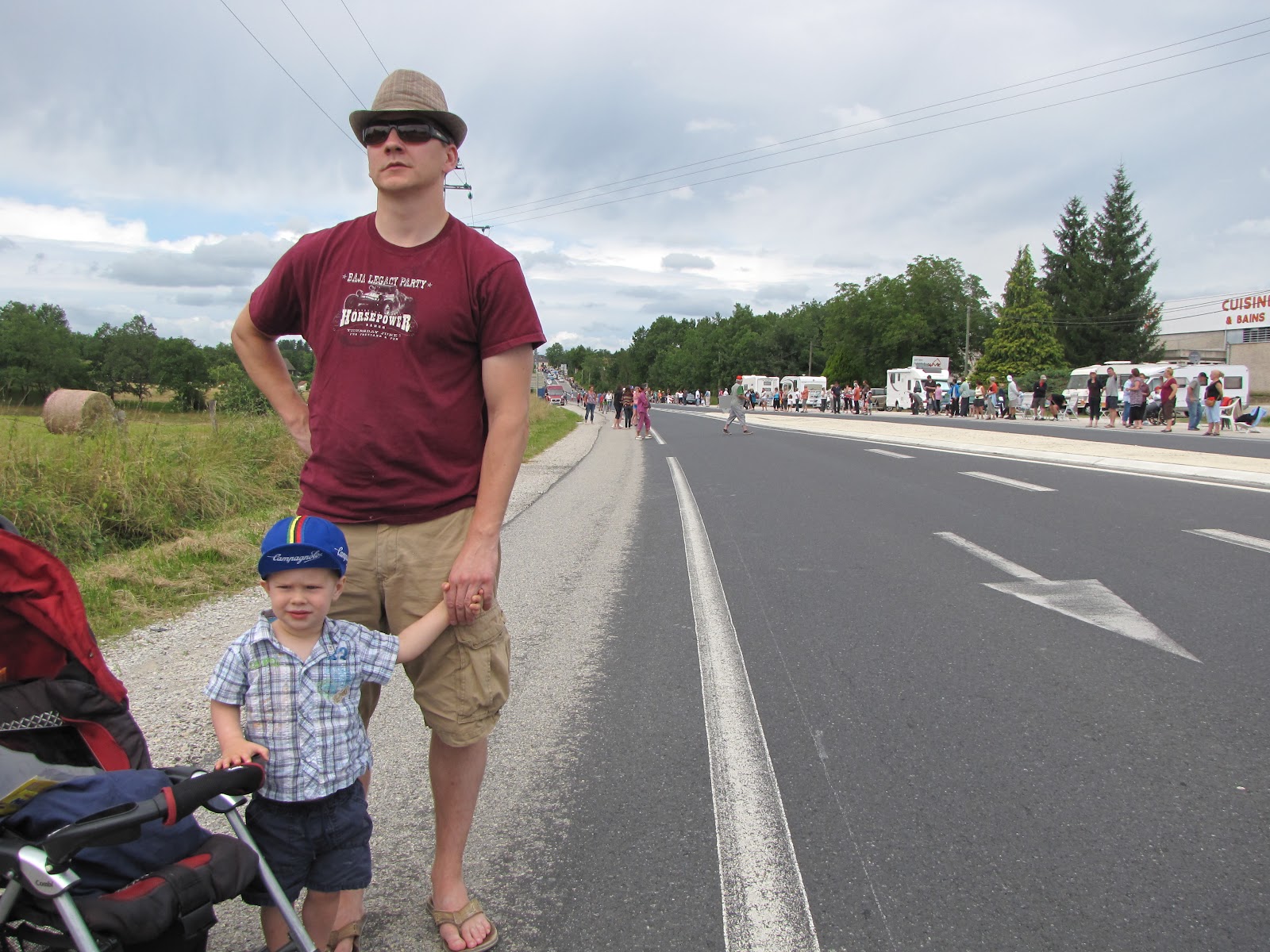
What would have been our last full day in France we had planned to cross something off of our must-do list. Although the Tour de France did not pass as close to Clermont-Ferrand as it did last year, there were several options open to us as we were willing to drive a few hours. As many of the mountain stages that were within our radius occurred while we were on holiday, the choice was made for us, and so we headed southwest on Friday to catch 222.5 km-long stage 18, Blagnac to Brive-la-Gaillarde.


After visiting Rocamadour (which I have yet to write my journal entry for but I’ll share some pictures eventually) we backtracked in a hurry to Cressensac at 193km. Really having no clue as to how easy it would be to access/park/find a spot, we chose the intersection that we did based on proximity to the highway and ease of access, but mostly just chance. Thinking it might be better to avoid the stage 18 finish in Brive-la-Gaillarde as there would be more people there, our route from Rocamadour led us straight to an intersection with the race. The road was blocked off and cars parked up and down the sides of the road, so we just fell in step with others headed the same way.


Cressensac is home to a 14th century castle, the Chausseneige. Located in the Midi-Pyrénées region which is the largest region of France, the Pyrenees are to the south and the massif Central to the north-east. However, the stage was a flat one with a few minor climbs, so when we settled in with our blanket and snacks, we chose a spot on the inside of a curve where we had a view of a small hill they would be coming down as well as a straight stretch that would take them into the village.


And then we waited. Soon the sponsor trucks came, music blaring and throwing little trinkets to spectators as they passed at 40km an hour. Somewhere I read President Holland had chosen stage 18 for the customary drive, but I’m honestly not sure if he passed us. Caught up in the excitement we waved and danced and chatted with other people, some from the next village over and some from farther away, like the man from the UK to our left. He had arrived with a RV (probably very early that morning or the previous night), a large banner hanging down the side and chairs out front, and was kind enough to give us some of the free keychains when he saw us relatively empty-handed due to the quick little professional scavengers to our right, four local kids who seemed to catch the freebies in mid-air.


We later found out there had been an incident with a dog at 120km, which caused a crash and exchange of words, but at our location it was quieter. Their imminent arrival was announced by helicopters, and soon we saw the riders cresting the hill amidst all the cars and video cameras. A quick woosh, and they were past, in an exhilarating run that left us in awe of how quick it happened. And then the rest of the group was by; my impressions of that moment are of cheers, whizzing tires and colorful jerseys. It was over in a few seconds.


On Sunday this 99th Tour wrapped up, with Bradley Wiggins emerging as the first ever Briton to win. His Sky teammate Mark Cavendish won stage 18, but I’ll remember the 99th Tour de France more for the anticipation, the excitement and the bittersweet knowledge that this might be one of our last truly French experiences, than for the winners. Just after the peloton passed us Lauris turned to me, waved his hand in the up and down motion he uses for when he wants more and simply asked, vēl?


(I'll post a few more pictures once Air France allows the end of our in-transit status!)

Sunday, June 24, 2012

Fête de la Musique

Happy Jāņi! Today is the Latvian name day of Jānis and Žanis. The name day tradition is celebrated in many countries, Latvia and France among them, and consists of celebrating the day of the year associated with one's given name.


In France, today is the Fête de la Saint-Jean (feast of St. John), which is traditionally celebrated with bonfires (le feu de la Saint-Jean). It is believed that the bonfire rites go back to the pagan rituals of Midsummer’s night, although today the catholic festival is in celebration of Saint John the Baptist. One source reports that in medieval times, this festival was celebrated with cat-burning rituals. Thankfully there will be no cat-burning in Clermont-Ferrand, but sadly I don’t know of a bonfire occurring here either.

A fête which was celebrated here in Clermont was the Fête de la Musique, also known as World Music Day. The music festival took place on June 21st and has an interesting history that binds the Americans and the French in yet another way. In 1976 American musician Joel Cohen proposed an all-night music celebration in France to mark the beginning of the summer solstice. It was first realized in 1982 in Paris, and has since spread to 32 countries worldwide. 


In Clermont-Ferrand the streets were full of amateur and professional musicians. There were concerts and unorganized jams, all for free. The noise and crowds weren’t the most child-friendly and so we mostly enjoyed the festivities from our window, watching the people on their way to and from Place de Jaude and listening to strains of music floating our way now and then.

The celebrations took a different twist later on that night, as revelers returning home kept us awake with yelling and honking until well after midnight, but as it was all in the name of music (and you’re not supposed to sleep on Jāņu night anyways) I didn’t get too upset. I only wish Mikus had gotten the memo about sleeping in…


Wednesday, March 21, 2012

Sophie, la girafe

I’ve heard every child in France has one*. I also restrained from buying one until about six months ago. Finally I caved in to the pregnant-questioning-my-mothering-abilities guilt and got one for Lauris, although he is a little older than usual to receive his first Sophie. And what is Sophie? La girafe! Born in France in 1961, I’ve heard rumors of desperate American moms seeking to be in the “in” crowd paying up to $50 for this 10 euro toy (but this just can’t be! Amazon.com has them for under $20.). 


So what ended up as an impulse buy has me pleasantly surprised. Six months later and Lauris still enjoys playing with it! The squeaker isn’t that annoying, and everything I’ve read about this toy is so very different from the mass-produced plastic toys of today. The pattern is supposed to be beneficial to a baby’s developing sight, and as the giraffe is made of 100% natural rubber it is advertised as safe to chew on: perfect for teething. There is also a distinct smell, which I thought might be obnoxious but as it turns out, doesn’t bother me at all. And for a small child, it would be incredibly easy to grab and play with, all those gangly legs and neck… Final verdict? I’m glad I finally bought one for Lauris; it’s a great toy for him to share with Mikus! And if any of our friends in the US decide their child absolutely must have this toy, get in touch and we’ll see if Femme au Foyer Inc. can’t import one for you!

Lauris and Sophie enjoying the view this morning

Mikus has already received his very own Sophie from my friend Marine and family who came to visit after we came home from the hospital. Not the same as Lauris’s, it wears an inner tube and is meant for bathtime. There’s all kinds of Sophie gear available, from teething rings to dish sets but I think this household has enough Sophie for now… one per child seems to be about perfect.

"Aw, mom! Enough with the pictures already!"

* From what I’ve seen, almost all French babies Lauris has met do have a Sophie. Most of them look well-loved, and a few mothers tell stories of lost Sophies wreaking havoc upon the household.

Sunday, January 8, 2012

My Two Kings

Friday France celebrated Kings Day (Epiphany); the day Catholic tradition states that the Three Kings arrived in Bethlehem to honor the Christ Child (the Latvian Zvaigznes diena). Celebrating with a “King Cake” in France is quite common, for Catholics and non-Catholics alike. According to Wikipedia, in Provence the King Cake is gâteau des Rois made of brioche and candied fruits and in the northern half of France galette des Rois, a puff pastry with frangipane. Historically there was a bean baked inside, and when eating the cake, the person who gets the piece of cake with the trinket becomes “king” for a day. The beans have over time been replaced first by porcelain and now by plastic figurines.


We were lucky enough to partake in the celebration twice, the first time with our mom & baby group here in Clermont. Nadine brought a delicious King Cake (a brioche with chocolate) to share with the group, and although we skipped having a child crawl under the table to determine who receives which piece (so that there is no possibility of the chef or cake-cutter rigging the process), there was indeed a little plastic king figurine hidden in the cake. Lauris was the lucky one to discover it, and I was the lucky one to have to explain that the plastic piece is in fact not edible, and not meant to swallow, eat or place in mouth. However he was crowned king for the day and we enjoyed a couple of hours spent catching up with our Clermont friends, sipping coffee and enjoying the King Cake.


I first heard of jubilārs vēlās from my aunt and her family, where on their birthday, the birthday boy/girl is in charge (within reason) and calls the shots. They can request special meals and favors, a sort of king for a day. And so it happens that the other man in my life becomes a king for a day, as Roberts celebrates his birthday today.


Today was also our second celebration of Kings Day. In the morning I ran out to our local bakery with Lauris for a couple of fresh croissants and found a line out the front door and a camera crew filming the action. The shelves were full of galette des Rois, and I couldn't help but change my order to include one of the beautiful looking pastries to eat with our breakfast of fruit salad. It seemed only destiny that Lauris find the second figurine in his mini portion of the pastry: this one an Auvergnate rugby player!

Robert, the coming year will bring another addition to the family as well as many wonderful adventures and challenges, and I just want to remind you that your “queen” will be by your side for all of it! Daudz laimes dzimšanas dienā, mīļais!

My two kings


Wednesday, January 4, 2012

Le Père Noël

It was with some trepidation that we awaited the arrival of le Père Noël this Christmas. Sara in Le Petit Village was the first to warn me about le Père Fouettard, the evil partner of the French Santa who travels around with him on Christmas eve to hand out coal and whippings to the naughty children... I will not repeat the terrible crimes he stands accused of (you can read about them here) but will admit that the stories scared me into behaving! And so on Christmas eve, when Lauris was finally tucked into bed (and we’ll wait a few years before mentioning Father Christmas’s partner to him) we hoped that in lieu of the good and evil duo we would be paid a visit by Sala vecīts, Santa Claus or Saint Nicholas.


As it turns out Lauris, our guests Matīss and Indra, Roberts and I must have been extremely good last year! While I started the crêpes in the kitchen Lauris discovered the giant construction crane in the living room (which truthfully was as much of a surprise to mom as it was to son!). We’ve been spending some time watching the construction site next to the Carrefour here in town, and Lauris’s favorite are the giant cranes (although the cement mixers come in a close second). He has become adept at spotting them before I even see them: looming over a building, out the car window and even in the dark! So imagine his joy at having an “AM-ĀH” (in Latvian the word is ceļamkrāns and Lauris has shortened it some) of his own to play with.

Learning to operate the crane with onkulis Matīss

After a late breakfast we opened presents and I was once again absolutely astonished by the lovely gifts and well wishes that appeared under our tree from across the Atlantic and Latvia. Being our first Christmas away from the parents/grandparents it was especially meaningful to me to know that all of our relatives were thinking of us and missing us as much as we them.

The rest of the day was lazily spent between the living room and the dining room, with a short break before dinner to take another walk through town and enjoy the beautiful lights. A beautiful Christmas with some of our favorite people!

The town hall, Place Delille and Place de Jaude

Friday, December 9, 2011

December in the Auvergne – raclette

Nāc, māsiņ, ciemoties
Ziemassvētku vakarā:
Būs pupiņas, būs zirnīši,
Būs cūciņas šņukurīts.

“Come for a visit on Christmas eve, there will be beans, peas and pork!” (Sounds a bit better in the Latvian Christmas carol!) This post is not about pork and beans, and honestly, it didn’t even happen in December, but since the holidays are upon us along with the various dinners, lunches and gatherings, I felt it was an appropriate “December in the Auvergne” post. During the very last days of November we were invited to a friend’s house to celebrate the November birthdays: among the five families that attended there had been seven birthdays (including mine)! The menu? Raclette!

The three amigos meet again!

A dish originally from Switzerland and the Savoy region of France, it involves melted cheese, potatoes and charcuterie/jambon cru. According to Wikipedia, the term raclette derives from the French word racler, meaning "to scrape", because traditionally the heated cheese was scraped from a large round onto diners’ plates. The modern version involves an electric table-top grill with small pans for heating the cheese and a griddle top for cooking the ham.


Melted cheese with bacon and potatoes, I believe I’ve mentioned a pregnant woman’s affinity for such dishes in posts such as Truffade, and Happy New Year. Actually, I’m surprised how little I’ve written about this particular weakness of mine, considering how much I’ve been thinking about it the past months. Why do my pregnancy cravings center around bacon, cheese and fried dough instead of healthier options such as veggies and grains, I do not question.

The evening was a wonderful success. The children spent all their energy while the adults dined and talked, and the raclette grills were turned off much too soon (in my opinion) to make room for dessert (well that did change my mind). Four different birthday cakes with candles appeared, happy birthday was sung twice, and I have my doubts that anyone left without a stuffed belly and that inner peace that comes after such a pleasant occasion.


* Thanks Robert, for all the pictures! Pregnancy brain struck again, as I left my camera at home!

Monday, September 5, 2011

On Eating in France – II. Seven Courses

As of yet I had not worked up the nerve to host my own dinner party, partly because we were still in our temporary apartment and lacked necessary kitchen utensils for even the most basic cooking, partly because the first trimester of this pregnancy was not conducive to food and visitors, and partly because I was intimidated by the endless requirements and formalities of the traditional French dinner. As I do more research on courses and customs, I realize that most everything is flexible. Of course, our friends will not hold it against us if a course comes out of order, and part of the experience is the mixing of a few Latvian or American customs into the French. On the other hand, I would like stick to the French basics, after all it is part of the fun being here in France, learning the traditions and way of life.

The first French friends that invited us to dinner helped explain the French tradition of a gift for the host or hostess. Latvians bring flowers, and often a bottle, often of wine. It is the norm that no one comes empty-handed. Americans tend to either bring a dish or a bottle of wine, which is immediately opened by the hosts and served with dinner. Here in France, because the meal is thoroughly planned out (and along with the meal, the wines that accompany each course), a dish is never brought unless requested by the host, and a bottle of wine will be well-received but rarely opened, as it might not match the food served. Flowers are a safe bet, and are great for any occasion (hint, husband!).

Bread is present throughout the meal. It is viewed it as a symbol of hospitality and a meal would not be served without it. Wine is the classic beverage of choice for meals, and is of course available. If you desire water in restaurants, you must request une carafe d’eau; if you only ask for water you will probably be served sparkling mineral water as well as its bill.

During the first course in a French dinner, L’Apéritif, hosts invite guests into their living room and serve them light alcoholic drinks and small appetizers to stimulate their appetites for the meal ahead. Usually drinks are not served until all guests have arrived, however in some more casual instances l’apéritifs are served to make waiting for any latecomers more bearable. A glass of flavored champagne is typical, although many times if there is a theme to the diner, they will follow this theme. Once in the dining room, l'Entrée follows. These appetizers vary from cold to hot dishes, and can be simple or elaborate.

A fish course is sometimes served between the entrée and the main course in a French dinner, le plat principal, if the main course is meat. But it is not compulsory, and often the meal continues with le plat. This course includes either meat or fish, served with side dishes of salads, rice, or pasta. Wine is served throughout the meal – red wine to go with red meat and white wine to go with white meat or fish (this is a very general statement – the grapes, vintage years and experiences with the wines are often closely matched with the food served). Another variation comes with the salad course, which can either be a separate course at this stage of the dinner, or it may be served with le plat. Traditionally, simple greens tossed with vinaigrette are served as a means of cleansing the palate and aiding optimal digestion of the meal.

The next course, the cheese course, is very important. After the plat and salad courses a selection of cheeses is served, sometimes with fruit or nuts, sometimes only with baguette. I will add at this point that the bread is not cut into slices.  Instead, each guest will tear off pieces with their hands as they wish.

Finally, my favorite, the dessert! French desserts can be indulgent, rich, and beautifully decorated, or they can be a simple bowl of sorbet or glace (ice cream). To keep guests from feeling too full it is usually light and small. Mousse or little tarts are also popular.

Dessert is followed by le café. A typical café is served in a small demitasse, rather than a coffee mug. Often, a small chocolate or sweet biscuit accompanies the coffee on the saucer. Finally, le digestif, which signals the end of a French dinner: Guests are offered small doses of strong alcoholic beverages such as cognac, brandy, or whisky. This last course is also not always observed, but after some holidays it is still a custom to smoke cigars along with it.

My editor, hard at work

Friday, September 2, 2011

On Eating in France – I. Intro

One of my favorite things about France is the focus on food. I know many Americans who skip breakfast on a regular basis, and eat lunch on the go and then grab a fast microwave dinner. I have yet to meet a French person who would even consider skipping a meal, and since I love food (aka I’m pregnant), this suits me just fine. Eating is central to the daily routine, and it starts off in the morning with le petit déjeuner which can be croissants with jams and honey, or for those with a sweet tooth, pain de chocolate. Breakfast cereals are available on store shelves, but not as ubiquitous as in the USA. Still, whenever possible we spoil ourselves with fresh croissants from the boulangerie down the block.

I have written about the difficulties in eating lunch while traveling; in many areas everything shuts down from 1200 to 1400 for le dejeuner. If you arrive even five minutes late, be prepared to be told that food is not being served any longer. The next meal after lunch, especially for families with children, is le gouter. Lauris has one of these when he is at the halte garderie in the afternoons, and I have started to have one at home as well, because who can’t resist cheese on a fresh baguette in the afternoon. Plus, of course, I’m eating for two!

The French dîner is a multi-course affair and can have elaborate themes, decorations and settings. We have been lucky enough to be invited to friends’ homes for a traditional dinner as well as had the experience at a few nice restaurants. The thing about good friends is that they will explain the customs, provide an authentic experience, yet not be offended by a lapse in custom-knowledge on our part. When in the US, we often had friends over for dinner and integrated Latvian customs into American dinners, and my hope in Clermont-Ferrand is to stick with the French traditions, yet allow our Latvian-American roots to show through. Please enjoy my dinner-related blogs next week leading up to our very first dinner party here in the apartment!

The kitchen help taking a break

Vēlos novēlēt manam krustdēlam Imantam daudz laimes 8. dzimšanas dienā!!! Astoņi ir Roberta mīļākais numurs, un tā zinam, ka būs varens gads!!!

Sunday, May 22, 2011

Fête de la Première des Communions

Today we had the honor of attending Kylian’s communion. Kylian’s family was among the first we met here in Clermont-Ferrand, and I was excited to participate in the service at one of the most beautiful churches in Clermont, the Eglise Saint-Pierre les Minimes, on Place de Jaude.

In 1470, when Saint-François de Paul created a new religious order, he called it "Minimal" because humility would be the first of the virtues. About 200 years later the order of Franciscan monks moved to Clermont and built the chapel, which after various renovations is the church today known as the Eglise Saint-Pierre les Minimes.

The communion class on the steps of the church
The service today was to celebrate the first communion of the children of the Notre-Dame of Clermont parish and the Massillon school. The chants sounded beautiful, sung in French and reverberating throughout the church due to the high vaulted ceilings. Rain was in the forecast, but sunlight illuminated the beautiful stained glass and shone upon the fifty-one students as they emerged on the steps of the church after the ceremony. Even top-flight paparazzi would have been elbowed out of the prime photo angles by the rightfully and proudly shutter-happy parents and relatives!

The crowd of parents-paparazzi waiting for their chance

We had been invited to Marine’s home after the service to celebrate. After an aperatif of finely aged wine with a hint of cognac we enjoyed several entrees, little smoked salmon sandwiches and bacon cheese breads being my favorites. The beautiful weather held for the barbecue in the backyard; kebabs and sausage served with a variety of salads. The food was a hit, guests went back for seconds and even after big plates of food, dessert found eager takers.

The kids were having a ball as well. In and out of the kiddie pool, they roamed the backyard in their swimsuits with the excitement of freedom. With a playhouse, swingset, sandbox and lots of toys – and several handfuls of like-aged playmates - they stayed busy, only surfacing for food. The older kids (as well as some of the dads) played futbol and wii, and the party didn’t break up until evening.

3 amigas, 3 amigos!

Thank you Marine for a wonderful Sunday afternoon, and congratulations to Kylian on his holy communion, a noteworthy step in a young man’s life!

Sunday, May 1, 2011

May 1st

This morning we took a stroll to the marché aux puces, and in addition to half dozen paperback novels (in English!!!) we also brought home a bouquet of lily of the valley. In Latvian they are called maijpulkstenīši (literally May clocks) and in French, muguets, but they are symbols of spring in all three cultures. Usually there are flower vendors selling homegrown flowers at the marché, but the difference today was in the sheer volume of the flowers present. It seemed that every person leaving had a bouquet in hand, and unknowingly we followed the tradition of May 1st by bringing one home ourselves. Their beautiful smell has now filled the room, and it brings back memories of my great-grandfather who once gave me a gift of lily of the valley perfume when I was a little girl.


A very nice description of the muguet tradition can be found here.
Related Posts Plugin for WordPress, Blogger...