Friday, July 5, 2013

The twelve days of Latvija: Day 7, the 4th of July

Sandwiched between the PLEIF conference and the main events of the National Song and Dance Festival was the 4th of July. It was with mixed emotions that I awaited this holiday, as it wasn’t going to be the fireworks and hot dogs holiday we would have celebrated in Greenville. We actually haven’t celebrated the American Independence Day in a few years since we were living in France; there, July 4th usually lands right in the middle of the Tour de France, and our days packing and preparing for our move to the US were interrupted by a road trip to Stage 18 of the famous bicycling race instead of parades and red, white and blue.

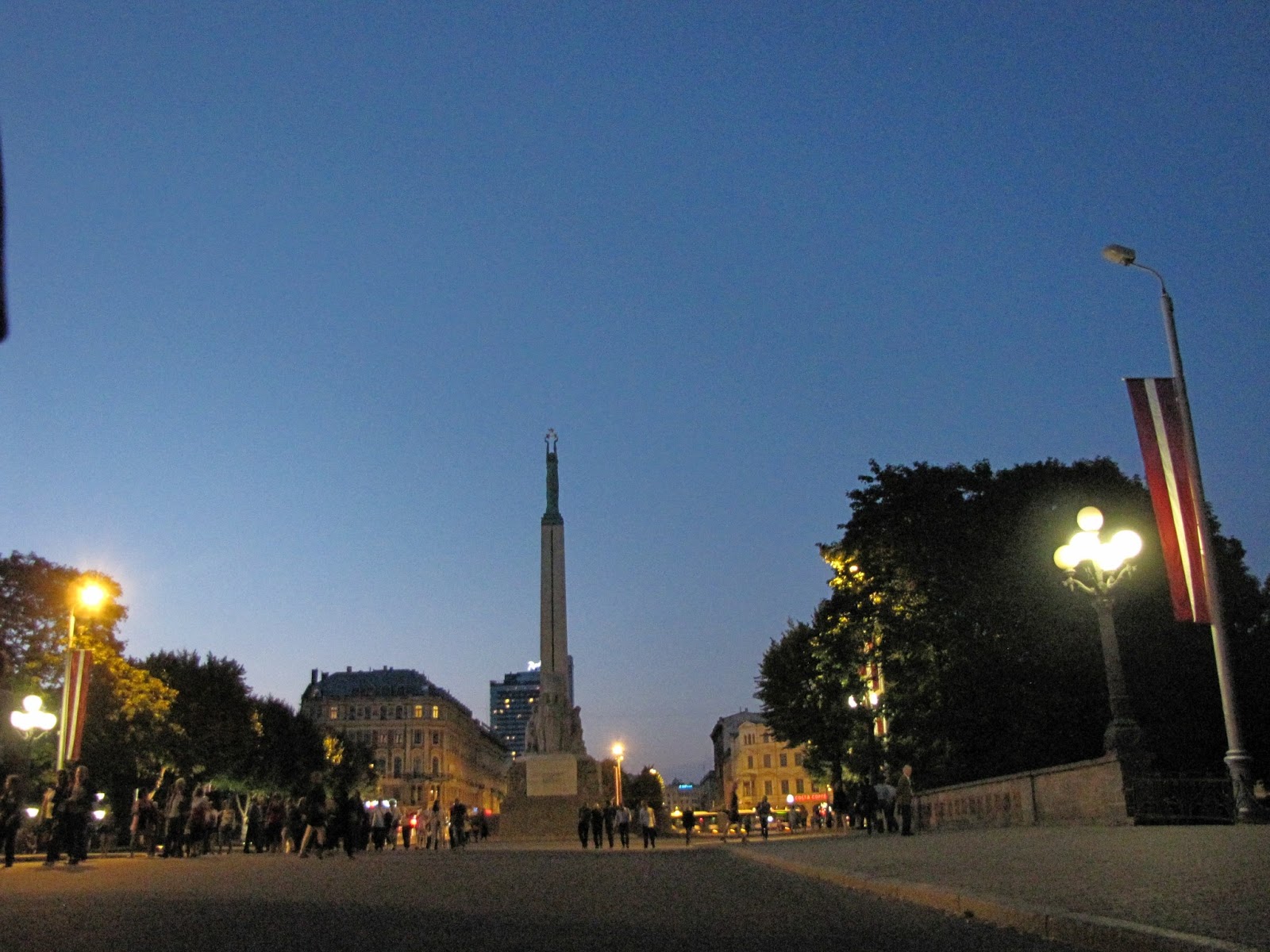
Milda at night
Being in Latvia, the complicating factor is that July 4th is officially a day of mourning here. In 1941, 300 Jews hiding in a basement in the Rīga Choral Synagogue were burned alive by Nazi forces. Since Latvia regained its independence in 1991, July 4th has been designated as the official Holocaust Memorial Day, and in 1994 a memorial was erected near the destroyed synagogue. President Ulmanis (President from 1993 until 1999) and the Saeima have formally apologized for Latvia’s role in the Holocaust, but the pain still lingers from the many horrors seen during the war and the 50 years of occupation by the Nazis and Soviets. The Museum of the Occupation of Latvia has exhibits pertaining to the Jewish deaths that occurred during World War II.

Our July 4th here did not see us watching the Tour de France, nor did we attend the commemorative event near the site of the synagogue, instead we celebrated with a group of Latvian scouts and guides. The only real connection I can draw between our celebration here in Latvia to American Independence Day is that the majority of guests were from the US, otherwise the party was mostly to celebrate our common association to the Latvian guide and scout organizations. I was excited to hear of the progress on the organization of the next big jamboree; I attended the last one three months after the birth of Lauris and hope that maybe our participation in this next one will be more camping, less newborn baby.

The boys and their newest friend, Suitcase Teacher

We also had a more serious celebration this morning, but one having nothing to do with the US or Latvia, and instead the Ķeņģis family. As I wrote about earlier in the week we joined 200 or so of our distant relatives for a large family reunion, and to continue to the festivities a film crew showed up this morning to record my mother in law speak about her parents and grandparents, and my husband to add in his memories of these family members. It was fascinating listening to the stories they both told, and I was secretly thrilled that the story of how Roberts met me up to our engagement made it on film.


And so instead of sitting next to the open window listening to the sound of fireworks, I’m  hearing a car stereo blaring some bad Russian techno interspersed with these birds (someone said they were gulls but they sound more like geese to me) and a TV airing the Song and Dance Festival events. Happy birthday to the land of the free and the home of the brave – ‘Merica!

Thursday, July 4, 2013

The twelve days of Latvija: Day 6, PLEIF and meeting the President

One of the main reasons for our trip to Latvia other than the National Song and Dance Festival was the PLEIF conference – Pasaules Latviešu Ekonomikas un Inovāciju Forums, or World Latvian Economics and Innovations Forum. The World Federation of Free Latvians (WFFL) and the Latvian Chamber of Commerce and Industry (LCCI) in collaboration with the Ministry of Foreign Affairs, the Ministry of Culture and the Investment and Development Agency of Latvia is organizing the Forum “targeting Latvian expatriates and their descendants to explore Latvia not only as their ancestral land and a place of cultural riches, but also to investigate Latvia as a land of great opportunities.” (source here)

Onkulis Pauls has arrived!
 
A rich and diverse program included discussion on topics such as Latvia in the global world, doing business in Latvia, Latvia’s export capabilities and investment opportunities. Along with being an ideal networking opportunity, it was a rare chance for Latvians and professionals from abroad to meet successful entrepreneurs and businessmen from Latvia, hear the success stories and learn from their collective experience. It is the organizers hope that through the forum new ideas aimed at promoting Latvia’s economic development and new business initiatives will be generated.

A very special invitation, from the President of Latvia
 
In my previous post I mentioned the kick-off dinner, featuring Valdis Dombrovskis, the Prime Minister of Latvia. It was exciting to feel the anticipation of the participants before the start of the conference, and in addition to getting reacquainting with people I hadn’t seen in years I made new contacts within forestry and natural resources. We enjoyed world-class koklētājas Laimas Jansones music and I want to share this YouTube video that showcases her unique fusion of new and old utilizing this very traditional Latvian instrument.

 
The next morning I wasn’t able to join the forum until after lunch, when my husband participated in a section “Latvian sectors with export potential: Promoting Latvia’s products and services on world markets,” specifically “How can Latvian businesses conquer world markets? Various scenarios of acquiring external markets.” Well-known directors and owners of Latvian brands such as Latvijas Balzams and Stenders joined to provide an inspiring and informative session. The only speaker who wasn’t born in Latvia, I was proud of my husband’s language skills as well as ability to engage the audience.

 
Later that evening I was honored to be invited to an invitation-only reception hosted by the President of Latvia, Andris Bērziņš in the Melngalvju nams, the temporary residence of the President while the Castle is being renovated. The “House of Blackheads” in Vecrīga was built in the 14th century for the Brotherhood of Blackheads, a guild for unmarried German merchants in Riga. Rumors of lavish feasts with participants such as Catherine the Great and other nobility abound, and the building was the richest building on the Town Hall square for many years. The name derives from the black caps worn by its members as well as the patron saint Mauritius, a Moor. During World War II it was destroyed by the Germans and the remains demolished by the Soviets in 1948, however the building was fully restored in the 1990’s in honor of the 800th anniversary of the city of Rīga.

 
It was a privilege to be able to see the extraordinary interior of this historically-accurate restored building, and even more so to meet the President, hear his address to the forum attendees and meet so many of the movers and shakers that have been instrumental in boosting Latvia into one of the top spots for economic growth in Europe in recent years. It was a remarkable evening; a perfect opportunity to dress up, I felt the part - snacking on flawless little hors d'oeuvres and sipping wine in such sophisticated surroundings. Such a unique opportunity and one I will surely be telling my (grand?)children about in years to come.


Wednesday, July 3, 2013

The twelve days of Latvija: Day 5, šopingošana

Have you heard the Brothers Grimm fairy tale of the town musicians of Bremen?

One very tattered, loved copy of Mana gudrā grāmata has travelled with us to Rīga, where the endless demands for naming the various fruits, vegetables, transporta līdzekļi and parts of the body pictured has caused the book to finally fall apart. In search for a new copy (as well as for several other books that have found their way onto our list) we headed to the bookstore and emerged not even a 30 minutes later arms laden with books. Of course Latvian books are available in the US, but the selection and prices are much better here and so it was in search of a few elusive titles that we headed back towards Vecrīga.

On our way we stopped in Vērmaņa dārzs where over the course of a day the Dziesmu Svētku tirdziņš had been set up. The fair is an integral part of the song festival; not only can one buy festival related music, DVDs, song books and other choral/dance related objects, but the whole spectrum of Latvian cultural and modern products are represented. Pottery, hand-carved wooden products, woven and linen traditional clothing, books, tourist stuff... The tautas tērpu luck was with me, as I was able to find the correct blouse and josta to go with my traditional folk costume skirt. The costumes range widely in color and design based on region, and so it wasn’t just any shirt I was after – the Suntažu skirt is worn only with the western Vidzemes blouse and belt. After coming up empty handed in our search the first day in Rīga as well as during our stay in Cēsis, I was very happy to find the needed parts to complete my set. The Latvian folk costume is an extremely beautiful but complicated subject, I will hopefully someday be able to go into more detail.

The loom my new josta was woven on
The boys used up some of their energy in the playground before we left for lunch. One of my favorite things about the Latvian Song Festival is how Latvians from all over the world have descended upon Rīga, which means you can’t go far without bumping into people you know – as was the case all morning and afternoon. Even our lunch spot, secluded as it felt, found more familiar faces and kind smiles. Stomachs filled we ventured into yet another bookstore to cross off the last item from our literary wish list, and then we turned the stroller back towards home.

It turns out my son is a big fan of aukstā biešu zupa- just like his father!

The National Opera was a great place to stop on our way, to soak in the view, people watch, and let Lauris explore while I helped Mikus embrace naptime. We celebrated the marriage of our good friends in the new section of the Latvian National Opera (LNO) some years ago, and I was able to see that the inside is really as impressive as the exterior. The building celebrates its 150th anniversary this year only slightly changed from the building that was completed in 1863; various renovations to modernize the lighting and ventilation have been completed over the years, and the new annex was added in 2001. The Latvian National Opera House is home to both the Latvian National Opera and the Latvian National Ballet, and during opera season the LNO performs more than 200 performances.

We were in a hurry to return home because we had an important dinner date to keep; Roberts is a speaker and member of the 1st ever Pasaules Latviešu Ekonomikas un Inovāciju Forums (World Latvian Economic and Innovation Forum). I’ll be reporting more on PLEIF tomorrow, but this particular evening we were headed for the Latvian biedrības nams for a dinner with speaker Valdis Dombrovskis, Prime Minister of Latvia. The affair was catered by Kaļķu Vārti, and between the very engaging speech, the “butter-fried sea bass fillet with celeriac, yellow wax beans and cauliflower purée” and the uninterrupted conversation with adults (that didn’t center around diapers and bedtime routines) I emerged refreshed and rejuvenated. I can’t wait to participate in a portion of tomorrow’s forum…
Tuesday, July 2, 2013

The twelve days of Latvija: Day 4, Okupācijas muzejs

The little country of Latvia has seen a tumultuous and wearisome history. During World War II it was occupied by Soviet forces just before the invasion of Nazi Germany. Three years later the USSR once more illegally occupied the nation, and independence was not regained again until 1991. The consequences of fifty years of occupation are still seen everywhere, even after twenty years as a free, democratic country. One of the most visible repercussions was population depletion; between the Nazis and Stalin Latvia lost hundreds of thousands of Latvians to labor and death camps. Besides the damaging demographic changes Latvia saw direct attacks on its language and culture, and the economy is still recovering from years of Soviet policies, the effects of farm collectivization and the Soviet military presence. The cumulative social, psychological and financial damage inflicted on Latvia by the three successive occupations cannot be measured.

The Museum of the Occupation of Latvia (Latvijas okupācijas muzejs)* was established in 1993 to exhibit artifacts from 1940-1991 and to educate the public about the 51-year period when Latvia was successively occupied by the USSR in 1940, by Nazi Germany in 1941, and then again by the USSR in 1944. This year marks the twentieth year the museum has been educating visitors, and we were able to attend the commemorative event marking the occasion.

 
All four Presidents since independence has been regained were in attendance: Guntis Ulmanis (1993-1999), Vaira Vīķe-Freiberga (1999-2007), Valdis Zatlers (2007-2011) and the current President, Andris Bērziņš.

 
The boys were not content to sit still, and so in between wanderings around Latviešu strēlnieku laukums we caught bits and pieces of emotional speeches from the President, the original founders of the museum, as well as other familiar faces.

 
After the official portion of the event we were invited in for a look at the museum, which was my first and hopefully not the last; I would like to return sans children for a closer look at the heartbreaking exhibits. My sister Anna spent a summer abroad working at the museum with a scholarship sponsored by various organizations in the US, and I contemplate whether this might have been the best way to experience the museum; it is regretful that the program did not exist when I was younger.

 
*The museum's stated mission (from the website) is to:
-Show what happened in Latvia, its land and people under two occupying totalitarian regimes from 1940 to 1991
-Remind the world of the crimes committed by foreign powers against the state and people of Latvia
-Remember the victims of the occupation: those who perished, were persecuted, forcefully deported or fled the terror of the occupation regimes.

Monday, July 1, 2013

The twelve days of Latvija: Day 3, Vanagi

After the family festivities we hitched a ride to our relatives’ country estate near the city of Cēsis. 55 miles east of Rīga, the city is one of the oldest in Latvija and is mentioned in accounts dating back to the 11th century. I vaguely remembered the castle ruins from my visit in 1995; I attended a concert with friends (Labvēlīgais Tips, if you were curious) in the shell of the Livonian Brothers of the Sword constructed castle ruins (1207). Cēsis is also well-known as the home to the oldest brewery in Latvia, Cēsu Alus, which was built in 1878 but whose origins date back to the period of the Livonian Order. Although I walked through town and peeked into the beautiful church in the city center, we spent the day in the country enjoying the splendor of a Latvian summer.

These wooden swings are a common sight in Latvia

 
The pirts; a focal point of the homestead, the saunas play a larger role in country life than just a bath house. We did partake in a sweat, followed by a plunge in the pond to wash away all that had been released from our pores, but traditionally we would have also cut fresh birch bundles, to gently slap the skin and further stimulate the pores and cells. By splashing water on the heated rocks steam vapor is created, increasing the temperature even more, and after a pirts experience one feels relaxed, rejuvenated and refreshed.

The smoke emerging from the chimney means the pirts is heating
 
Our relatives have situated their pirts on a hillside just next to the water, and so the porch was an ideal spot to enjoy a long lunch together. We feasted on a crisp aukstā zupa, followed by šašliki (shish kebobs) and all the makings for delicious maizītes (sandwiches), and then just enjoyed the peace and quiet, as well as the company of family we don’t see often. Our previous visit to Vanagi was seven years ago; I remember dancing with the patriarch of the family on the veranda to the accompaniment of accordion music, and Roberts enjoyed a bonding session with the cousins in the pirts, but neither of us could believe that seven years, a marriage and two children had occurred in the blink of an eye since our last trip.

 
In their gardens I found inspiration; a bountiful harvest of strawberries was just ending, only to be replaced in ripening by every vegetable I have ever grown and more. Rows after rows of berry bushes including raspberries, blueberries, gooseberries, red and black currents! The orchard and the apple, pear and cherry trees were brimming with green fruit, while the greenhouses modeled rows of tomato plants, all heavy with the tomatoes. Our visit perfectly coincided with the blooming of the little-leaf linden, and I was rewarded for my assistance in picking the blossoms with a bag of my own to dry and take home to brew tea.

 
Basking in the warm sunshine with a fishing pole or picking strawberries roadside it is easy to imagine returning with Mikus and Lauris for an idyllic summer, one that forever would be the definitive childhood memory for the boys. Running barefoot, picking berries, deep slumber after days spent in fresh air… these are the dreams I have for the boys, endless summer in our mīļā, mazā Latvija. Mīļš paldies to our gracious hosts, may we not see the passage of another seven years before returning!


Related Posts Plugin for WordPress, Blogger...