Wednesday, September 23, 2015

Krimulda - hiking the historic Sigulda area

Just southwest of Gūtmaņala are a steep set of stairs leading up the wooded cliffs. What better reason is needed to climb dozens of flights of stairs than simply their existence? We probably could have looked at a map beforehand, but our spontaneous ascent led to a scenic day in the area between Turaida and Krimulda, and so it wasn’t the worst decision.


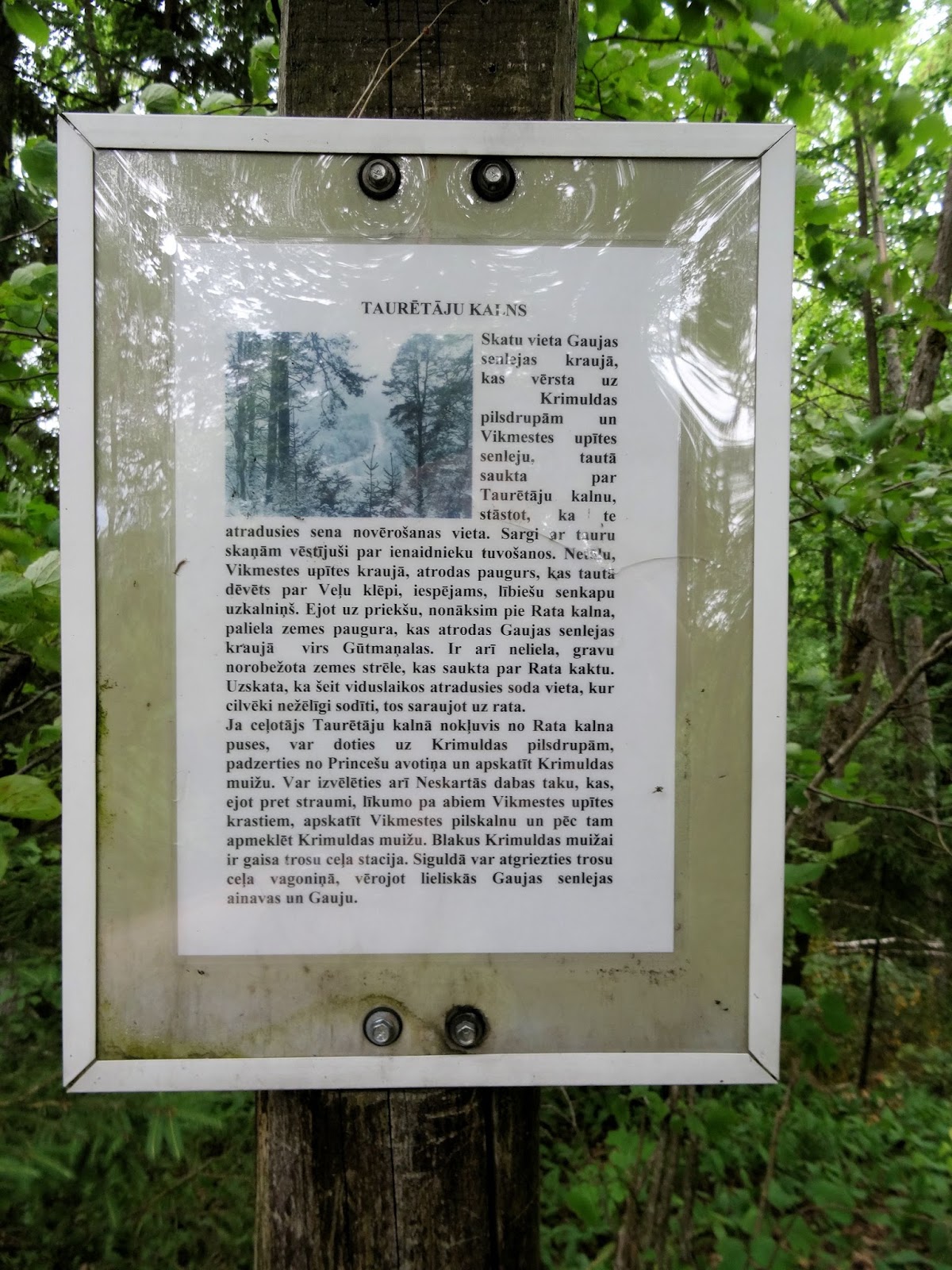
Trails crisscross the ridges and valley between Sigulda and Turaida, some of them newer and well-marked, others older and not as well-suited for hiking with children. Upon reaching the top of the stairs above Gūtmaņala we found ourselves on a trail with clearly marked directions (either to Turaida or Krimulda), but no clear indication of distances or degree of difficulty. Despite this we set off in the direction of Krimulda, and not long after found ourselves on the summit of Rata kalns, or Rack’s Hill. It is believed that during the Middle Ages this was a place of torture as well as home to a castle. We hurried on to the next hill, Taurētājkalns or Trumpeters’ Hill. With a good view of the Gauja valley it is thought that this was an old observation point where soldiers stood on guard, warning of the enemy’s approach by sounding a bugle.

Somewhere we must have deviated from the main path, as we were suddenly encountering fallen trees over the trail and entire sections of steps missing from stairs. However, we made it down to the valley and better marked trails, and decided to continue on in search of a meal.


At this junction we had the option to hike west to the Vikmeste castle mound, not far from Veļu klēpi (also on the shores of the Vikmeste river), named as such because of the historical importance as a burial grounds for the ancient Liv peoples. Instead we opted for the shorter route to Krimulda, up Serpentine Road. The historic route connecting Sigulda to Krimulda was built in 1862 in honor of the visit of Tsar Alexander II, and was restored in 2007. At the top lie the Krimulda Medieval ruins of the castle built in the 13th century for the Archbishopric of Rīga. In 1601 the castle was burned down upon the approach of Polish troops on the order of a Swedish colonel, and afterwards the location abandoned. A little further there are several old wooden structures with fascinating ornate facades, identified on a sign as the Swiss House, built in the first part of the 19th century. The chalet was modeled after the architecture of Swiss mountain houses, and served as a guest house.


We passed the station for the cable car & the greenhouses and entered the gates of the Krimulda manor-house, walking down a lane lined with old trees towards the 19th century castle. Built in 1872 in the style of late classicism, the estate was home to three generations of the Lieven family. The last of the Lievens left Latvia during WWI, whereupon the estate was transferred to the Red Cross to serve as a tuberculosis sanatorium.  Over the years the property has served as a children’s sanatorium and a rehabilitation center, and today is “Rehabilitation Centre Krimulda” in addition to a tourist destination and overnight accomodations.


We lunched at the grocery/café Milly in what used to be the cattle-yard building, refueling after what had been a steep climb. From our outdoor seating we had a good view of the 19th century Steward’s house and Bookkeeper’s office, built of stone and covered in a century’s worth of ivy.


Just as we finished our lunch it started to drizzle, and so instead of continuing on to explore the rest of the estate we retraced our steps, passing between the manor and the sunbathing ‘porch’ built in 1927.


Arriving at the cable car station we learned the next car was due in 10 minutes and elected to wait. Dating back to 1969, the car takes about 5 minutes to transport you 140 feet above the Gauja river to Sigulda, a distance of 3,500 feet. The aerial excursion was not meant to be; upon the car's arrival the operator informed us there was a 2-3 hour wait for a return trip, and so we continued down the Serpentine Road down into the Gauja Valley.


Instead of climbing the steep stairs and returning via the ridge, we followed one of the trails that led us back to Gūtmaņala along the Gauja river. Along the way we found Mazā ala, the little cave that is much smaller than its counterpart a little further on, but that had a powerful artesian aquifer flowing out of the ground. We all ducked inside, amazed at the drop in temperature and mesmerized by the eddying sand of the spring.


And then suddenly we rounded a corner to find ourselves back at Gūtmaņala, and at the foot of the stairs that had started our adventure. A stop at the Visitor Center was a must, and soon after we were in the car headed the short distance north to Turaida…


Monday, September 21, 2015

Raven Cliff Falls Trail

On the mountain road that winds its way up to Caesars Head we saw evidence of the approach of fall; it was in the first red maple and tupelo leaves to turn bright orange and red, and in the smell of the cool air rolling in through the windows. Down in Greenville it is still summer, with 90˚ days despite the chill in the nights. We gambled that the majority of the Upstate might be at one of the dozen of events this weekend and therefore the parking lot at Caesars Head might not be so full, but as we joined the caravan of cars driving up the steep road full of switch-backs, it became obvious we weren’t the only ones with fall fever looking to get outdoors and away from the busy weekday craziness.


Our destination was the Raven Cliff Falls overlook, a 1 hour drive from Greenville followed by a 2.2 mile hike. The parking area for the Raven Cliff Falls Trail also serves as the western terminus of the 2.3 mile Coldspring Branch Trail and 0.7 mile connector to the west end of the Jones Gap Trail. A daily use fee of $2/adult and a card with our hiking information deposited in the day-use hiking logbox and we were off, headed south towards and then along the Blue Ridge Escarpment.


The hike is rated ‘moderate,’ but in reality it is stretching the limits of our 3 and 5-year-old’s little legs. Lacking the really steep sections of trail that earned the ‘Dismal Trail’ its name (which along with Gum Gap/Foothills Trail and a portion of the Naturaland Trust Trail connect the Raven Cliff Falls trail to the swinging suspension bridge just over the falls), the Raven Cliff Trail is do-able with kids, but still a challenging hike with one child in the carrier and two on foot.


There were too many leaves on the trees to be able to see the falls clearly, although the evergreens blocking the upper portion will not change as the season progresses. The next time I hike this trail it will be with the intention of completing the loop that passes right over the falls via the bridge: Raven Cliff Falls Trail (2 miles) to Dismal Trail (1.5 miles) then west on Naturaland Trust Trail (about 2  miles) over the suspension bridge to Gum Gap Trail (1.5 miles) and backtracking on Raven Cliff Falls Trail (1.5 miles) for a total of 8.5 miles. As Dismal Trail is currently closed, another option is to take the Gum Gap Trail to Naturaland Trust Trail, for an in-and-out total of 7 miles. This option skips the 1,200 foot descent into Matthews Creek gorge and out.


From our vantage point we looked out across the gorge where Matthews Creek falls 420 feet into the cove below. The boys didn’t mind the shabby view of the falls; in fact, Mikus kept repeating “I wish we could have stayed longer” on the trip out. Although the trail was relatively crowded (as should be expected on a fall weekend), we never felt overwhelmed by crowds, even at the shelter at the overlook. Temperatures this time of year were perfect, the breeze on the escarpment cooling the sweat we worked up on the hike without feeling a chill, but the heat which can make even a 4-mile hike unbearable, absent.


Big picture: The Raven Cliff Falls trail is one of dozens crisscrossing the Mountain Bridge Wilderness Area. Raven Cliff Mountain marks the western border of the area, and is part of Caesars Head State Park. Jones Gap SP is on the east end of the area, the two state parks connected with several trails including the Palmetto Trail – the planned 425-mile-long foot, mountain bike and equestrian trail that will cross the entire state from Oconee SP to Charleston County. The Gum Gap Trail (via the Raven Cliff Falls Trail) is also an access point to the Foothills National Recreation Trail, which covers some of the most scenic portions of the Blue Ridge Mountains: Table Rock to Whitewater Falls to the Chattooga River and Oconee State Park. All in all I’ve got a lot of miles ahead of me here in the Upstate!


Directions: One mile north from Caesars Head State Park on US 276 you will find a large, paved parking lot. Pay the daily use fee for a permit to hang in your window, and then cross the road to reach the trailhead. After registering at the trail box you’ll follow the red blazes. Happy hiking!


Friday, September 18, 2015

Gūtmaņala - Latvia's biggest cave

Gūtmaņala is not only the largest and oldest cave in Latvia, but also the most visited. A protected geological site since 1967, it is the largest grotto in the Baltics: 33 feet high, 40 feet wide and 62 feet deep.


The cave dates back about 10,000 years to the postglacial period, carved over time by the Gauja River and spring waters running through the Devonian sandstone. The original name has been lost, replaced by the Germanic gute Mann cave or ‘good man’ cave after Baltic German naturalist and apothecary Jakob Benjamin Fischer described the cave in his 1778 papers.


According to legend the spring that flows out of the cave is sacred and its waters healing. A local healer lived next to the cave and treated patients with herbs and water from the spring, thus the name ‘good man’.


The cave just might be the oldest tourist attraction in the country, with mentions in German literature of carvings dating back to 1521 and 1564. However, the sandstone surfaces have faced much erosion since these 1812 records, and the oldest inscription remaining today is “ANNA MAGDALENA VON TIESENHAVSEN ANNO 1667,” located in the arch of the ceiling above the cascade of the spring. A majority of the ancient inscriptions have been lost to newer inscriptions.


Located between the towns of Sigulda and Turaida, there are a variety of walking trails crisscrossing the valley and ridgetop. A Gauja National Park visitor center has extensive information on the animal and plant life of the park, and a cafe and restrooms are available. Although the cave can be viewed for free, there is a fee for parking.


A 360˚ virtual tour of the cave can be found online, at the Gauja National Park website: http://www.gnp.lv/360/index.html.


Wednesday, September 9, 2015

The fall of the giant oak

“The state came out and measured it a few years ago. Said it was the third biggest willow oak in South Carolina.” Our neighbor paused and looked up into what remains of the canopy of the giant oak that seemed to shade half the city block. “There used to be a city bus stop right there. That bus came right up (our street), took a left and went back down (the next street) on its way back to town. The help for (the big estate house) would all take that bus.”


According to A Development History of the Stone Avenue and North Main Street Area, in 1924 Greenville’s first bus route came out North Main, turned west on Stone, and went up Rutherford Road as far as Ashley or Mountainview Avenue. It was about 40-50 years ago that the bus stop was taken down.


The center of the grand tree had slowly rotted from age, and the storm last weekend was finally too much. It seems as if the willow oak just gave up; the enormous branches were dropped to the ground radiating from the trunk. One lone branch remains stretching upward toward the sky, but not for long; the City of Greenville arrives today to clean up. I wonder if the armada of dump trucks and cherry pickers will be enough, or will they call for backup. I speculate how big of a blade they’ll need for that trunk, probably 200 inches around even without the burls. I mourn how quickly 200-300 years worth of North Main history can be reduced to wood chips and sawdust.


200-300 years of shade here in North Main. That oak has been here longer than any of the houses on our street, the hundreds of busses that passed by the stop at its base just a fragment of its history. How many couples have paused in its shade to steal a kiss, how many people out for a walk have rested in its shadow. The hundreds of birds that have fledged from its branches and the gallons of honey produced by the bees that still swarm from hollow cavities.

a branch, with Vilis for scale

I came home with a few pictures of the enormous trunk and branches, and a heavy heart.


My son came home with a handful of acorns…

--------------------------

9/20/2015
Although my diameter tape wouldn't reach around the massive trunk, we did get out to measure the tree utilizing a string. Our measurement, taken at breast-height (DBH) was 203 inches in circumference, which is almost 17 feet. That's roughly a 65 inch diameter, or 5 1/2 feet.


Monday, September 7, 2015

Ten top New York City gifts for kids

My father was born and raised in the Bronx, reluctantly leaving the borough and his parents behind for his new family in Chicago. Fast-forward many years to find my sister living there with her husband, only this time in Brooklyn. New York City: the Big Apple, the City that Never Sleeps, the Center of the World! We’ve always had a special connection to NYC, and have all sorts of souvenirs, presents and keepsakes to prove it. I wanted to share some of the more recent gifts that have come our way; these would be perfect for a child with ties to New York and NYC fans alike!


For his first birthday Vilis received a couple of books from his godfather, including the most fantastic dimensional board book I’ve ever seen. New York City is written by Paula Hannigan & illustrated by Shannon Chandler, and features iconic locations such as the Brooklyn Bridge, Grand Central Terminal, Times Square and Central Park (among others), with die-cut pages contoured in the shape of New York’s skyline. The familiar outlines of the Empire State Building and the Statue of Liberty provide tactile learning opportunities for toddlers while the fun facts engage older children: “…one souvenir you’ll want to pick up in a New York minute.”


This cozy toddler zip hoodie by Brooklyn Industries is a fall staple. The durable zipper, split kangaroo pockets and leather detailing ensure you’ll be able to pass it down to younger friends or siblings. If you’re looking for some warmer weather gear check out the “Brooklyn” line of graphic T-shirts – plenty of trend-setting designs for men, women and children.


Pop-up New York takes slightly older readers on a tour from Brooklyn to the Bronx with a fact-filled, interactive, large-format book that might teach even life-long New Yorkers a thing or two about the city they live in. Jam-packed with informative blurbs and fantastic paper engineering by Richard Ferguson, this book touches on all five boroughs and a variety of subjects: sports, history, architecture, culture, culinary, the arts and more. You’ll find all of your favorite places in New York within, and a ton of stuff to move, open and read - the pop-ups are even double-sided! From the lush greenery of the High Line and Central Park to the dizzying heights of the Manhattan skyline, this book is really for children of all ages.


The High Line train whistle is a nod to the High Line’s past as an elevated rail line serving Manhattan’s West Side. The wooden toy is made in the USA and in our home is played with daily while the kids are gathered around the train table. It makes me happy to see the boys playing with solid wooden toys rather than the plastic crap that lines the toy aisles these days, and it’s a lovely reminder of our trip to this unique Urban Park.


Dynamic illustrations layered over black & white photographs of Park Slope tell the story of a day in the life of Trixie in Knuffle Bunny: A Cautionary Tale. Adult readers will recognize scenes from Prospect Park and the streets of Brooklyn while the kids are involved in the tale of a lost-then-found stuffed bunny. We enjoyed the two books that followed as well, Knuffle Bunny Too and Knuffle Bunny Free.


A good friend of Lauris and Mikus spends his summers in New York City, and I consider his mom to be an expert on great NYC gear. It was at their home that we first read Knuffle Bunny, and through her recommendation that we discovered Wow! City! by Robert Neubecker, and I Lego N.Y. - a humorous look at the city through a series of vignettes featuring designer and illustrator Christoph Niemann’s son’s toys.


For the train enthusiasts nothing beats the NYC wooden subway trains from the NY Transit Museum Store. Which rail line would you choose?


As a child I visited the Bronx Botanical Gardens, and upon returning as an adult found them every bit as enthralling as I remembered. This “color-me” Tee from the New York Botanical Gardens shop would be a fun gift for an artist, as it can be colored in again and again with the included markers.


There’s always New York In A Bag, the wooden playset from the Museum of Modern Art featuring NYC icons such as the Empire State Building, the Chrysler Building, the Statue of Liberty, and the Guggenheim Museum. The 8 structures and 6 cars are made of wood from sustainable forests, and although not intended for children under 3, would be appreciated by a budding architect or a NY child-at-heart .


So there you have it, an idea or two for a NYC-themed gift outside of the usual “I heart NYC” gear or NYPD T-shirts! The new books have quickly become favorites on our bookshelf, and having a little piece of the Big Apple in our home makes a couple of our favorite people seem closer despite the 700 miles between us. Do you have a favorite New York City souvenir or toy?

Related Posts Plugin for WordPress, Blogger...