Showing posts sorted by relevance for query mammoth cave. Sort by date Show all posts

Monday, April 4, 2016

Mammoth Cave - Discovery Tour

A cave’s a cave?


We’ve explored dozens of caves; from the underground waterfall Ruby Falls near Chattanooga, TN, to the largest Latvia has to offer, Gūtmaņala, all the way across the ocean to the grottes of Gorges du Tarn in France and the σπήλαιο of Antiparos, Greece… we’ve experienced caves across the world. However none had prepared us for the enormity of Mammoth Cave!


On our recent trip to Ohio to spend Easter with family we elected to add a few days to the drive and make a vacation out of it. On the way north we explored Big South Fork NRRA and Caryville, while on our way south we had plans to stop at Mammoth Cave National Park. Being a popular spring break destination we knew we were in for some crowds and so we planned ahead, contacting the Park for information not only on their cave tours, but the above-ground hiking options as well. However, the truth is this – if you are going to visit Mammoth Cave National Park, you must descend into the cave to get the full experience.


There are almost a dozen cave tours offered at the Park, some seasonal and some year-round. The Mammoth Cave website offers descriptions of which tours are offered when, as well as great maps of which portion of the cave the tour explores. However, I feel that it doesn’t do the best job of explaining your options upon visiting the Park. A majority of the tours have a capacity under 40, and with anywhere from 1 to about 10 tours per day, you can imagine that these options sell out quickly, even at $12-$55/person. We went back and forth on which tour we were interested in, wanting to see more than just ¼ mile on the Frozen Niagara tour, but not wanting to go underground with a crowd of 120 people on the Historic Tour, nor spend 2.5 hours in the caves with Vilis (and no backpack carrier as they aren’t allowed) on the Domes and Dripstones Tour. Reservations are not required, but are strongly recommended to ensure a spot on cave tours, and cannot be made the same day of the tour. With our indecision we missed our chance to participate in any of these tours, but luckily there is another option that isn’t clearly explained on the website – the Mammoth Cave Discovery Tour. Along with the Mammoth Passage Tour, these tickets are only available on site on the day of. We wouldn’t have even known about this option if it hadn’t been for a stop at the Visitor Center on our second day in the Park, as our first visit was after 3pm – when the tickets aren’t available. Even upon inquiring if the tours were full, this option wasn’t mentioned… and I can see why - they want to sell out all their other tours. The tickets for the self-guided exploration are only $5/adult (kids 6-12 $3.50 and under 6 free), entry is through the Historic Entrance (right next to the visitor center), and you can explore a designated section of the cave at your own pace. Online feedback from the guided tours indicates little time to photograph or admire individual features with the large groups, and while these tours may offer visits to intricate features such as the Frozen Niagara or famous ‘rooms’ such as the Snowball Room, the Discovery Tour takes you through a giant dome (the Rotunda) and long passageway, more than enough to suit our little group.


Mammoth Cave is the longest cave system known in the world. The park was established on July 1, 1941, and became a UNESCO World Heritage Site on October 27, 1981. There is archeological evidence in the cave of 4,000 years of exploration, and geologists think that there could be 600 miles of undiscovered passageways. The cave also predates all other National Parks as a tourist attraction, for as early as during the War of 1812 the site was already being advertised as one of the greatest natural treasures of the United States.


A short hike from the Visitor Center brought us to the Historic Entrance where we descended into the dark passage that would take us to the Rotunda. Although the cave system is home to about 130 forms of life such as the eyeless cavefish and the cave crayfish, we only saw a couple of brown bats, asleep in the beginning passage right above unsuspecting tourists’ heads. Soon we entered into the Rotunda, one of the largest rooms in the cave system. Lighted information placards and exhibits described the 19th century saltpeter mining operations that took place in the cave, as well as the geologic origins. From the Rotunda we explored Audubon Avenue, a vast canyon passageway. The Narrows and Rafinesque Hall are also open to view on this tour. You will experience an elevation change of 140 feet and must climb 120 stairs.


If you are interesting in crawling through tight passageways on your belly by headlamp, photographing the domes and dripstones or discovering famous rooms further into the underground labyrinth, you probably want to reserve one of the many tours offered by the Park Service. However, if you are interested in getting a feel for the enormity of this underground natural wonder without the time, physical fitness or $ commitment, the Discovery Tour might be for you. Visit the website to explore the multitude of options and to see what tours are offered during the season you expect to visit, and make your reservations early if you choose to do so. However, keep in mind that you can always see a portion of the cave on a self-guided tour – and don’t forget there’s also the above-ground portion of Mammoth Cave to explore!


Monday, April 18, 2016

Mammoth Cave - the Green River Bluffs

Happy National Park Week! This week is America's largest celebration of national heritage; it’s about exploring amazing places, discovering open spaces and honoring the national parks that make America great! From April 16-24th every national park will give you free admission, so get out there and find your park!


In honor of National Park week I’ll be blogging about some of the Parks we’ve recently visited as a family, wrapping up our spring break trip to Mammoth Cave National Park. Famous for over than 400 miles of explored tunnels, Mammoth Cave is the longest known cave system – but that’s not all that’s there! Although we did descend down into the cave through the Historic Entrance on the Discovery Tour, we spent most of our time in the Park exploring above ground. Spring is the perfect time to visit as dozens of species of wildflowers are adorning the forest floor, and temperatures are mild allowing comfortable adventuring of one of Mammoth Cave’s 50 trails totaling over 80 miles of hiking.

Continuing on the Dixon Cave trail from the Historic Entrance

Our first taste of Mammoth Cave was the area around the Historic Entrance and the Visitor Center. We hiked a portion of the Green River Bluffs trail, the Dixon Cave trail, the Sunset Point trail and the Heritage trail, making a big loop down to the Green River and then back up. Leaving the crowds behind at the Historic Entrance we headed north on the Dixon Cave trail, 0.4 miles to reach what used to be a part of Mammoth Cave – perhaps a million years ago. The one cave became two when a sinkhole collapse cut Dixon off from Mammoth, creating the Historic Entrance. Endangered Indiana and gray bats use Dixon Cave, and so it’s gated off and shouldn’t be approached due to the threat of spreading deadly white-nose syndrome.


From Dixon Cave it’s an easy 0.1 miles back up to the paved picnic area loops where hikers can tie into one end of the Green River Bluffs trail. We elected to cut out a portion of the 1.3 mile trail and took the shortcut to the middle of the trail where we were rewarded with scenic views of the Green River from high on the bluffs.


After a swift descent to the river we were able to explore a sandy beach just opposite Cave Island. Large amounts of Tiger swallowtail butterflies had congregated here, and while I watched and photographed them the boys took turns throwing stones into the river.


The coves down adjacent to the Green River contained some enormous trees; the sycamores and beeches were each more massive and impressive then the last, colossal trunks supporting immense canopies that had just begun budding on our visit.


Soon we reached the mouth of the River Styx where there used to be an old riverboat landing. As the river was replaced as a means of transporting large loads by the railroad, steamboats took over touring the Green River, offering cruises complete with musicians, fine dining, traveling shows and circuses. We turned inland on the 0.4 mile River Styx boardwalk which leads to the point where the River Styx emerges above-ground for a short trip to empty into the Green River.


A short climb on the Echo River Spring trail brought us to the 0.3 mile Sunset Point trail which took us up the steep bluffs through a series of switchbacks. It was here that the boys encountered their third deer, eliciting a few screams as it crashed across the trail just as they had rounded a corner out of our line of sight – affecting a few more gray hairs before we learned the reason for their shrieks.


Sunset Point might provide a scenic viewpoint of the sun setting over the river; however it was more convenient as a rest point after a steep climb even as the shadows lengthened. The boys used the opportunity to continue work on their Junior Ranger Adventure books, the effort rewarded the following day when they received their hard-earned badges at the Visitor Center.


From Sunset Point we followed the half-mile paved Heritage loop past the Mammoth Cave Hotel back to the Visitor Center. Our loop totaled about 1.5 miles, but as it included several steep portions it was a challenging, rewarding hike. By including the entire Green River Bluffs trail it could easily be extended to 2 miles, and by adding loops to Dome Sink, Echo River and White Cave one could easily incorporate 4-5 miles of trail into their itinerary.

The view from Sunset Point


It seemed easy to separate our visit to Mammoth Cave into two parts; the descent into the underground world of the cave system, and the above-ground realm of rivers, forests and wildflowers. However, in reality these are two parts of a greater whole (hole!), unified by the various forces of nature that continue to form the caves and shape the landscape of this one ecosystem linked by water. With a wide variety of tours, trails and adventures awaiting, Mammoth Cave National Park is deserving of the title of World Heritage Site and should be included on your quest to find your park.

Friday, April 22, 2016

Mammoth Cave - Turnhole Bend and the Green River Ferry

To wrap up National Park Week we return to Mammoth Cave National Park to explore two more above-ground areas that visitors often don’t get to experience on their trip to the Park (famous for its enormous cave system). Although we did take the Discovery Tour to get a taste of the underground, the big surprise on our visit was the adventure waiting for us on the 80 –mile trail system; from spring wildflowers on the Cedar Sink Trail to the massive bluffs on the GreenRiver, there were beautiful views and interesting geographical oddities around every bend.


After our morning wildflower hike we ate a picnic lunch and then headed a very short distance to 0.5 mile Turnhole Bend Nature Trail (not to be confused with the 1.8 mile Turnhole Bend Trail north of the Green River). This short loop brings hikers to an overlook of the bend the Green River makes on its 27 mile journey through the Park. At the base of the bluff is Turnhole Spring, and along the trail are several sinkholes.

a large sinkhole

Turnhole Bend Spring is the 3rd largest spring in Kentucky, originating from a large area of sinkholes south of the Park. After the water drains underground, it flows through cave passages, briefly surfaces at the Cedar Sink, and then continues its underground journey until converging with the Green River.


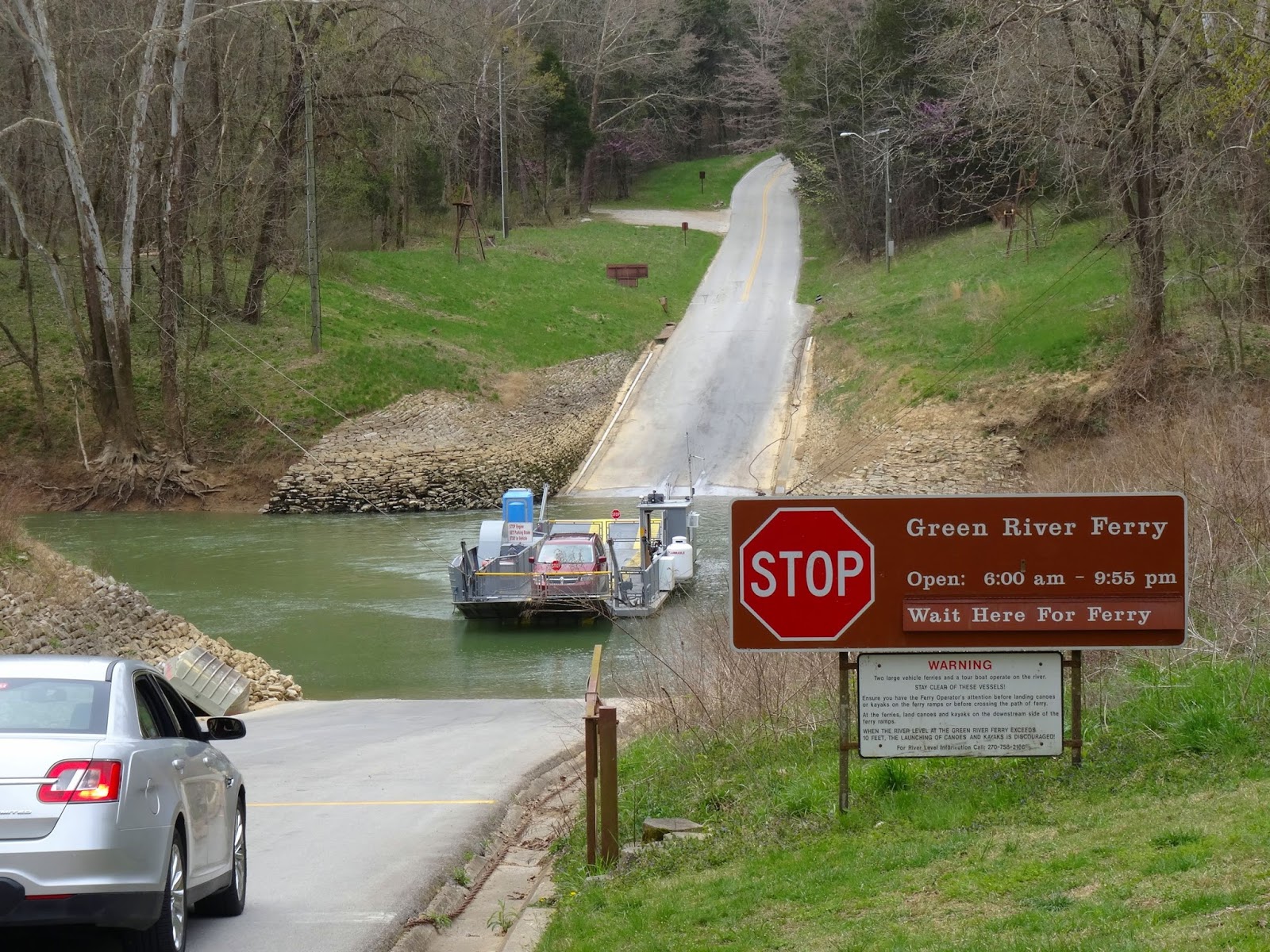
The area gets its name from the 19th century riverboats that would enter the spring to reverse their course up the river – a “turn hole.” Upstream from the bend in the river is the Green River Ferry crossing, one of two ferry crossings within the Park and one of only a few operating rural ferries in the US.


Before the establishment of the National Park, 8 private river boat ferries provided a way to cross the river. Among them was the Mammoth Cave ferry (near the Historic Entrance to the cave), the Turnhole Ferry (at the very south end of the bend) and Houchins Ferry, which still operates today (note: the Houchin ferry is temporarily out of service, for up-to-date info call the Ferry Hotline at (270) 758-2166).


The Green River Ferry operates year-round with the exception of Christmas Day (December 25), 6:00am-9:55pm.  Your vehicle must not exceed 8 tons and can be no longer than 16 feet. During our short visit the ferry made close to ten visits across the river, ferrying one, sometimes two cars at a time. The Green River Ferry Rd. is the only vehicular access to the Maple Springs Group Campground and the majority of the north end of the park without having to drive all the way around the boundaries of the park.


The parking lot at the ferry crossing is also the trailhead for the Echo River Spring Trail. The one-mile hike circles around Echo River, splits off into the Whites Cave Trail and Mammoth Dome Sink Trail, and ends at the Green River Bluffs Trail above the mouth of the River Styx. We found an amazing sycamore on the bank of Echo River, the trunk entirely hollow all the way to the river below as well as up to where the main trunk had snapped off some years previous – yet it was still alive, clinging to the banks as it had been doing for a hundred years.


Our trip to Mammoth Cave ended sooner than I would have liked. We still had a stop or two before returning to Greenville, but we were leaving the wilderness behind as we headed south to Knoxville. It had been an amazing few days – above and below ground – and I can easily imagine our travels will bring us back to this area someday. As a finale to National Park Week I invite you to visit the More Than Just Parks website, where you will find amazing time-lapse videos of some of the most remarkable National Parks in the US, including Joshua Tree, Great Smoky Mountains, and the most recent, Zion. Watch, dream, and plan…


Wednesday, April 6, 2016

Mammoth Cave - wildflowers and Cedar Sink

After our expedition into the cave, we went in search of an above-ground adventure in Mammoth Cave National Park that would give us a taste of the region, and found this in Cedar Sink Trail. A short walk leads to the lip of a giant depression, at the very bottom of which is a glimpse of an underground river as it briefly emerges into the sunlight. From the Highway 422 trailhead it was 0.6 miles on the spur trail to the intersection with the loop that descends down into the sink. Several short spur trails in the sink allowed hikers to view various natural features before the loop takes you back up the other side and circles around on the rim of the sink. I believe the total mileage to be somewhere around 1.6 miles, including the several flights of stairs.

yellow trout lily

The small body of water visible in the sink is a section of the Hawkins-Logsdon underground river system, which stretches dozens of miles before surfacing, then disappearing again into the bluff to continue its journey to the Green River (which it meets at Turnhole Bend). Sinks are essential to the cave ecosystem, as organic matter is washed into the cave providing nutrients to the underground ecosystem.


Our visit to the sink corresponded to the rebirth of the forest floor after the cold winter. The sink was carpeted in wildflowers, dozens of different species in a plethora of colors painting a gorgeous canvas on our morning hike. On our way out we noticed smaller sinks, deer trails, animal tracks and more beautiful flora.

Catesby's trillium
celandine poppy

common blue violet

cutleaf toothwort

immature ferns

fire pink

Halberd-leaf yellow violet

mayapple

ragwort

rattlesnake plantain

red trillium

rue anemone

wild blue phlox

this one is so familiar, but I couldn't place it...

star chickweed

spring beauty

saxifrage

It was easy to get lost in the beautiful spring landscape on this short, but educational hike. Other than a ranger, a few people taking photographs of the trout lilies and a couple of families out for a hike, the woods were quiet and still – I imagine most of the crowds stick to the underground tours and Green River hikes. However, this relative ‘wildness’ gives a false sense of security – not far away the National Park boundary marks the beginning of private lands, and although the underground rivers don’t recognize these boundaries, pollutants do. Contamination from agriculture, transportation corridors and residential developments pose serious threats to the fragile underground habitat of the cave rivers.


Upon our return to the trailhead we settled down for a picnic lunch before continuing our exploration of the above-ground portion of Mammoth Cave National Park. Next was a stop at Turnhole Bend, to see where the river that runs through the Cedar Sink joins the Green River.

Monday, April 25, 2016

Dinosaur World gets an A+ from the kids


You might miss the giant T-Rex standing guard beside I-65 near the Cave City exit on your way north, but you’ll have a harder time ignoring the triceratops and pterodactyl once you get off the highway on the way to Mammoth Cave National Park. A string of yellow flags along with the giant reptiles give this attraction maximum visibility, the location and hype needed in this tourist town filled with competing enterprises with names like “Historic Diamond Caverns,” “Kentucky Action Park” and “Kentucky Down Under Adventure Zoo.”


The boys’ curiosity grew on every trip past the giant gates. They really had asked for so little on our Big South Fork/Mammoth Cave trip, and so we promised to take a look online and entertain the possibility of stopping on our last day in Cave City. With the promise of “150 life size dinosaurs to see and discover” even dad was intrigued – and so it came about that we pulled into the parking lot with about two hours left until closing.


The attraction covers 20 acres. The entrance gift shop opens into a courtyard surrounded by activities: a museum, a playground, the fossil dig, “touch and tell,” the boneyard, a movie cave, a gem mine and the dinosaur walk, a path leading visitors through the woods past all the giant dinos. A 4 and 5-year-old’s dream!


We managed to do it all: mine gems, dig for fossils, glance at the movie, and of course walk the dinosaur walk. The boys were in paradise, as even the playground was dinosaur themed; we even made it out to the giant T-Rex that you can see from the highway. As far as touristy places go, this one isn’t bad: the facilities were clean, the dinosaurs of better quality than expected, and the staff were friendly enough. Our stop was entirely for the boys after their patience in the car and multiple hikes at Mammoth Cave, but we parents enjoyed it as well; it’s hard to begrudge a tourist trap that receives such an euphoric response from the boys!


Related Posts Plugin for WordPress, Blogger...