Sunday, October 25, 2015

Morehead Planetarium & Science Center in Chapel Hill

With one more morning left in North Carolina we headed to the University of North Carolina campus in Chapel Hill to visit the Morehead Planetarium & Science Center. The complex was built as a gift from John Morehead III, UNC class of 1891, and opened its doors in 1949. The GlaxoSmithKline Fulldome Theater is in the Morehead building, which also houses the Science Stage, classrooms, exhibits, the UNC Visitor Center and the Observatory.


We bought tickets for the Planetarium show “Earth, Moon and Sun.” Although geared towards 7-13 year olds, Lauris and Mikus thoroughly enjoyed it, laughing loudly and repeatedly at the antics of Coyote, a cartoon character adapted from Native American folk tales. With his help we explored the relationship between the earth, moon and sun, and even got a guided tour of the evening nighttime sky by the astronomer on duty. The boys have been more interested in the phases of the moon since the harvest eclipse moon last month, and this awareness has only increased since our visit.  On the other hand, the one-year old mostly slept, as the theatre was dark and my lap warm…


After the show we took a look at the various exhibits in the lower level of the planetarium. The most famous visitors to Morehead were the US astronauts in training for the Mercury, Gemini and Apollo missions, including Edwin E. Aldrin Jr., Neil Armstrong, John Glenn and Alan B. Shepard Jr. among others.


A quick stop in the souvenir store later we were already headed out the door, anxious to get back to the hotel and start the next leg of our journey. The morning had turned cool and rainy, and so large sundial on Franklin Street threw no shadow. We took a look nonetheless, the task of explaining how it works harder when it’s not operational, and then we were off. The Planetarium is high on my list of places in the Chapel Hill/Durham area I would recommend to visitors, and we might return on our next visit to the region to catch one of the other shows.


* Morehead's programs include classes for adults and children, special courses for teachers, summer camps for children, afterschool programs, memberships, public viewings of astronomical events and lectures. It’s a good idea to call/check the website for scheduling information before your visit, as there are numerous shows aimed at a variety of ages, and on days when large groups visit shows can be sold out. Note for Roper Mountain Science Center members - Morehead participates in the ASTC Travel Passport Program, and so members can receive 2-for-1 admission to all regularly scheduled shows.

Friday, October 23, 2015

Carrboro, North Carolina

Named for NC industrialist Julian Shakespeare Carr, the little town just west of Chapel Hill has a history similar to many of the mill towns of the region. Originally known as West End, Carrboro’s roots are in the establishment of a railway depot; in order to keep university students from leaving on weekends (and spending their money elsewhere), state statutes required the railway depot to be at least one mile from campus. The arrival of the train to the area brought along with it a steam-powered grist mill which in turn became the Alberta Cotton Mill before being incorporated into the Durham Hosiery Mills complex. In addition to the university and the textile mills, the depot was also a major hub in the lumber industry in the 1920s and 1930s. The Great Depression, the closure of several mills and the end of passenger service on the train line resulted in the Carrboro languishing until the 1960s when the growth of the University of NC sparked an economic upturn.

An oak on the old mill property

The abandoned mill stood empty for a decade and was nearly demolished in 1975 before being saved by the community to be restored as Carr Mill Mall, now on the National Registry of Historic Places. In the complex is also one of Carrboro's most famous attractions, the Weaver Street Market. A co-op with plenty of organic and healthy choices, the market has a hot bar, perfect for the boys to choose what they want for lunch. We were rather hungry from our hike and time spent at Bolin Creek, and as the market is conveniently right off main street in the heart of the town it was an easy choice. Another great healthy option is only a few blocks away; the Carrboro Farmer's Market features local organic produce, locally produced cheeses, baked goods, and handmade crafts, it was one of the first stores in the area to link farmers directly with their customers (they require that everything sold must be produced within a 50-mile radius).

Source: here
We paid for our meals and headed outdoors to a large grassy field with picnic tables. Lauris and Mikus devoured their lunch and scampered off to play hide-and-seek, a favorite hiding spot being behind one of the massive oaks that I imagine to have been planted in the heyday of the mill. It’s the perfect lunch set-up; healthy food for a variety of budgets that can be consumed in an area that lets kids play and entertain themselves while mom savors her lunch and takes a bit of a breather!

  
It’s no surprise then that Carrboro is a favorite destination of UNC students, not just for places like the farmers market but also for the restaurant scene. One of our Carrboro favorites is the homage to the town’s railroad origins, the Southern Rail Restaurant and Bar, located across the street from the Carr Mill Mall and Weaver Street Market. The eatery is located between active freight train tracks and not only is decorated with an extensive assortment of train-themed memorabilia, but is housed in restored vintage rail cars that have been connected with an industrial steel and glass platform enclosure. There’s even a dining car that allows for an alternative to the outdoor seating in the front courtyard, and the adjacent Station bar is separate, creating a one-of-a-kind place to eat: for rail-enthusiasts, children and the university crowd alike.

  
Southern Rail Restaurant & Bar

Our waitress mentioned that the best time to see trains on the freight tracks is Friday morning, and sure enough, several trains passed the next morning blowing their whistles in a seeming salute to the long-stationary cars of the Southern Rail. Across the road from the restaurant the tracks run adjacent to the Libba Cotten Bikeway, the trail connecting the UNC-Chapel Hill Campus to Carrboro. Paved with separate bike and walking lanes, many students and professors use it daily to get to and from campus. The bikeway was named for Elizabeth “Libba” Cotten (1895-1987), best known for her song “Freight Train” about the train that ran past her house on Lloyd St. Cotten’s left-handed guitar and banjo playing style won her a Grammy at the age of 89 along with a place on the Smithsonian Folkways recording label, and although the only trains running on these tracks today are the ones UNC uses to transport materials to its power plant, the spirit of the rail lives on in the vibrant town of Carrboro.

Along the Cotten trail: poison ivy, view down the trail and the cemetery near Brewer Lane

Wednesday, October 21, 2015

A Track Trail adventure in Carrboro, NC

Last week we once more found ourselves in the “Research Triangle” in North Carolina, home to University of North Carolina in Chapel Hill, Duke in Durham and NC State in Raleigh. Our stay was in the town of Carrboro, which neighbors Chapel Hill to the west with no clear boundary separating it from the University town of larger fame. We’ve visited many attractions in the nearby area including the NC Botanical Garden, University of North Carolina, the Coker Arboretum and the Museum of Life & Science, but on our first day decided to stick rather close to our temporary home and go for a local hike.


On our most recent visit to Congaree National Park I signed the boys up for the Blue Ridge Parkway Foundation’s Kids in Parks Track Trail program, aimed at promoting children’s health and the health of our parks by “increasing physical activity and engaging families in outdoor adventures that foster a meaningful connection to the natural and cultural world.” Sadly there is only one Track Trail in South Carolina (the one in Congaree), but as I soon noticed, dozens in North Carolina including one not even a mile north of Carrboro’s Main Street. We got an early start and pulled into a near-empty parking lot at Charles Herman Wilson Park.


The 1.3 mile Track Trail follows trails in “Adam’s Tract,” with a very short section utilizing the Bolin Creek Greenway, a multi-use, paved trail connecting the Community Center Park and the Battle Branch Trail. Each Track Trail has an accompanying “adventure,” the choices for the Town of Carrboro being Birds, Bug Out and Nature’s Relationships in addition to our choice, Hide and Seek. The brochures are meant to guide the kids in their exploration, to be educational without being dry, and are available for download or at the beginning of the hike. Lauris and Mikus both got into the spirit, finding all sorts of cool stuff that had escaped my notice.


We found a pair of mature American elms that have somehow escaped/repelled the Dutch elm disease, the fatal fungal disease that pretty much wiped out the American elm in the 1900s. Spread by the elm bark beetle the tree is usually killed upon reaching maturity, and although isolated native elms have survived in the US and researchers have developed several hybrid Asian elms and American elms that are resistant or tolerant, it is extremely rare to see large American elms in our forests.


They also spotted a lime-green Luna moth caterpillar, the Actias luna moth being one of the largest in the US with an average wingspan of 3-4.5 inches (but occasionally up to 7 inches!). Because they only spend a week of their lives as adults, sightings of the luna moth are rare so a daytime sighting of a caterpillar (while not as rare) was a cool discovery.


However, Bolin Creek was the most exciting ‘find’ on our hike. With numerous opportunities for boulder climbing, splashing and rock skipping, the boys were in their element. Lauris and Mikus were immediately engrossed with the search for animal tracks, the splash resulting from a rock being dropped in, the eddy of leaves in the current and with criss-crossing the stream via rocks. Vilis would have been more content to play in the water; cooler weather disallowing this option he was rather unsatisfied at first, but eventually his fussiness was lulled by the sounds of water rushing over stone and autumn wind rustling the trees.


As far as other sightings go, the boys checked off quite a few things in their nature journals including mammals (squirrels and chipmunks), amphibians (Lauris sighted the toad trailside on our hike in) and birds. Even the hike out was all smiles, and there was enough energy remaining that another hour was happily spent playing in the sandbox and on the playground. It was only when the time came to head out that the smiles disappeared – but not for long, as we were headed to lunch and another adventure…


Monday, October 19, 2015

A lake hike at Furman University

During these beautiful and warm autumn days it’s a little easier to coax the boys out for a hike! I’m trying not to overschedule, I’ve got a hundred +1 things to do just like everyone else this time of year – but we can at least head over to Furman!


Furman University is just 5 miles north of downtown Greenville! I wrote about the iconic clock tower and the previous location in the west end of Greenville, but neglected to mention the 1.5 mile Lake hike. There is no better time than the present to fix that, especially since the temperatures, fall color and buzz of students on campus makes for perfect hike with the kids!

The Janie Earle Furman rose garden


Visitor parking is conveniently just next to the Barnes & Noble, which is located in the Trone Student Center. If you’re looking for a place to eat there are several options in the center, but if you’ve brought your own lunch you can grab one of the outdoor picnic tables or bring it along to eat at the picnic shelter at the opposite end of the lake. The trail runs between the Student Center and 40-acre Swam Lake, and the first place you’ll want to explore is between Trone and the Daniel Dining Hall: the Janie Earle Furman Rose Garden. The rose garden is named in honor of the late Janie Earle Furman, a graduate of Greenville Woman’s College and wife of the late Alester G. Furman, Jr., a member of the university’s founding family. No matter the season, it’s worth ducking in to see the fountain and feel the tranquility within.

The Jamie Earle Furman rose garden

Continuing on, the trail crosses a bridge over a small canal. If you were to continue straight instead and look to your right you'll see a gravel path and stairs gradually leading upward. Another interesting detour, the Place of Peace is an inter-generational temple (Hei-Sei-Ji) that once stood in Nagoya, Japan. In 2004 it was dismantled into 2,400 pieces, transported through the Panama Canal, and reconstructed by Japanese craftsmen in 2008. We’ve not yet had the chance to see the interior, but the craftsmanship and serene architectural lines of the temple are a sight in itself.

Place of Peace

Across the bridge is the Asia Garden, which together with the Place of Peace are “designed to stimulate your experience of connection to the earth, and all the peoples of the world.” A little pond and manicured gardens are contained off a pebble path, and if you choose to take this route you’ll be back on the trail in only a few dozen feet.

Asia Garden

My two older boys enjoy riding their bikes while I walk with the stroller, and what makes this hike such a success other than proximity to our home is that the trails are very safe for beginning bicyclists. There are only a few points that we have to worry about vehicular traffic, and these are easy to navigate as there are few cars utilizing these small roads. The first stretch is while walking along Bell Tower housing to the clock tower, but the speed limit is set low and there is good visibility. After the tower the trail resumes, and to your right is another of our favorite stops, the Susan Shi Garden. The David E. Shi Center for Sustainability/Furman Farm is named for Furman’s 10th president (and Susan Shi was his First Lady from 1994-2010). The gardens echo the goal of the Center, which is to support the study and integration of sustainability-related topics on campus as well as in the greater Greenville community.

Susan Shi Garden

Next you’ll pass the Amphitheatre, after which the trail loops around to continue following the shoreline of Swan Lake, and there you will find the afore-mentioned picnic shelter. The environs are more wooded for this second portion of the hike, the only structures being the Thoreau Cabin and the Lakeside Rest Room. The Cabin was built by Furman students, a replica of the cabin Thoreau inhabited while writing Walden, the same distance from the water as Thoreau’s cabin sat from Walden Pond. This is the home stretch, and I let the boys ride out far ahead of me knowing that they’ll stop where the trail meets the road. What’s interesting about this section is that it runs parallel to the Swamp Rabbit Trail – visible in places, I’m always tempted to skip over and continue on…


At the road we cross the spillway to find ourselves at the parking lot and at the end of our hike. Often we will linger a while outside the student center for a snack before hopping back in the car for the short ride home. If you’re looking for a longer hike/run, be sure to check out the Furman website and the trails map; the Lake trail is just one of the several trails on campus, various combinations of which could make for a lengthier hike. 


For a map of the trail click here.

Friday, October 16, 2015

The bogs of Kemeri National Park


Ķemeri National Park contains one of the largest moss bogs along the Latvian coast. Located only 30 miles from the capital city Rīga and not far from the popular beach resort area Jūrmala, this biologically diverse area provides an excellent opportunity to get acquainted with the bog ecosystem. The Great Ķemeri Bog (Lielais Ķemeru tīrelis in Latvian) covers an area of over 12,000 of the National Park’s 94,000 acres and dates back about 8,000 years. The bogs are an integral part of the ecosystem, soaking up significant amounts of precipitation and preventing flooding, but also acting as water cleaning systems.


The Park still shows the scars of WWI in the form of trenches in the bogs & marshes and cemeteries in Smārde and Kalnciems. WWII saw tanks sunk in the bog, the peat layer 15-50 feet deep. The Ķemeri National Park was established in 1997 to protect these historically and culturally important areas, but also the famous natural mineral springs used for centuries because of their reputed therapeutic benefits. The springs led to development of many resorts, spas, and sanitariums in the vicinity in the 18th and 19th centuries. Today the newly reconstructed Ķemeri sanatorium bears testimony to the belief in the healing properties of the sulphur springs.


Forests occupy 57% of the total area of the park, and bogs another quarter. All three wetland types – fens, transition and raised bogs – are found in Ķemeri, making it an internationally important wetland. Rich in flora and fauna, the Ķemeri National Park boasts 897 species of plants, 202 mosses, 139 lichens and 521 species of mushrooms, the mosses and orchids especially prominent in the wetlands. The rare black stork and corncrake nest in the bogs, and sea eagles, eagle-owls and cranes are often spotted throughout. The Park’s streams contain a wide variety of rare native snails, mussels, fishers, storks and otters, and in the forests you’ll find beaver, lynx, elk, red deer, wild boars and wolves, the isolated habitat ideal for large mammals. 47 species of mammals including wild horses call the Park their home, and more than 250 bird species (67 of them listed as protected - such as the rare white-backed woodpecker) have been observed in the area.


The lowlands of the region are separated from the Baltic Sea by several rows of dunes which mark the shores of the ancient Littorina Sea. When the sea receded lagoon lakes were formed; the 100-foot deep Lake Valgums on the north end of the Park contains the history of the ice age in its depths. A combination of factors including these geologic beginnings were the foundation of the formation of the Great Ķemeri bog, one of the largest mossy bogs in Latvia. The most popular attraction in Ķemeri National Park is the Great Ķemeri bog trail (Lielā Ķemeru tīreļa laipa in Latvian), which lets visitors explore without harming the fragile bog ecosystem.


The trail consists of over 2 miles of boardwalks, a giant loop with a shortcut halfway resembling a giant figure 8 (can be seen in the aerial photo below in the upper left corner). Bear in mind that the shorter 1-mile loop does not include the watchtower, a highlight of the hike. The bog is characterized by a series of elongated lakes visible on portions of the hike, but the scenery is mesmerizing and suprisingly diverse along the entire length.


Aerial view from Google Earth

From the parking area it is a good ½ mile to the beginning of the trail down a sandy, forested road. Wild blueberries and raspberries grow sporadically along the ditches, blanketing the forest floor once you reach the trailhead. Only a short distance further we emerged from the trees into the bog and began our adventure into the stark milieu.


The first constructed trail to venture out into the bog was a Soviet era footbridge used to access the swamp meteorological station whose operations ceased in 1990. In 2000 the base of that walkway was utilized to build boardwalks, but they quickly deteriorated and by 2008 were unusable. Funds to restore the trail were granted by the European Union in 2013 and on our visit it was in impeccable condition. In some places the remnants of the old piers could still be seen.


Our midday visit yielded little in the terms of wildlife sightings, but was rich in plant life; a favorite was the carnivorous plant which was small but prolific along the boardwalks. According to the government webpage 86 of the more than 900 plant species in the park are protected.

Drosera rotundifolia, the carnivorous apaļlapu rasene or common sundew

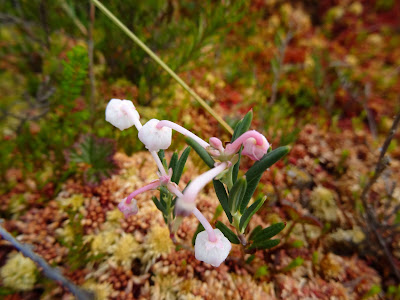
Andromeda polifolia, bog rosemary or polijlapu andromeda

A morning or evening visit might allow for more waterfowl sightings, but we enjoyed our visit nonetheless, especially with the opportunity to get a different perspective of the bog – one from above. About halfway through the hike is an observation deck, a perfect spot for seeing the unique pattern the elongated lakes make over the landscape. The boardwalk creates an interesting contrast to the subtle hues of the bog, and even in the middle of summer the array of colors was stunning.


With its raised bogs, black alder forests, floodplain meadows and seaside lakes, Ķemeri National Park is a treasure, one every visitor to the region should go to. The views are glorious, the diversity easily observable, the beauty subtle yet memorable. All too soon we saw the forest looming ahead of us on the boardwalk, signaling the end of our hike through the bog and the end of our visit approaching, and although those with shorter legs might have been a tad relieved, the melancholy landscape had struck a chord within me. A sincere note of gratitude to our friends AKKM for introducing us to this enchanting locale!


PS I've truly never seen anything quite like these bogs up close and personal, except maybe the Hautes Fagnes of Belgium. You can read the post about that experience here.

Related Posts Plugin for WordPress, Blogger...